

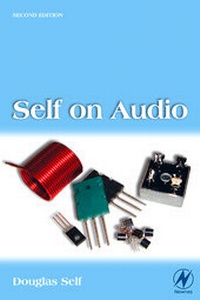
Self on Audio
2nd Edition
Published on 29. June 2006
Book
Paperback/Softback
488 pages
978-0-7506-8166-7 (ISBN)
Description
Whether you are a dedicated audiophile who wants to gain a more complete understanding of the design issues behind a truly great amp, or a professional electronic designer seeking to learn more about the art of amplifier design, there can be no better place to start than with the 35 classic magazine articles collected together in this book.Douglas Self offers a tried and tested method for designing audio amplifiers in a way that improves performance at every point in the circuit where distortion can creep in - without significantly increasing cost. Through the articles in this book, he takes readers through the causes of distortion, measurement techniques, and design solutions to minimise distortion and efficiency. Most of the articles are based round the design of a specific amplifier, making this book especially valuable for anyone considering building a Self amplifier from scratch.Self is senior designer with a high-end audio manufacturer, as well as a prolific and highly respected writer. His career in audio design is reflected in the articles in this book, originally published in the pages of Electronics World and Wireless World over a 25 year period.
More details
Edition
2nd edition
Language
English
Place of publication
Oxford
United Kingdom
Publishing group
Elsevier Science & Technology
Target group
Professional and scholarly
Professional audio amplifier designers
High-end audio / Hi-Fi enthusiasts
Advanced electronics hobbyists
Edition type
New edition
Dimensions
Height: 233 mm
Width: 156 mm
Weight
730 gr
ISBN-13
978-0-7506-8166-7 (9780750681667)
Copyright in bibliographic data and cover images is held by Nielsen Book Services Limited or by the publishers or by their respective licensors: all rights reserved.
Schweitzer Classification
Other editions
Additional editions
Person
Douglas Self has a worldwide reputation as a leading authority on audio amplifier design, but it is perhaps less well known that he has devoted a good deal of study to small-signal circuitry, including many years as the chief design engineer at one of the major mixing console manufacturers, where his achievements included winning a Design Council Award. His rigorous, skeptical, and thoroughly practical approach to design has been applied to the small signal area as well, and some of the results to be found in this book.
Senior designer of high-end audio amplifiers and contributor to Electronics World magazine, Douglas has worked with many top audio names, including Cambridge Audio, TAG-McLaren Audio, and Soundcraft Electronics.
Senior designer of high-end audio amplifiers and contributor to Electronics World magazine, Douglas has worked with many top audio names, including Cambridge Audio, TAG-McLaren Audio, and Soundcraft Electronics.
Content
1: Advanced preamplifier design
2: High-performance preamplifier
3: Precision preamplifier
4: Design of moving-coil head amplifiers
5: Precision preamplifier '96, Part I
6: Precision preamplifier '96, Part II
7: Overload matters
8: A balanced view, Part I
9: A balanced view, Part II
10: High-quality compressor/limiter
11: Inside mixers
12: Electronic analogue switching, Part I: CMOS gates
13: Electronic analogue switching, Part II: discrete FETs
Power Amplifiers
14: Sound mosfet design
15: FETs versus BJTs: the linearity competition
16: Distortion in power amplifiers, Part I: the sources of distortion
17: Distortion in power amplifiers, Part II: the input stage
18: Distortion in power amplifiers, Part III: the voltage-amplifier stage
19: Distortion in power amplifiers, Part IV: the power amplifier stages
20: Distortion in power amplifiers, Part V: output stages
21: Distortion in power amplifiers, Part VI: the remaining distortions
22: Distortion in power amplifiers, Part VII: frequency compensation and real designs
23: Distortion in power amplifiers, Part VIII: Class A amplifiers
24: Power amplifier input currents and their troubles
25: Diagnosing distortions
26: Trimodal audio power, Part I
27: Trimodal audio power, Part II
28: Load-invariant audio power
29: Common-emitter power amplifiers: a different perception?
30: Few compliments for non-complements
31: Loudspeaker undercurrents
32: Class distinction
33: Muting relays
34: Cool audio power
35: Audio power analysis
2: High-performance preamplifier
3: Precision preamplifier
4: Design of moving-coil head amplifiers
5: Precision preamplifier '96, Part I
6: Precision preamplifier '96, Part II
7: Overload matters
8: A balanced view, Part I
9: A balanced view, Part II
10: High-quality compressor/limiter
11: Inside mixers
12: Electronic analogue switching, Part I: CMOS gates
13: Electronic analogue switching, Part II: discrete FETs
Power Amplifiers
14: Sound mosfet design
15: FETs versus BJTs: the linearity competition
16: Distortion in power amplifiers, Part I: the sources of distortion
17: Distortion in power amplifiers, Part II: the input stage
18: Distortion in power amplifiers, Part III: the voltage-amplifier stage
19: Distortion in power amplifiers, Part IV: the power amplifier stages
20: Distortion in power amplifiers, Part V: output stages
21: Distortion in power amplifiers, Part VI: the remaining distortions
22: Distortion in power amplifiers, Part VII: frequency compensation and real designs
23: Distortion in power amplifiers, Part VIII: Class A amplifiers
24: Power amplifier input currents and their troubles
25: Diagnosing distortions
26: Trimodal audio power, Part I
27: Trimodal audio power, Part II
28: Load-invariant audio power
29: Common-emitter power amplifiers: a different perception?
30: Few compliments for non-complements
31: Loudspeaker undercurrents
32: Class distinction
33: Muting relays
34: Cool audio power
35: Audio power analysis