

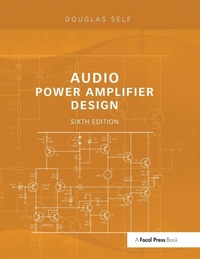
Audio Power Amplifier Design
6th Edition
Published on 11. July 2017
Book
Hardback
752 pages
978-1-138-40660-5 (ISBN)
Description
This is the essential book reference for amplifier designers. Douglas Self covers all the design issues of noise, distortion, power supply rejection, protection, reliability, and layout. He describes advanced forms of compensation that give dramatically lower distortion.
This edition is much expanded, and packed with new information. It is a must-have for audio power amplifier professionals and audiophiles, amateur constructors and anyone with intellectual curiosity about the struggle towards technical excellence.
New to the sixth edition:
The characteristics of the audio signal
The principles of distortion
Feedback intermodulation distortion
Non-switching output stages
VAS distortion explained
Push-pull VAS configurations
Output-inclusive compensation
In addition, five amplifier design examples that illustrate important design principles are examined and measured in detail. These can be straightforwardly adapted to specific requirements.
This new edition also includes a wealth of material on the XD crossover-displacement principle (invented by the author and in use by Cambridge Audio), four-stage amplifier architectures, error correction, current-mirrors, power transistors with internal sensing diodes, amplifier bridging, input-stage-common-mode distortion, amplifier stability, output stages with gain, inrush current suppression, DC servo design, thermal protection, cooling fan control, advanced line input stages, testing and safety, infrared remote control, signal activation, 12V trigger control, the history of solid-state amplifiers and much more. Simple procedures for heatsinking and power supply design are given.
This edition is much expanded, and packed with new information. It is a must-have for audio power amplifier professionals and audiophiles, amateur constructors and anyone with intellectual curiosity about the struggle towards technical excellence.
New to the sixth edition:
The characteristics of the audio signal
The principles of distortion
Feedback intermodulation distortion
Non-switching output stages
VAS distortion explained
Push-pull VAS configurations
Output-inclusive compensation
In addition, five amplifier design examples that illustrate important design principles are examined and measured in detail. These can be straightforwardly adapted to specific requirements.
This new edition also includes a wealth of material on the XD crossover-displacement principle (invented by the author and in use by Cambridge Audio), four-stage amplifier architectures, error correction, current-mirrors, power transistors with internal sensing diodes, amplifier bridging, input-stage-common-mode distortion, amplifier stability, output stages with gain, inrush current suppression, DC servo design, thermal protection, cooling fan control, advanced line input stages, testing and safety, infrared remote control, signal activation, 12V trigger control, the history of solid-state amplifiers and much more. Simple procedures for heatsinking and power supply design are given.
More details
Edition
6th edition
Language
English
Place of publication
London
United Kingdom
Publishing group
Taylor & Francis Ltd
Target group
Professional and scholarly
Professional Practice & Development
Dimensions
Height: 241 mm
Width: 196 mm
Thickness: 45 mm
Weight
1576 gr
ISBN-13
978-1-138-40660-5 (9781138406605)
Copyright in bibliographic data and cover images is held by Nielsen Book Services Limited or by the publishers or by their respective licensors: all rights reserved.
Schweitzer Classification
Other editions
Additional editions
Douglas Self
Audio Power Amplifier Design
E-Book
07/2013
6th Edition
Routledge
€104.99
Available for download
Douglas Self
Audio Power Amplifier Design
E-Book
07/2013
6th Edition
Routledge
€104.99
Available for download
Douglas Self
Audio Power Amplifier Design
Book
06/2013
6th Edition
Focal Press
€115.60
Shipment within 15-20 days
Person
Douglas Wiliams
Content
Chapter 1 Amplifiers and The Audio Signal; Chapter 2 The Basics of Distortion; Chapter 3 Negative Feedback; Chapter 4 Amplifier Architecture, Classes, and Variations; Chapter 5 General Principles and Distortion Mechanisms; Chapter 6 The Input Stage; Chapter 7 The Voltage-Amplifier Stage; Chapter 8 The Push-pull Voltage-Amplifier Stage; Chapter 9 The Output Stage; Chapter 10 Output Stage Distortions; Chapter 11 More Distortion Mechanisms; Chapter 12 Closely Observed Amplifiers: Design Examples; Chapter 13 Compensation and Stability; Chapter 14 Output Networks and Load Effects; Chapter 15 Speed and Slew-rate; Chapter 16 Power Dissipation in Amplifiers; Chapter 17 Class-A Power Amplifiers; Chapter 18 Class XD: Crossover Displacement; Chapter 19 Class-G Power Amplifiers; Chapter 20 Class-D Power Amplifiers; Chapter 21 FET Output Stages; Chapter 22 Thermal Compensation and Thermal Dynamics; Chapter 23 The Design of DC Servos; Chapter 24 Amplifier and Loudspeaker Protection; Chapter 25 Layout, Grounding, and Cooling; Chapter 26 Power Supplies and PSRR; Chapter 27 Power Amplifier Input Systems; Chapter 28 Input Processing and Auxiliary Systems; Chapter 29 Testing and Safety; Chapter 30 A Brief History of Solid-state Power Amplifiers;