

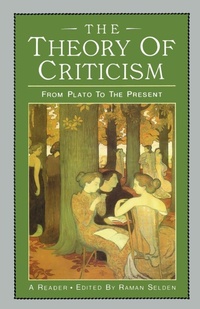
The Theory of Criticism
From Plato to the Present: A Reader
1st Edition
Published on 5. September 1988
Book
Paperback/Softback
576 pages
978-0-582-00328-6 (ISBN)
Description
This book is divided into five parts and covers: representation; subjectivity; form, structure and system; history and society; morality, class and ideology. Each part contains several thematic sections in which extracts from different writers and periods are juxtaposed. The study of literary theory has tended to concentrate on very recent developments. This volume, however, establishes both a sense of the continuities from Plato to the present day as well as the discontinuities. These are presented through comparisons and contrasts across the entire field of critical history.
Reviews / Votes
"If you seek a reader for the history of ideas...then Professor Selden's book is perfect." Modern Language Review "...an impressive feat of scholarship." Times Literary SupplementMore details
Language
English
Place of publication
London
United Kingdom
Publishing group
Taylor & Francis Ltd
Target group
Professional and scholarly
Dimensions
Height: 216 mm
Width: 140 mm
Thickness: 31 mm
Weight
718 gr
ISBN-13
978-0-582-00328-6 (9780582003286)
Copyright in bibliographic data and cover images is held by Nielsen Book Services Limited or by the publishers or by their respective licensors: all rights reserved.
Schweitzer Classification
Other editions
Additional editions

Book
01/2017
1st Edition
Routledge
€215.77
Shipment within 10-20 days
Previous edition

Book
09/1988
Longman
€34.71
Article exhausted; check for reprint
Person
Raman Selden
Content
Preface Acknowledgements Introduction Part 1 - Representation 1. Imaginative Representation 2. Mimesis and Realism 3. Nature and Truth 4. Language and Representation Part II - Subjectivity 1. Wit Judgement, Fancy and Imagination 2. Genius, Nature vs Art 3. Emotive Theories 4 Subjective criticism and the reader's reponse 5. Unconscious Processes Part III - Form, System and Structure 1. The Aesthetic Dimension 2. Unity and Literariness 3. Ambiguity and Polysemy 4. Impersonality and the 'death' of the author 5. Rhetoric - Style and point of view 6. Structuree and system 7. Structure and Indeterminacy Part IV - History and Society 1. Tradition and Intertextuality 2. History 3. Literature and 'life' 4. Class and Gender Index