

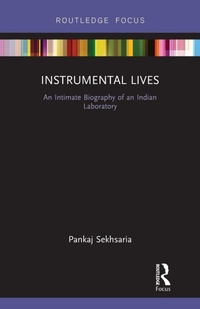
Instrumental Lives
An Intimate Biography of an Indian Laboratory
1st Edition
Published on 14. October 2024
Book
Paperback/Softback
148 pages
978-1-032-93073-2 (ISBN)
Description
Instrumental Lives is an account of instrument making at the cutting edge of contemporary science and technology in a modern Indian scientific laboratory. For a period of roughly two-and-half decades, starting the late 1980s, a research group headed by CV Dharmadhikari in the physics department at the Savitribai Phule University, Pune, fabricated a range of scanning tunnelling and scanning force microscopes including the earliest such microscopes made in the country. Not only were these instruments made entirely in-house, research done using them was published in the world's leading peer reviewed journals, and students who made and trained on them went on to become top class scientists in premier institutions.
The book uses qualitative research methods such as open-ended interviews, historical analysis and laboratory ethnography that are standard in Science and Technology Studies (STS), to present the micro-details of this instrument making enterprise, the counter-intuitive methods employed, and the unexpected material, human and intellectual resources that were mobilised in the process. It locates scientific research and innovation within the social, political and cultural context of a laboratory's physical location and asks important questions of the dominant narratives of innovation that remain fixated on quantitative metrics of publishing, patenting and generating commerce.
The book is a story as much of the lives of instruments and their deaths as it is of the instrumentalities that make those lives possible and allow them to live on, even if with a rather precarious existence.
The book uses qualitative research methods such as open-ended interviews, historical analysis and laboratory ethnography that are standard in Science and Technology Studies (STS), to present the micro-details of this instrument making enterprise, the counter-intuitive methods employed, and the unexpected material, human and intellectual resources that were mobilised in the process. It locates scientific research and innovation within the social, political and cultural context of a laboratory's physical location and asks important questions of the dominant narratives of innovation that remain fixated on quantitative metrics of publishing, patenting and generating commerce.
The book is a story as much of the lives of instruments and their deaths as it is of the instrumentalities that make those lives possible and allow them to live on, even if with a rather precarious existence.
Reviews / Votes
"The book gives an insight into the state of laboratories in India and scientific research and i)nnovation done in them...New, creative work can come only if young scholars strike completely new paths in working on an S&T policy in India. Fortunately, this is happening from emerging young scientists, and Sekhsaria's work is definitely in that direction. His work, hopefully, will inspire more work in this direction as he himself keeps emphasising at different points in his book." - Lawrence Surendra, Frontline, The Hindu (March 25, 2020)"Sekhsaria's book is an important contribution towards the growth of STS and innovation in India in terms of local narratives of S&T. Instrumental Lives heralds a new wave of S&T studies that if taken forward seriously will provide a major alternative to existing positivist narratives in India. In the future, policy makers can take their cues from academic scholarship, such as Sekhsaria's, towards more inclusive, sustainable and sensitive S&T policies in India." - Vivek Kant, Indian Institute of Technology Bombay, Social Epistemology Review and Reply Collective (March 5, 2020)
More details
Series
Language
English
Place of publication
London
United Kingdom
Publishing group
Taylor & Francis Ltd
Target group
College/higher education
Professional and scholarly
Academic and Postgraduate
Product notice
Paperback (trade)
Illustrations
17 s/w Abbildungen
17 Illustrations, black and white
Dimensions
Height: 216 mm
Width: 140 mm
Thickness: 8 mm
Weight
183 gr
ISBN-13
978-1-032-93073-2 (9781032930732)
Copyright in bibliographic data and cover images is held by Nielsen Book Services Limited or by the publishers or by their respective licensors: all rights reserved.
Schweitzer Classification
Other editions
Additional editions
Book
12/2018
1st Edition
Routledge
€84.00
Shipment within 10-20 days
E-Book
12/2018
1st Edition
Routledge
€26.49
Available for download
E-Book
12/2018
1st Edition
Routledge
€26.49
Available for download
Person
Pankaj Sekhsaria is Associate Professor at the Centre for Technology Alternatives for Rural Areas (C-TARA), IIT Bombay. He was until recently Senior Project Scientist at the DST-Centre for Policy Research, Department of Humanities and Social Science, IIT-Delhi. His research interests lie at the intersection of science, environment, technology and society. He has a PhD in Science and Technology Studies (STS) from the Maastricht University in the Netherlands and has written extensively on issues of environment, development and wildlife conservation in India with a special focus on the Andaman and Nicobar Islands.
Content
1. Series Editor Foreword (Saurabh Dube) 2. Introduction: Entering the lab/setting the stage 3. 1986-2014: Making of the STM 4. S&T in modern India - a brief history 5. Jugaad and its many worlds/avatars 6. Dharmadhikari's microscopes and technological jugaad 7. Implications for innovation policy 8. De-centred/de-centring cultures of innovation 9. In the end...or call it an epilogue