

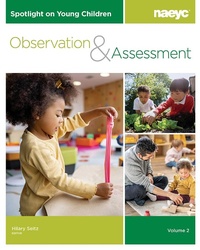
Spotlight on Young Children: Observation and Assessment, Volume 2
Published on 25. April 2024
Book
Paperback/Softback
128 pages
978-1-952331-25-1 (ISBN)
Description
Meaningful, developmentally appropriate
observation
and assessment are core components of every early learning setting. In today's
world of data collection, high-stakes testing, and accountability, it is
vitally important to understand how to effectively assess young children in
familiar settings; use this data to inform the curriculum; and communicate this
information with staff, families, and communities.
Carrying on the work of the first volume of Spotlight on Young Children:
Observation and Assessment, this book brings together
all-new articles curated by Hilary Seitz, director for educator and leadership
programs in the California State University system. Organized into three
distinct parts, the contributions
Discuss changing the landscape
of observation and assessment
Emphasize the need for
assessment to be culturally and linguistically responsive
Showcase a variety of
reasons why educators use observation and assessment, exploring information
about the foundations and meanings behind them
Highlight different facets of the
authentic assessment process and how to capture thinking and learning moments
Address reflecting on,
celebrating, and including all children by identifying their unique
strengths and needs and using a variety of supporting strategies Each article in this collection is accompanied by questions to
prompt deeper thinking on the content. With this resource, continue to grow your
understanding of how observation and assessment can guide your instruction and
promote children's learning.
observation
and assessment are core components of every early learning setting. In today's
world of data collection, high-stakes testing, and accountability, it is
vitally important to understand how to effectively assess young children in
familiar settings; use this data to inform the curriculum; and communicate this
information with staff, families, and communities.
Carrying on the work of the first volume of Spotlight on Young Children:
Observation and Assessment, this book brings together
all-new articles curated by Hilary Seitz, director for educator and leadership
programs in the California State University system. Organized into three
distinct parts, the contributions
Discuss changing the landscape
of observation and assessment
Emphasize the need for
assessment to be culturally and linguistically responsive
Showcase a variety of
reasons why educators use observation and assessment, exploring information
about the foundations and meanings behind them
Highlight different facets of the
authentic assessment process and how to capture thinking and learning moments
Address reflecting on,
celebrating, and including all children by identifying their unique
strengths and needs and using a variety of supporting strategies Each article in this collection is accompanied by questions to
prompt deeper thinking on the content. With this resource, continue to grow your
understanding of how observation and assessment can guide your instruction and
promote children's learning.
Reviews / Votes
In a time when assessment is frequently associated with formal testing that takes precious time away from instruction, the authors demonstrate how authentic assessment can shape teachers' decisions about creating optimal learning environments for young learners. Aligned with the principles and guidelines of the fourth edition of Developmentally Appropriate Practice, this book is a valuable resource in the toolbox of novice and experienced early childhood educators.-Elena Bodrova, Cofounder and Knowledge Advisor, Tools of the Mind Navigating the challenges of assessment in education is no easy task. This new volume manages to address the anxiety around the topic by offering actionable insights that educators across the early childhood continuum can utilize to benefit children.
-Vincent J. Costanza, Principal, Campbell Elementary School Full of research-based information, strategies, and examples, this highly readable book is a must for students, teachers, and directors seeking to better understand the whats, whys, and hows of authentic, data-driven, individualized, and equitable assessment for all children.
-Mary Benson McMullen, Professor of Early Childhood Education, Indiana University Bloomington
More details
Series
Language
English
Place of publication
Washington DC
United States
Product notice
Paperback (trade)
Illustrations
4-color figures and tables
Dimensions
Height: 264 mm
Width: 208 mm
Thickness: 8 mm
Weight
363 gr
ISBN-13
978-1-952331-25-1 (9781952331251)
Copyright in bibliographic data and cover images is held by Nielsen Book Services Limited or by the publishers or by their respective licensors: all rights reserved.
Schweitzer Classification
Person
Hilary Seitz, PhD, is director for educator and leadership programs in the California State University system. She advocates and supports statewide efforts to support early childhood education and the new California PK-3 Early Childhood Education Specialist Instruction Credential. Dr. Seitz is professor emerita in early childhood education at the University of Alaska Anchorage. Her research areas have been in early literacy development, collaborative practices between families and schools including culturally responsive pedagogies, emergent curriculum development, documentation, authentic assessment, and social constructivist learning theories inspired by Reggio Emilia practices.
Content
Introduction ??
Hilary Seitz?
Part 1:
Purposes of Observation and Assessment?
Foundations
of Assessment for Preschool Settings??
Catherine
Scott-Little, with Kathy L. Reschke?
Meaningful
Assessment and Documentation: How Directors Can Support Teaching and Learning?
Debbie LeeKeenan and Iris Chin Ponte?
Assessing
Agency in Learning Contexts: A First, Critical Step to Assessing Children?
Natacha Ndabahagamye Jones, Amber T. Fowler, and Jennifer
Keys Adair?
Part 2:
Strategies for Observing and Assessing?
Authentic Assessment: A Strengths-Based
Approach to Making Thinking, Learning, and Development Visible?
Hilary Seitz?
Anecdotal Records: Practical Strategies for
Taking Meaningful Notes?
Celeste C. Bates, Stephanie M. Madison, and
Hayley J. Hoover
Bringing Observation and Documentation to Life
in Infant and Toddler Settings?
Rebecca Parlakian ?
Unlocking the Potential of Data-Driven
Coaching: Child Assessment Evidence as a Guide for Informing Instructional
Practices?
Christine M. Snyder and Holly P. Delgado ?
Effective Kindergarten Readiness Assessments:
Influencing Policy, Informing Instruction, and Creating Joyful Classrooms?
Elliot Regenstein, Maia C. Connors, Rio
Romero-Jurado, and Joyce Weiner?
Photographs and Learning Progressions:
Supports for Intentional Assessment?and Instruction in Mathematics?
Sarah Roller Dyess, Elizabeth Petit
Cunningham, and Katherine Ariemma Marin
Part 3: Assessment Practices to Support
Inclusion?
Assessing Opportunities to Support Each Child:12 Practices for Quality Inclusion?
Camille Catlett and Elena P. Soukakou
Embedded Learning Opportunities for Children with and Without Disabilities?
Christan G. Coogle, Emily M. Rose, Jennifer R.
Ottley, Jennifer A. Brown, and Mollie K. Romano?
Authentic and Meaningful Developmental Screening in Early Childhood?
Marisa Macy and Stefano J. Bagnato??
Enhancing Toddlers' Communication Skills: Partnerships with Speech-Language Pathologists?
Janet L. Gooch? ?
Hilary Seitz?
Part 1:
Purposes of Observation and Assessment?
Foundations
of Assessment for Preschool Settings??
Catherine
Scott-Little, with Kathy L. Reschke?
Meaningful
Assessment and Documentation: How Directors Can Support Teaching and Learning?
Debbie LeeKeenan and Iris Chin Ponte?
Assessing
Agency in Learning Contexts: A First, Critical Step to Assessing Children?
Natacha Ndabahagamye Jones, Amber T. Fowler, and Jennifer
Keys Adair?
Part 2:
Strategies for Observing and Assessing?
Authentic Assessment: A Strengths-Based
Approach to Making Thinking, Learning, and Development Visible?
Hilary Seitz?
Anecdotal Records: Practical Strategies for
Taking Meaningful Notes?
Celeste C. Bates, Stephanie M. Madison, and
Hayley J. Hoover
Bringing Observation and Documentation to Life
in Infant and Toddler Settings?
Rebecca Parlakian ?
Unlocking the Potential of Data-Driven
Coaching: Child Assessment Evidence as a Guide for Informing Instructional
Practices?
Christine M. Snyder and Holly P. Delgado ?
Effective Kindergarten Readiness Assessments:
Influencing Policy, Informing Instruction, and Creating Joyful Classrooms?
Elliot Regenstein, Maia C. Connors, Rio
Romero-Jurado, and Joyce Weiner?
Photographs and Learning Progressions:
Supports for Intentional Assessment?and Instruction in Mathematics?
Sarah Roller Dyess, Elizabeth Petit
Cunningham, and Katherine Ariemma Marin
Part 3: Assessment Practices to Support
Inclusion?
Assessing Opportunities to Support Each Child:12 Practices for Quality Inclusion?
Camille Catlett and Elena P. Soukakou
Embedded Learning Opportunities for Children with and Without Disabilities?
Christan G. Coogle, Emily M. Rose, Jennifer R.
Ottley, Jennifer A. Brown, and Mollie K. Romano?
Authentic and Meaningful Developmental Screening in Early Childhood?
Marisa Macy and Stefano J. Bagnato??
Enhancing Toddlers' Communication Skills: Partnerships with Speech-Language Pathologists?
Janet L. Gooch? ?