

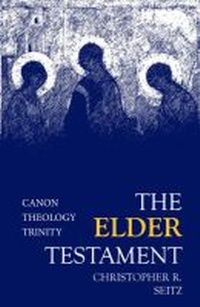
The Elder Testament
Canon, Theology, Trinity
Published on 30. July 2018
Book
Hardback
310 pages
978-1-4813-0828-1 (ISBN)
Description
The Elder Testament serves as a theological introduction to the canonical unity of the Scriptures of Israel. Christopher Seitz demonstrates that, while an emphasis on theology and canonical form often sidesteps critical methodology, the canon itself provides essential theological commentary on textual and historical reconstruction.
Part One reflects on the Old Testament as literature inquiring about its implied reader. Seitz introduces the phrase ""Elder Testament"" to establish a wider conceptual lens for what is commonly called the ""Old Testament"" or the ""Hebrew Bible,"" so that the canon might be read to its fullest capacity.
Part Two provides an overview of the canon proper, from Torah to Prophets to Writings. Seitz here employs modern criticism to highlight the theological character of the Bible in its peculiar canonical shape. But he argues that the canon cannot be reduced to simply vicissitudes of history, politics, or economics. Instead, the integrated form of this Elder Testament speaks of metahistorical disclosures of the divine, correlating the theological identity of God across time and beyond.
Part Three examines Proverbs 8, Genesis 1, and Psalms 2 and 110 - texts that are notable for their prominence in early Christian exegesis. The Elder Testament measures the ontological pressure exerted by these texts, which led directly to the earliest expressions of Trinitarian reading in the Christian church, long before the appearance of a formally analogous Scripture, bearing the now-familiar name ""New Testament.""
Canon to Theology to Trinity. This trilogy, as Seitz concludes, is not strictly a historical sequence. Rather, this trilogy is ontologically calibrated through time by the One God who is the selfsame subject matter of both the Elder and New Testaments. The canon makes the traditional theological work of the church possible without forcing a choice between a minimalist criticism or a detached, often moribund systematic theology. The canon achieves ""the concord and harmony of the law and the prophets in the covenant delivered at the coming of the Lord"" of which Clement of Alexandria so eloquently spoke.
Part One reflects on the Old Testament as literature inquiring about its implied reader. Seitz introduces the phrase ""Elder Testament"" to establish a wider conceptual lens for what is commonly called the ""Old Testament"" or the ""Hebrew Bible,"" so that the canon might be read to its fullest capacity.
Part Two provides an overview of the canon proper, from Torah to Prophets to Writings. Seitz here employs modern criticism to highlight the theological character of the Bible in its peculiar canonical shape. But he argues that the canon cannot be reduced to simply vicissitudes of history, politics, or economics. Instead, the integrated form of this Elder Testament speaks of metahistorical disclosures of the divine, correlating the theological identity of God across time and beyond.
Part Three examines Proverbs 8, Genesis 1, and Psalms 2 and 110 - texts that are notable for their prominence in early Christian exegesis. The Elder Testament measures the ontological pressure exerted by these texts, which led directly to the earliest expressions of Trinitarian reading in the Christian church, long before the appearance of a formally analogous Scripture, bearing the now-familiar name ""New Testament.""
Canon to Theology to Trinity. This trilogy, as Seitz concludes, is not strictly a historical sequence. Rather, this trilogy is ontologically calibrated through time by the One God who is the selfsame subject matter of both the Elder and New Testaments. The canon makes the traditional theological work of the church possible without forcing a choice between a minimalist criticism or a detached, often moribund systematic theology. The canon achieves ""the concord and harmony of the law and the prophets in the covenant delivered at the coming of the Lord"" of which Clement of Alexandria so eloquently spoke.
Reviews / Votes
"Christopher Seitz is one of the freshest voices in biblical scholarship: learned, witty, and incisively theological. He provides more reasons for recovering the Elder Testament as a source for Christian thinking." Gary A. Anderson, Hesburgh Professor of Catholic Theology, Notre Dame University "The book is a kind of window onto the theological distillation of an especially gifted critical reader of the Bible, deeply immersed in the churchs lived experiences and challengesa kind of intellectual testament, that carries the charge of a special witness." Ephraim Radner, Professor of Historical Theology, Wycliffe College "Impossible. Sealed tight. The Christian doctrine of the Trinity cannot be successfully grounded in the Old Testament, read on its own terms. Or so scholars have claimed for hundreds of years. But the Old Testaments witness to Gods complex reality contains volcanic pressure. Large cracks have already appeared. But stand back! Christopher Seitz has blown off the lid." Matthew W. Bates, author of The Birth of the Trinity "Christ is already at work in the Old Testament, which resists therefore our attempts at historicizing it. This claim forms the solid basis on which Seitz grounds his reading of the Old Testament. Drawing on many years of teaching and writing, The Elder Testament presents Seitzs mature understanding of a canonical reading of the Scriptures. His rich treatment reminds us why Gods purposes with the Scriptures reach beyond authorial intent to the theological ontology that comes to expression in the first witness." Hans Boersma, J. I. Packer Professor of Theology, Regent College ...A remarkable tour de force, a re-envisioning of theological study of the Old Testament, whose implications merit serious thought on the part of Christian theologians. -- Walter R.W.L. Moberly -- Modern TheologyMore details
Language
English
Place of publication
Waco
United States
Target group
College/higher education
Professional and scholarly
Illustrations
2 black & white plates
Dimensions
Height: 216 mm
Width: 140 mm
Thickness: 27 mm
ISBN-13
978-1-4813-0828-1 (9781481308281)
Copyright in bibliographic data and cover images is held by Nielsen Book Services Limited or by the publishers or by their respective licensors: all rights reserved.
Schweitzer Classification
Other editions
Additional editions
E-Book
10/2018
Baylor University Press
€44.49
Available for download
Person
Christopher R. Seitz (Ph.D. Yale) is Senior Research Professor of Biblical Interpretation at Wycliffe College at the University of Toronto.