

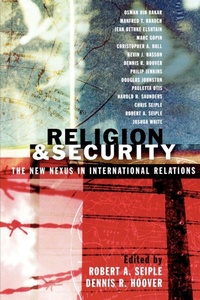
Religion and Security
The New Nexus in International Relations
Published on 13. September 2004
Book
Paperback/Softback
216 pages
978-0-7425-3212-0 (ISBN)
Description
Religion and Security: The New Nexus in International Relations focuses on a groundbreaking theme. In global security today, religion is not only part of the problem but also part of the solution. This book explores positive nexus points between religion and security, paying particular attention to the resources within the Abrahamic faith traditions of Judaism, Christianity, and Islam that foster sustainable peace. Religion and Security is a lively and insightful collection of analyses by distinguished scholars and practitioners in security, diplomacy, conflict resolution, human rights and theology. As states and nongovernmental organizations alike reconsider their strategies for being relevant in the 21st century, this book provides a practical framework through which both can work toward reducing violence and promoting human dignity. Divided into four parts, Religion and Security addresses themes of war and terrorism, pluralism and stability, military intervention and conflict resolution, and religious freedom and civil society. It underscores a crucial irony: nations that violate religious human rights in the name of 'security' will ultimately be vulnerable to a number of significant threats to stability. This volume is a timely guide to the intersection of religion and security for human rights organizations, security experts, scholars of religion and politics, government and non-government staffers and decision-makers, and students in the disciplines of international affairs.
Reviews / Votes
Armed with impressive scholarship and policy experience, these contributions drive home a vital yet neglected truth: religious freedom is more than a matter of political justice; it's also a crucial ingredient of political survival-both for religiously diverse nation-states and our multi-civilizational international system. -- Timothy Samuel Shah, The Harvard Academy for International and Area Studies After September 11, 2001, the discussion on world events tended more to obfuscate than illuminate. We are just entering a new phase of more sophisticated studies, and Religion and Security, which brings together some of the leading authorities in the field, is essential reading to understand our complex, dangerous, and changing world. -- Akbar S. Ahmed, Ibn Khaldun Chair of Islamic Studies, American University, Washington, D.C.More details
Language
English
Place of publication
United States
Publishing group
Bloomsbury Publishing Plc
Dimensions
Height: 229 mm
Width: 152 mm
Thickness: 13 mm
Weight
352 gr
ISBN-13
978-0-7425-3212-0 (9780742532120)
Copyright in bibliographic data and cover images is held by Nielsen Book Services Limited or by the publishers or by their respective licensors: all rights reserved.
Schweitzer Classification
Other editions
Additional editions
Religion and Security
The New Nexus in International Relations
E-Book
09/2004
1st Edition
Sheed & Ward,U.S.
€36.99
Available for download
Persons
Robert A. Seiple was U.S. Ambassador-at-Large for International Religious Freedom from 1998-2000, after which he founded the Institute for Global Engagement. Author of Ambassadors of Hope , he teaches in the Templeton Honors College, Eastern University. Dennis R. Hoover is vice president for research and publications at the Institute for Global Engagement. A graduate of Oxford University (D.Phil. in Politics), he directs the Council on Faith & International Affairs and edits The Brandywine Review.
Content
Part 1 Foreword
Part 2 Introduction: Religion Gets Real
Part 3 Section I: Religion and (In)Security: The 21st Century Challenge
Chapter 4 Religion and War in the 21st Century
Chapter 5 The Politics of Persecuted Religious Minorities
Chapter 6 Uzbekistan and the Central Asian Crucible of Religion and Security
Part 7 Section II: Perspectives on Pluralism: Making a World Safe for Diversity
Chapter 8 Choosing Exclusion or Embrace: An Abrahamic Theological Perspective
Chapter 9 Truth, Pluralism, and Religious Diplomacy: A Christian Dialogical Perspective
Chapter 10 Pluralism and the "People of the Book": An Islamic Faith Perspective
Part 11 Section III: Into the Breach: Restoring Sustainable Security
Chapter 12 Military Intervention and Justice as Equal Regard
Chapter 13 When the Fighting Stops: Healing Hearts with Spiritual Peacemaking
Part 14 Section IV: Religious Freedom and Security: The Civil Society Nexus
Chapter 15 Neither Sacred Nor Secular: A Public Anthropology of Human Dignity, Religious Freedom, and Security
Chapter 16 Relational Realism: Toward a New Political Paradign for Security
Chapter 17 Conclusion: A Lively Experiment, A Most Flourishing Civil State
Part 2 Introduction: Religion Gets Real
Part 3 Section I: Religion and (In)Security: The 21st Century Challenge
Chapter 4 Religion and War in the 21st Century
Chapter 5 The Politics of Persecuted Religious Minorities
Chapter 6 Uzbekistan and the Central Asian Crucible of Religion and Security
Part 7 Section II: Perspectives on Pluralism: Making a World Safe for Diversity
Chapter 8 Choosing Exclusion or Embrace: An Abrahamic Theological Perspective
Chapter 9 Truth, Pluralism, and Religious Diplomacy: A Christian Dialogical Perspective
Chapter 10 Pluralism and the "People of the Book": An Islamic Faith Perspective
Part 11 Section III: Into the Breach: Restoring Sustainable Security
Chapter 12 Military Intervention and Justice as Equal Regard
Chapter 13 When the Fighting Stops: Healing Hearts with Spiritual Peacemaking
Part 14 Section IV: Religious Freedom and Security: The Civil Society Nexus
Chapter 15 Neither Sacred Nor Secular: A Public Anthropology of Human Dignity, Religious Freedom, and Security
Chapter 16 Relational Realism: Toward a New Political Paradign for Security
Chapter 17 Conclusion: A Lively Experiment, A Most Flourishing Civil State