

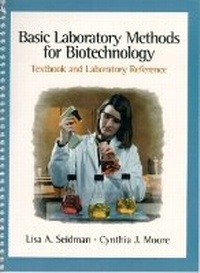
Basic Laboratory Methods for Biotechnology
Published on 17. February 2000
Book
Paperback/Softback
751 pages
978-0-13-795535-0 (ISBN)
Description
A primary text for courses that focus on basic laboratory methods in biotechnology, and an ancillary text for any biology course that includes a laboratory component that want to focus on biotechnology.
Unique in both content and approach, this text/reference provides a systematic introduction to basic laboratory methods from the perspective of the everyday work in the labs of the biotechnology/bioscience industry. Written at a level that is accessible to beginning college students with average math and science backgrounds. Provides the depth and detail useful to professional laboratory workers. It blends the background and theory provided by introductory chemistry texts with the practical concerns discussed in advanced lab manuals. It focuses on basic laboratory methods, the principles that underlie those methods, and the equipment that makes laboratory work possible.
Unique in both content and approach, this text/reference provides a systematic introduction to basic laboratory methods from the perspective of the everyday work in the labs of the biotechnology/bioscience industry. Written at a level that is accessible to beginning college students with average math and science backgrounds. Provides the depth and detail useful to professional laboratory workers. It blends the background and theory provided by introductory chemistry texts with the practical concerns discussed in advanced lab manuals. It focuses on basic laboratory methods, the principles that underlie those methods, and the equipment that makes laboratory work possible.
Reviews / Votes
"The authors have done an outstanding job of capturing the essential skills and applied theories of mathematics, physics, biology and chemistry that are pertinent to the training needs of workers in biotechnology. The information contained in these chapters represent a wealth of basic, practical knowledge that previously was not readily available in print, but more likely was acquired 'on the job'," -- Dr. Gail Baughman, MiraCosta College "The texts we have found for our biotechnology theory course are either too deep (molecular biology) or too shall (gee whiz). It is ironic that all three of the internships I have done in biotech companies have asked for the kinds of skills found in this text, but no other text seems to be available like it. I think that the book will be a best seller." -- Bill Thieman, Ventura College "The use of many worked out examples make this test especially strong as a reference for the technician." -- David B. Shaw, Madison Area Technical CollegeMore details
Language
English
Place of publication
United States
Publishing group
Pearson Education (US)
Target group
Professional and scholarly
Dimensions
Height: 280 mm
Width: 235 mm
Thickness: 30 mm
Weight
1492 gr
ISBN-13
978-0-13-795535-0 (9780137955350)
Copyright in bibliographic data and cover images is held by Nielsen Book Services Limited or by the publishers or by their respective licensors: all rights reserved.
Schweitzer Classification
Other editions
New editions
Lisa Seidman
Basic Laboratory Methods for Biotechnology
Book
12/2008
2nd Edition
Pearson
€86.62
Article not available
Persons
LISA SEIDMAN received her Ph.D. from the University of Wisconsin and has taught for over twelve years in the Biotechnology Laboratory Technician Program at Madison Area Technical College, Madison, Wisconsin.
CYNTHIA MOORE received her doctoral degree from Temple University School of Medicine and has a career both in research and as a science educator. She is currently a faculty member in the Department of Biological Sciences at Illinois State University, Normal, Illinois.
The authors welcome comments and feedback from readers. You can e-mail Lisa Seidman at lseidman@madison.tec.wi.us and Cynthia Moore at cjmoor1@ilstu.edu.
CYNTHIA MOORE received her doctoral degree from Temple University School of Medicine and has a career both in research and as a science educator. She is currently a faculty member in the Department of Biological Sciences at Illinois State University, Normal, Illinois.
The authors welcome comments and feedback from readers. You can e-mail Lisa Seidman at lseidman@madison.tec.wi.us and Cynthia Moore at cjmoor1@ilstu.edu.
Content
I. INTRODUCTION TO THE BIOTECHNOLOGY WORKPLACE.
1. Biotechnology and the Workplace.
2. Introduction to a Safe Workplace.
3. Biotechnology and the Regulation of Medical and Food Products.
II. PRODUCT QUALITY AND BIOTECHNOLOGY.
4. Introduction to Product Quality Systems.
5. Documentation: The Foundation of Quality.
6. Quality Systems in the Laboratory.
7. Quality Systems in the Production Facility.
III. MATH IN THE BIOTECHNOLOGY LABORATORY: AN OVERVIEW.
8. Basic Math Techniques.
9. Proportional Relationships.
10. Relationships and Graphing.
IV. DATA IN THE LABORATORY.
11. Descriptions of Data.
12. The Collection of Meaningful Data; Avoiding Errors in the Laboratory.
V. LABORATORY MEASUREMENTS.
13. Introduction to Quality Laboratory Measurements, Tests, and Assays.
14. Introduction to Instrumental Methods and Electricity.
15. The Measurement of Weight.
16. The Measurement of Volume.
17. The Measurement of Temperature.
18. The Measurement of pH, Selected Ions, and Conductivity.
19. Measurements Involving Light A: Basic Principles and Instrumentation.
20. Measurements Involving Light B: Applications and Methods.
VI. LABORATORY SOLUTIONS.
21. Preparation of Laboratory Solutions A: Concentration Expressions and Calculations.
22. Preparation of Laboratory Solutions B: Basic Procedures and Practical Information.
23. Laboratory Solutions to Support the Activity of Biological Macromolecules and Intact Cells.
24. Solutions: Associated Procedures and Information.
VII. BASIC SEPARATION METHODS.
25. Introduction to Filtration.
26. Introduction to Centrifugation.
27. Introduction to Bioseparations.
VIII. SAFETY IN THE LABORATORY.
28. Working Safely in the Laboratory: General Considerations and Physical Hazards.
29. Working Safely with Chemicals.
30. Working Safely with Biological Materials.
IX. COMPUTERS IN THE LABORATORY.
31. Computers: An Overview.
32. Data Handling with Computers.
33. Telecommunications and the Internet.
1. Biotechnology and the Workplace.
2. Introduction to a Safe Workplace.
3. Biotechnology and the Regulation of Medical and Food Products.
II. PRODUCT QUALITY AND BIOTECHNOLOGY.
4. Introduction to Product Quality Systems.
5. Documentation: The Foundation of Quality.
6. Quality Systems in the Laboratory.
7. Quality Systems in the Production Facility.
III. MATH IN THE BIOTECHNOLOGY LABORATORY: AN OVERVIEW.
8. Basic Math Techniques.
9. Proportional Relationships.
10. Relationships and Graphing.
IV. DATA IN THE LABORATORY.
11. Descriptions of Data.
12. The Collection of Meaningful Data; Avoiding Errors in the Laboratory.
V. LABORATORY MEASUREMENTS.
13. Introduction to Quality Laboratory Measurements, Tests, and Assays.
14. Introduction to Instrumental Methods and Electricity.
15. The Measurement of Weight.
16. The Measurement of Volume.
17. The Measurement of Temperature.
18. The Measurement of pH, Selected Ions, and Conductivity.
19. Measurements Involving Light A: Basic Principles and Instrumentation.
20. Measurements Involving Light B: Applications and Methods.
VI. LABORATORY SOLUTIONS.
21. Preparation of Laboratory Solutions A: Concentration Expressions and Calculations.
22. Preparation of Laboratory Solutions B: Basic Procedures and Practical Information.
23. Laboratory Solutions to Support the Activity of Biological Macromolecules and Intact Cells.
24. Solutions: Associated Procedures and Information.
VII. BASIC SEPARATION METHODS.
25. Introduction to Filtration.
26. Introduction to Centrifugation.
27. Introduction to Bioseparations.
VIII. SAFETY IN THE LABORATORY.
28. Working Safely in the Laboratory: General Considerations and Physical Hazards.
29. Working Safely with Chemicals.
30. Working Safely with Biological Materials.
IX. COMPUTERS IN THE LABORATORY.
31. Computers: An Overview.
32. Data Handling with Computers.
33. Telecommunications and the Internet.