

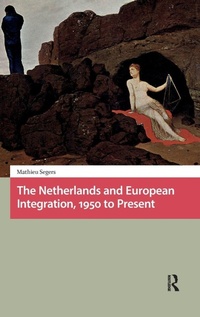
The Netherlands and European Integration, 1950 to Present
Published on 28. February 2020
Book
Hardback
334 pages
978-94-6372-813-3 (ISBN)
Description
On 9 May 1950, France launched a revolutionary plan for supranational cooperation in Western Europe. The Netherlands was taken completely by surprise. In the decades that followed, European integration moved forward at an unprecedented pace, taking the Netherlands with it. Geography and the post-war world seemed to leave the country no other choice. European integration forced - and is still forcing - the Netherlands on a far-reaching 'journey to the continent'. For the Netherlands, European integration represents a difficult journey to a new old world that often seems far off. How has that journey progressed so far? Why did the Netherlands join the common European market and currency from the very beginning? Was this course inevitable? And where has it brought the country? Using new, international source material, The Netherlands and European Integration, 1950 to Present digs deeply into the history of the Netherlands in Europe - a subject that is today more topical than ever.
More details
Language
English
Place of publication
Oxford
Netherlands
Target group
Professional and scholarly
Academic
Dimensions
Height: 240 mm
Width: 161 mm
Thickness: 23 mm
Weight
669 gr
ISBN-13
978-94-6372-813-3 (9789463728133)
Copyright in bibliographic data and cover images is held by Nielsen Book Services Limited or by the publishers or by their respective licensors: all rights reserved.
Schweitzer Classification
Other editions
Additional editions
Mathieu Segers
The Netherlands and European Integration, 1950 to Present
Book
approx. 12/2025
1st Edition
Routledge
€69.50
Not yet published
Mathieu Segers
The Netherlands and European Integration, 1950 to Present
E-Book
10/2025
Routledge
€60.49
Available for download
Mathieu Segers
The Netherlands and European Integration, 1950 to Present
E-Book
10/2025
Routledge
€60.49
Available for download
Persons
Mathieu Segers (1976) is Professor of Contemporary European History and European Integration at Maastricht University.
Content
Prologue: Dinner in Laeken (1989)
Kohl's great leap forward
The surgeons of French Realpolitiek
Exploiting Franco-German reconciliation
The Netherlands between Anglo-Saxons and Teutons
Journey to the continent
1 American concepts: building Europe (1947-1949)
Eternal division
2 Magical realism (1949-1951)
Putting the country's mental stability to the test
The Germany memorandum
Atlantis and bloc formation within the Western bloc
The Netherlands taken by surprise
Manufacturing a tranquillizer
3 The Beyen Plan (1951-1954)
The letter from 'the Ten'
Red versus Catholic
From Europe
A game for insiders
4 Around Cologne cathedral (1954-1957)
Adenauer's Abendland
Coordination through Europe's backchannels
With the Benelux to Sicily
Rebirth as a market
The latest trend
The Treaties of Rome
5 A Europe of conspiracies (1957-1968)
Faust in Paris
Rhetoric and intrigue
Market expansion by a gentleman farmer
Silence is golden
6 At home in the Basel biotope (1968-1974)
American dreams
An alternative loan circuit
Holtrop's logic
Masters of the interim stage
7 Sturm und Drang (1974-1982)
Late conversion
The monetary trilemma
Failure for Duisenberg
The stick of free movement of capital
8 The hand of French-German friendship (1982-1989)
A community united by blood
Celebrating success and earning money
Work in progress
The Delors report
9 After Strasbourg: a different party than expected (1989-1992)
Piet's work of art
The consequences
10 European realities: defining Europe after the Cold War
The direction of integration
The 1990s and after
The tragedy of Maastricht and Amsterdam
A rediscovery
Epilogue: the call of Calypso
Notes
Sources and references
Abbreviations
Acknowledgements
Index of names
Subject index
Kohl's great leap forward
The surgeons of French Realpolitiek
Exploiting Franco-German reconciliation
The Netherlands between Anglo-Saxons and Teutons
Journey to the continent
1 American concepts: building Europe (1947-1949)
Eternal division
2 Magical realism (1949-1951)
Putting the country's mental stability to the test
The Germany memorandum
Atlantis and bloc formation within the Western bloc
The Netherlands taken by surprise
Manufacturing a tranquillizer
3 The Beyen Plan (1951-1954)
The letter from 'the Ten'
Red versus Catholic
From Europe
A game for insiders
4 Around Cologne cathedral (1954-1957)
Adenauer's Abendland
Coordination through Europe's backchannels
With the Benelux to Sicily
Rebirth as a market
The latest trend
The Treaties of Rome
5 A Europe of conspiracies (1957-1968)
Faust in Paris
Rhetoric and intrigue
Market expansion by a gentleman farmer
Silence is golden
6 At home in the Basel biotope (1968-1974)
American dreams
An alternative loan circuit
Holtrop's logic
Masters of the interim stage
7 Sturm und Drang (1974-1982)
Late conversion
The monetary trilemma
Failure for Duisenberg
The stick of free movement of capital
8 The hand of French-German friendship (1982-1989)
A community united by blood
Celebrating success and earning money
Work in progress
The Delors report
9 After Strasbourg: a different party than expected (1989-1992)
Piet's work of art
The consequences
10 European realities: defining Europe after the Cold War
The direction of integration
The 1990s and after
The tragedy of Maastricht and Amsterdam
A rediscovery
Epilogue: the call of Calypso
Notes
Sources and references
Abbreviations
Acknowledgements
Index of names
Subject index