

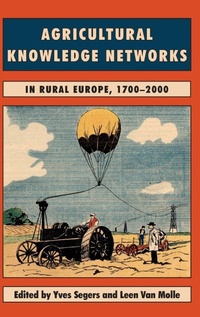
Agricultural Knowledge Networks in Rural Europe, 1700-2000
Published on 14. June 2022
Book
Hardback
262 pages
978-1-78327-712-4 (ISBN)
Description
An examination of how farming expertise could be shared and extended, over four centuries.
All kinds of knowledge, from traditional know-how to modern science, are socially contingent and the product of an age-long and permanent social struggle. This book unravels the creation and the exchange of agronomic knowledge in rural Europe, from the early eighteenth century up until the end of the twentieth. It explores the spreading of knowing through the lens of "knowledge networks": where did agricultural knowledge come from and how did one learn to run a farm? Who was involved in this process of knowledge exchange? Which strategies and communicative methods were employed and what kind of networks were active?
The answers to these questions mirror, as the book illustrates, the inventiveness of the actors on the scene: the creativity of a French naturalist in establishing links with local farmers to stop the circulation of a devastating grain moth, the power of the agricultural press to instill "proper values" into Hungarian farming practices or to shape the identity of the Galician agrarian movement, and the agency of post-war British farmers in selecting their own information, from sources such as lectures to the Young Farmers' Club, visits by public advisors and representatives of commercial firms, and radio programs.
From the start of the agricultural Enlightenment, increasingly farmers have been besieged by a growing army of experts, telling them what to do, when and how. In a sense farming has become one of the most patronised professions. But farmers can resist and carve their own path. The chapters here reveal the continuous tensions between science-based agriculture and practice-based farming, between the expert image of an ideal agriculture and the (less known) self-image of being a good farmer. The dominant process, as this book shows, is that of an instrumental top-down transmission of knowledge from "the lab to the field". But between these two poles, complex and flourishing networks developed, functioning as trading zones in which knowledge and experience could be circulated, put to the test, forgotten, altered, rejected - and sometimes imposed.
All kinds of knowledge, from traditional know-how to modern science, are socially contingent and the product of an age-long and permanent social struggle. This book unravels the creation and the exchange of agronomic knowledge in rural Europe, from the early eighteenth century up until the end of the twentieth. It explores the spreading of knowing through the lens of "knowledge networks": where did agricultural knowledge come from and how did one learn to run a farm? Who was involved in this process of knowledge exchange? Which strategies and communicative methods were employed and what kind of networks were active?
The answers to these questions mirror, as the book illustrates, the inventiveness of the actors on the scene: the creativity of a French naturalist in establishing links with local farmers to stop the circulation of a devastating grain moth, the power of the agricultural press to instill "proper values" into Hungarian farming practices or to shape the identity of the Galician agrarian movement, and the agency of post-war British farmers in selecting their own information, from sources such as lectures to the Young Farmers' Club, visits by public advisors and representatives of commercial firms, and radio programs.
From the start of the agricultural Enlightenment, increasingly farmers have been besieged by a growing army of experts, telling them what to do, when and how. In a sense farming has become one of the most patronised professions. But farmers can resist and carve their own path. The chapters here reveal the continuous tensions between science-based agriculture and practice-based farming, between the expert image of an ideal agriculture and the (less known) self-image of being a good farmer. The dominant process, as this book shows, is that of an instrumental top-down transmission of knowledge from "the lab to the field". But between these two poles, complex and flourishing networks developed, functioning as trading zones in which knowledge and experience could be circulated, put to the test, forgotten, altered, rejected - and sometimes imposed.
Reviews / Votes
[G]ive[s] us much food for thought and points the way to further studies and collaborations in rural Europe, an interesting time to be doing so as the United Kingdom leaves the Common Agricultural Policy. -- LANDSCAPES [...] readers will find value in every chapter, which all offer clear, thoughtful and well-researched histories of farming knowledge. * AGRICULTURAL HISTORY REVIEW * Taken together, these essays amount to an outstanding book, which anyone interested in agricultural history should read. * H-ENVIRONMENT, H-NET REVIEWS * An important and inspiring contribution to the history of knowledge in agriculture from the early 18th to the end of the 20th century. Agricultural Knowledge Networks in Rural Europe has the merit of pointing out valuable analytical pathways that historians can pursue to come to terms with the rewarding challenge of writing histories of agricultural knowledge. * HISTORIA AGRARIA * The introduction of this book, written by Yves Segers and Leen Van Molle, offers a riveting interpretation of the phenomenon of knowledge diffusion in the agricultural sector from the eighteenth century. Authors' contributions provide exhaustive insights into the diffusion of agricultural knowledge in different European space-time contexts. * LOW COUNTRIES JOURNAL OF SOCIAL AND ECONOMIC HISTORY *More details
Series
Language
English
Place of publication
Woodbridge
United Kingdom
Publishing group
Boydell & Brewer Ltd
Target group
Professional and scholarly
Product notice
Cloth over boards
Illustrations
2 Karten
2 Maps
Dimensions
Height: 240 mm
Width: 161 mm
Thickness: 19 mm
Weight
561 gr
ISBN-13
978-1-78327-712-4 (9781783277124)
Copyright in bibliographic data and cover images is held by Nielsen Book Services Limited or by the publishers or by their respective licensors: all rights reserved.
Schweitzer Classification
Other editions
Additional editions
Unknown | Yves Segers | Leen Van Molle
Agricultural Knowledge Networks in Rural Europe, 1700-2000
E-Book
06/2022
1st Edition
Boydell & Brewer Ltd
€48.99
Available for download
Yves Segers | Leen Van Molle
Agricultural Knowledge Networks in Rural Europe, 1700-2000
E-Book
06/2022
1st Edition
De Gruyter
€48.99
Available for download
Persons
Yves Segers is professor of Rural History at KU Leuven and director of the Interfaculty Centre for Agrarian History (ICAG, KU Leuven). Leen Van Molle is emeritus professor of Social History at KU Leuven and president of the Interfaculty Centre for Agrarian History (ICAG, KU Leuven). Yves Segers is professor of Rural History at KU Leuven and director of the Interfaculty Centre for Agrarian History (ICAG, KU Leuven). Leen Van Molle is emeritus professor of Social History at KU Leuven and president of the Interfaculty Centre for Agrarian History (ICAG, KU Leuven). MIGUEL CABO VILLAVERDE is Professor of Modern History at the University of Santiago de Compostela (Galicia, Spain). LOURENZO FERNANDEZ PRIETO is Professor of Modern History at the University of Santiago de Compostela and director of the CISPAC (Inter-universities Research Centre for Atlantic Cultural Landscapes). PAUL BRASSLEY is an Honorary University Fellow in the Centre for Rural Policy Research at the University of Exeter
Content
Introduction: Knowledge and its Networks in Rural Europe: From the Early Eighteenth to the Late Twentieth Century - Yves Segers and Leen Van Molle
Agricultural Literature in Scandinavia and the Anglo-Saxon Countries as an Indicator of a Deep-Rooted Economic Enlightenment, c.1700-1800 - Janken Myrdal
Peasant Eyes: A Critique of the Agricultural Enlightenment - Verena Lehmbrock
Fighting the Angoumois Grain Moth: Henri-Louis Duhamel du Monceau and his Network of Entomological Observers - Pierre-Etienne Stockland
'Promoting and Accelerating the Progress of Agriculture': A Case Study of Agricultural Societies in the Doncaster District, South Yorkshire, England - Sarah Holland
'Proper Values' in Agriculture: The Role of Agricultural Associations in Knowledge Dissemination in Hungary,
1830-1880 - Zsuzsanna Kiss
'The Eye of the Master'. Livestock Improvement and Knowledge Networks in Belgium, 1900-1940 - Dries Claeys and Yves Segers
Bridging Rural Culture and Expert Culture: The Agrarian Press in Galicia, c.1900-c.1950 - Miguel Cabo and Lourenzo Fernandez Prieto
Farmers Facing a Body of Expertise: the Activities and Methods of the Departmental Services for Agriculture in Oise (France), 1945-1955 - Laurent Herment
Technical Change and Knowledge Networks in England, 1945-1980s - Paul Brassley
Communicating an Innovation: Building Dutch Progeny Testing Stations for Pigs - Steven van der Laan
Agricultural Literature in Scandinavia and the Anglo-Saxon Countries as an Indicator of a Deep-Rooted Economic Enlightenment, c.1700-1800 - Janken Myrdal
Peasant Eyes: A Critique of the Agricultural Enlightenment - Verena Lehmbrock
Fighting the Angoumois Grain Moth: Henri-Louis Duhamel du Monceau and his Network of Entomological Observers - Pierre-Etienne Stockland
'Promoting and Accelerating the Progress of Agriculture': A Case Study of Agricultural Societies in the Doncaster District, South Yorkshire, England - Sarah Holland
'Proper Values' in Agriculture: The Role of Agricultural Associations in Knowledge Dissemination in Hungary,
1830-1880 - Zsuzsanna Kiss
'The Eye of the Master'. Livestock Improvement and Knowledge Networks in Belgium, 1900-1940 - Dries Claeys and Yves Segers
Bridging Rural Culture and Expert Culture: The Agrarian Press in Galicia, c.1900-c.1950 - Miguel Cabo and Lourenzo Fernandez Prieto
Farmers Facing a Body of Expertise: the Activities and Methods of the Departmental Services for Agriculture in Oise (France), 1945-1955 - Laurent Herment
Technical Change and Knowledge Networks in England, 1945-1980s - Paul Brassley
Communicating an Innovation: Building Dutch Progeny Testing Stations for Pigs - Steven van der Laan