

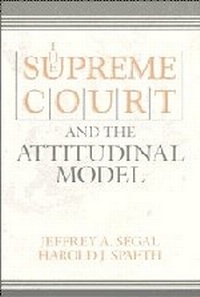
The Supreme Court and the Attitudinal Model
Published on 26. February 1993
Book
Hardback
410 pages
978-0-521-41130-1 (ISBN)
Description
The behaviour and decision-making processes of the US Supreme Court have often been examined using the legal model, which holds that Supreme Court decisions are based on the 'plain meaning' of the Constitution, the intent of the framers and precedent. This book investigates the decisions and the decision-making processes of the Supreme Court using an alternative framework: the attitudinal model, which holds that Supreme Court decisions are based on the attitudes and values of justices. Using the highly reliable US Supreme Court Judicial Data Base, compiled by Professor Spaeth, the authors examine all stages of the Court's decision-making processes, from staffing and access, to case selection, votes on the merits, opinion assignments and opinion coalitions, and judicial restraint and activism, and manage to explain and predict behaviour with a greater degree of accuracy. They also include a framework for understanding the impact of judicial decisions and the place of the Court in the American political system.
More details
Language
English
Place of publication
Cambridge
United Kingdom
Target group
Professional and scholarly
Illustrations
56 Tables, unspecified; 8 Line drawings, unspecified
Dimensions
Height: 242 mm
Width: 157 mm
Thickness: 23 mm
Weight
686 gr
ISBN-13
978-0-521-41130-1 (9780521411301)
Copyright in bibliographic data and cover images is held by Nielsen Book Services Limited or by the publishers or by their respective licensors: all rights reserved.
Schweitzer Classification
Other editions
New editions
Jeffrey A. Segal | Harold J. Spaeth
The Supreme Court and the Attitudinal Model Revisited
Book
09/2002
Cambridge University Press
€137.10
Shipment within 15-20 days
Persons
Content
Preface; 1. Introduction: Supreme Court policy making; 2. Models of decision making; 3. A political history of the Supreme Court; 4. Staffing the Court; 5. Getting into court; 6. The decision on the merits process; 7. Opinion assignment and opinion coalitions; 8. The Supreme Court and constitutional democracy; 9. The impact of judicial decisions; 10. Conclusion; Appendix; Index.