

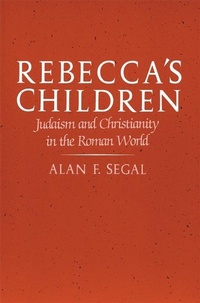
Rebecca's Children
Judaism and Christianity in the Roman World
Published on 15. March 1989
Book
Paperback/Softback
224 pages
978-0-674-75076-0 (ISBN)
Description
Renowned scholar Alan F. Segal offers startlingly new insights into the origins of rabbinic Judaism and Christianity. These twin descendants of Hebrew heritage shared the same social, cultural, and ideological context, as well as the same minority status, in the first century of the common era.
Through skillful application of social science theories to ancient Western thought, including Judaism, Hellenism, early Christianity, and a host of other sectarian beliefs, Segal reinterprets some of the most important events of Jewish and Christian life in the Roman world. For example, he finds:
- That the concept of myth, as it related to covenant, was a central force of Jewish life. The Torah was the embodiment of covenant both for Jews living in exile and for the Jewish community in Israel.
- That the Torah legitimated all native institutions at the time of Jesus, even though the Temple, Sanhedrin, and Synagogue, as well as the concepts of messiah and resurrection, were profoundly affected by Hellenism. Both rabbinic Judaism and Christianity necessarily relied on the Torah to authenticate their claim on Jewish life.
- That the unique cohesion of early Christianity, assuring its phenomenal success in the Hellenistic world, was assisted by the Jewish practices of apocalypticism, conversion, and rejection of civic ritual.
- That the concept of acculturation clarifies the Maccabean revolt, the rise of Christianity, and the emergence of rabbinic Judaism.
- That contemporary models of revolution point to the place of Jesus as a radical.
- That early rabbinism grew out of the attempts of middle-class Pharisees to reach a higher sacred status in Judea while at the same time maintaining their cohesion through ritual purity.
- That the dispute between Judaism and Christianity reflects a class conflict over the meaning of covenant.
The rising turmoil between Jews and Christians affected the development of both rabbinic Judaism and Christianity, as each tried to preserve the partly destroyed culture of Judea by becoming a religion. Both attempted to take the best of Judean and Hellenistic society without giving up the essential aspects of Israelite life. Both spiritualized old national symbols of the covenant and practices that consolidated power after the disastrous wars with Rome. The separation between Judaism and Christianity, sealed in magic, monotheism, law, and universalism, fractured what remained of the shared symbolic life of Judea, leaving Judaism and Christianity to fulfill the biblical demands of their god in entirely different ways.
Through skillful application of social science theories to ancient Western thought, including Judaism, Hellenism, early Christianity, and a host of other sectarian beliefs, Segal reinterprets some of the most important events of Jewish and Christian life in the Roman world. For example, he finds:
- That the concept of myth, as it related to covenant, was a central force of Jewish life. The Torah was the embodiment of covenant both for Jews living in exile and for the Jewish community in Israel.
- That the Torah legitimated all native institutions at the time of Jesus, even though the Temple, Sanhedrin, and Synagogue, as well as the concepts of messiah and resurrection, were profoundly affected by Hellenism. Both rabbinic Judaism and Christianity necessarily relied on the Torah to authenticate their claim on Jewish life.
- That the unique cohesion of early Christianity, assuring its phenomenal success in the Hellenistic world, was assisted by the Jewish practices of apocalypticism, conversion, and rejection of civic ritual.
- That the concept of acculturation clarifies the Maccabean revolt, the rise of Christianity, and the emergence of rabbinic Judaism.
- That contemporary models of revolution point to the place of Jesus as a radical.
- That early rabbinism grew out of the attempts of middle-class Pharisees to reach a higher sacred status in Judea while at the same time maintaining their cohesion through ritual purity.
- That the dispute between Judaism and Christianity reflects a class conflict over the meaning of covenant.
The rising turmoil between Jews and Christians affected the development of both rabbinic Judaism and Christianity, as each tried to preserve the partly destroyed culture of Judea by becoming a religion. Both attempted to take the best of Judean and Hellenistic society without giving up the essential aspects of Israelite life. Both spiritualized old national symbols of the covenant and practices that consolidated power after the disastrous wars with Rome. The separation between Judaism and Christianity, sealed in magic, monotheism, law, and universalism, fractured what remained of the shared symbolic life of Judea, leaving Judaism and Christianity to fulfill the biblical demands of their god in entirely different ways.
Reviews / Votes
Segal's work reveals a broad command of the sources and the multidisciplinary outlook requisite for modern reconstructions. He has raised issues that will excite discussion and respectfully challenge many a traditional approach. * American Historical Review * Provocative... [Segal crafts] valuable discussions of the relation between the religious and the political dimensions of Jesus' teaching, the nature of messianism and apocalypticism, and the functions of myth and mythic language in the creation and maintenance of religious communities. * Journal of Religion * The book is enlivened by modern analogies and firmly rooted in social-scientific analysis... A delightful read. * Studies in Religion * Alan Segal brings a new perspective to the early histories of Christianity and Rabbinic Judaism by showing how they are responses to the same social situation. The book is sociologically significant, sensitive, historically illuminating, and eminently teachable. -- Robert M. Bellah, University of California, BerkeleyMore details
Edition
Revised edition
Language
English
Place of publication
Cambridge, Mass
United States
Target group
College/higher education
Professional and scholarly
Product notice
Paperback (trade)
Unsewn / adhesive bound
Cloth over boards
Illustrations
none
Dimensions
Height: 235 mm
Width: 151 mm
Thickness: 15 mm
Weight
286 gr
ISBN-13
978-0-674-75076-0 (9780674750760)
Copyright in bibliographic data and cover images is held by Nielsen Book Services Limited or by the publishers or by their respective licensors: all rights reserved.
Schweitzer Classification
Other editions
Additional editions
E-Book
03/1989
1st Edition
Harvard University Press
€82.99
Available for download
Person
Alan F. Segal was Professor Emeritus of Religion and Ingeborg Rennert Professor Emeritus of Judaic Studies at Barnard College, Columbia University.
Content
Introduction. Myth in Israelite Society 1. Israel Between Empires 2. Society in the Time of Jesus 3. Jesus, the Jewish Revolutionary 4. Paul, the Covert and Apostle 5. Origins of Rabbinic Movement 6. Communities in Conflict 7. The Ways Divide Notes Scriptural Index General Index