

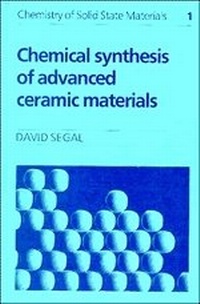
Chemical Synthesis of Advanced Ceramic Materials
Published on 28. July 1989
Book
Hardback
200 pages
978-0-521-35436-3 (ISBN)
Description
This is the first book devoted to the role of chemical synthetic techniques in the development of advanced ceramic materials. It bridges the gap between existing volumes dealing with the properties of ceramic materials, for example their mechanical properties, and those on chemistry. The author describes the variety of advanced ceramics and their conventional synthesis and fabrication. This is followed by a description of the range of non-conventional synthetic methods. The basic chemistry of the synthesis is described and well-illustrated by reference to ceramics made on both laboratory and industrial scales. This resource book will be of value to anyone working with advanced ceramics in research laboratories, and to postgraduate students and research workers in chemistry, material science, physics, metallurgy and mechanical engineering departments involved with ceramic materials.
Reviews / Votes
' ... it is a pleasure to recommend it ...' Anthony Moulson, The Times Higher Education SupplementMore details
Series
Language
English
Place of publication
Cambridge
United Kingdom
Target group
Professional and scholarly
Dimensions
Height: 236 mm
Width: 152 mm
Thickness: 16 mm
Weight
450 gr
ISBN-13
978-0-521-35436-3 (9780521354363)
Copyright in bibliographic data and cover images is held by Nielsen Book Services Limited or by the publishers or by their respective licensors: all rights reserved.
Schweitzer Classification
Other editions
New editions
David Segal
Chemical Synthesis of Advanced Ceramic Materials
Book
09/1991
Cambridge University Press
€77.70
Shipment within 15-20 days
Additional editions
David Segal
Chemical Synthesis of Advanced Ceramic Materials
Book
09/1991
Cambridge University Press
€77.70
Shipment within 15-20 days
Content
1. Introduction: the variety of ceramic systems; 2. Conventional routes to ceramics; 3. Ceramic fabrication; 4. Sol-gel processing of colloids; 5. Sol-gel processing of metal-organic compounds; 6. Non-aqueous liquid phase reactions; 7. Polymer pyrolysis; 8. Hydrothermal synthesis of ceramic powders; 9. Gas phase reactions; 10. Miscellaneous synthetic routes to ceramic materials; Appendix; List of symbols; Index.