

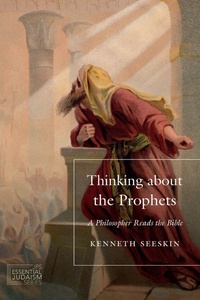
Thinking About the Prophets
A Philosopher Reads the Bible
Published on 1. September 2020
Book
Paperback/Softback
176 pages
978-0-8276-1505-2 (ISBN)
Description
Readers of all levels will find this volume an accessible and provoking introduction to the enduring significance of biblical prophecy.
Rethinking the great literary prophets whose ministry ran from the eighth to the sixth centuries BCE-Amos, Hosea, First Isaiah, Jeremiah, Ezekiel, Second Isaiah, and Job-Thinking about the Prophets examines their often-shocking teachings in light of their times, their influence on later Western and Jewish thinkers, and their enduring lessons for all of us. As a noted scholar of Jewish philosophy, Kenneth Seeskin teases out philosophical, ethical, and theological questions in the writings, such as the nature of moral reasoning, the divine persona, divine providence, the suffering of the innocent, the power of repentance, and what it means to believe in a monotheistic conception of God.
Seeskin demonstrates that great ideas are not limited by time or place, but rather once put forth, take on a life of their own. Thus he interweaves the medieval and modern philosophers Maimonides, Kant, Cohen, Buber, Levinas, Heschel, and Soloveitchik, all of whom read the prophets and had important things to say as a result. We come to see the prophets perhaps in equal measure as divinely authorized whistle-blowers and profound thinkers of the human condition.
Rethinking the great literary prophets whose ministry ran from the eighth to the sixth centuries BCE-Amos, Hosea, First Isaiah, Jeremiah, Ezekiel, Second Isaiah, and Job-Thinking about the Prophets examines their often-shocking teachings in light of their times, their influence on later Western and Jewish thinkers, and their enduring lessons for all of us. As a noted scholar of Jewish philosophy, Kenneth Seeskin teases out philosophical, ethical, and theological questions in the writings, such as the nature of moral reasoning, the divine persona, divine providence, the suffering of the innocent, the power of repentance, and what it means to believe in a monotheistic conception of God.
Seeskin demonstrates that great ideas are not limited by time or place, but rather once put forth, take on a life of their own. Thus he interweaves the medieval and modern philosophers Maimonides, Kant, Cohen, Buber, Levinas, Heschel, and Soloveitchik, all of whom read the prophets and had important things to say as a result. We come to see the prophets perhaps in equal measure as divinely authorized whistle-blowers and profound thinkers of the human condition.
Reviews / Votes
"Erudite and accessible, this insightful analysis will appeal to any reader interested in the Bible, the philosophy of religion, or simply the history and literature of the ancient world."-Publishers Weekly "Thinking about the Prophets is a significant contribution to understanding the institution of Israelite prophecy as fundamentally an ethical project and to understanding the prophets as moral thinkers taking their rightful place in the long history of moral social thinkers in the Jewish and Western philosophical tradition."-Steven P. Kepnes, professor of world religions and of religion and Jewish studies, Colgate University"Seeskin innovatively shows us that the prophets were thinkers too and that their thinking has had an indelible impact on Western understandings of God, the world, and human responsibility. Erudite and accessible as well, this work would be an excellent text in college-level courses on biblical literature or Jewish thought and in adult education settings."-Judith R. Baskin, Philip H. Knight Professor of Humanities Emerita, University of Oregon
More details
Series
Language
English
Place of publication
Philadelphia
United States
Product notice
Paperback (trade)
Dimensions
Height: 226 mm
Width: 157 mm
Thickness: 11 mm
Weight
227 gr
ISBN-13
978-0-8276-1505-2 (9780827615052)
Copyright in bibliographic data and cover images is held by Nielsen Book Services Limited or by the publishers or by their respective licensors: all rights reserved.
Schweitzer Classification
Other editions
Additional editions
E-Book
09/2020
Jewish Publication Society
€34.49
Available for download
E-Book
09/2020
Jewish Publication Society
€20.99
Available for download
Person
Kenneth Seeskin is Philip M. and Ethel Klutznick Professor of Jewish Civilization at Northwestern University. He is the author of several books, including Thinking about the Torah: A Philosopher Reads the Bible (JPS, 2016) and Searching for a Distant God: The Legacy of Maimonides.
Content
Acknowledgments
Preface: Children of Prophets
Introduction: What Is a Prophet?
1. Amos: Moral Idealism
2. Hosea: Divine Pathos
3. First Isaiah, Part 1: War and Peace
4. First Isaiah, Part 2: The Coming of the Messiah
5. Jeremiah: Suffering for the Sake of God
6. Ezekiel: Freedom and Responsibility
7. Second Isaiah: Monotheism Takes Hold
8. Job: Innocent Suffering
Conclusion: The Legacy of the Prophets
Notes
Bibliography
Preface: Children of Prophets
Introduction: What Is a Prophet?
1. Amos: Moral Idealism
2. Hosea: Divine Pathos
3. First Isaiah, Part 1: War and Peace
4. First Isaiah, Part 2: The Coming of the Messiah
5. Jeremiah: Suffering for the Sake of God
6. Ezekiel: Freedom and Responsibility
7. Second Isaiah: Monotheism Takes Hold
8. Job: Innocent Suffering
Conclusion: The Legacy of the Prophets
Notes
Bibliography