

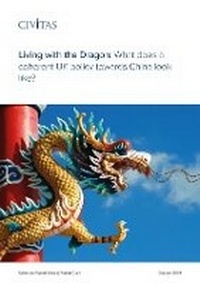
Living with the Dragon
What does a coherent UK policy towards China look like?
Published on 14. October 2024
Book
Hardback
90 pages
978-1-912581-58-0 (ISBN)
Description
China is becoming the most serious challenge to UK and the
West, due to its economic growth, military strength, and fast-developing
foreign policy in relation to its territorial claims and record on human
rights. These developments are as significant a priority for new British Prime
Minister Sir Keir Starmer and his Labour colleagues as they were for their
Conservative predecessors.
Our response to this challenge so far - both in the UK and
more widely across Western democracies - remains piecemeal, disconnected, and
lacking a long-term strategic vision. This essay collection aims to remedy this
failing through a consideration of leading cross-government policies and
recommendations - covering the challenges to our prosperity, trade and
investment, our international approach and human rights record, our national
defences and security framework, through to our universities and emerging technologies
such as genomics.
This essay collection first seeks to lay out clearly what
China's agenda is, in its own words. Critically, it also examines the creation
of a dependency which has ensured that foreign governments cannot adopt
policies inimical to Chinese Communist Party (CCP) interests. Others have
described the CCP is a highly impactful perpetrator of transnational repression
- cross-border interference with the exercise of basic rights - in the UK.
It is argued we should not deflect from the very real
problems with China's human rights record and the challenges these pose to our
relationship. However, we too are the problem. Too often in the West, we seem
to have an intrinsic challenge in our lack of resilience or even of belief in
our civilisational values.
One Labour MP and leading intellectual on the left suggests
in this collection we need a new Office of Economic Statecraft to coordinate
the intelligence, economic models and plans for economic resilience and
security. Another contribution suggests policymakers should also link future
supply chain policies with national security strategies.
The benefits of continued economic engagement are
significant. So too are the risks and dependencies that such engagement can
generate. Crafting policy that furthers all British interests - those of
economics, security, and values - is difficult. New technologies and the
shifting policy choices of our allies and of China call for novel and adaptive
policy responses. We already know more detailed and accurate research
information is required in government examining CCP interference, including the
practices of the United Front Work Department.
In terms of our international partners, further
contributions address whether the UK's American and European allies can align
their priorities and objectives in Eurasia, in which an integrated Eurasian
Rimland coalition could be capable of containing Chinese expansionist
objectives. Others suggest Taiwan's continued exclusion from the world stage
frustrates knowledge exchange and cooperation and helps justify Beijing's
expansionist claims.
It is concluded by the editors that we have some tactics,
but no strategy. Working with friends and allies around the world, the time has
come to develop such a strategy.
West, due to its economic growth, military strength, and fast-developing
foreign policy in relation to its territorial claims and record on human
rights. These developments are as significant a priority for new British Prime
Minister Sir Keir Starmer and his Labour colleagues as they were for their
Conservative predecessors.
Our response to this challenge so far - both in the UK and
more widely across Western democracies - remains piecemeal, disconnected, and
lacking a long-term strategic vision. This essay collection aims to remedy this
failing through a consideration of leading cross-government policies and
recommendations - covering the challenges to our prosperity, trade and
investment, our international approach and human rights record, our national
defences and security framework, through to our universities and emerging technologies
such as genomics.
This essay collection first seeks to lay out clearly what
China's agenda is, in its own words. Critically, it also examines the creation
of a dependency which has ensured that foreign governments cannot adopt
policies inimical to Chinese Communist Party (CCP) interests. Others have
described the CCP is a highly impactful perpetrator of transnational repression
- cross-border interference with the exercise of basic rights - in the UK.
It is argued we should not deflect from the very real
problems with China's human rights record and the challenges these pose to our
relationship. However, we too are the problem. Too often in the West, we seem
to have an intrinsic challenge in our lack of resilience or even of belief in
our civilisational values.
One Labour MP and leading intellectual on the left suggests
in this collection we need a new Office of Economic Statecraft to coordinate
the intelligence, economic models and plans for economic resilience and
security. Another contribution suggests policymakers should also link future
supply chain policies with national security strategies.
The benefits of continued economic engagement are
significant. So too are the risks and dependencies that such engagement can
generate. Crafting policy that furthers all British interests - those of
economics, security, and values - is difficult. New technologies and the
shifting policy choices of our allies and of China call for novel and adaptive
policy responses. We already know more detailed and accurate research
information is required in government examining CCP interference, including the
practices of the United Front Work Department.
In terms of our international partners, further
contributions address whether the UK's American and European allies can align
their priorities and objectives in Eurasia, in which an integrated Eurasian
Rimland coalition could be capable of containing Chinese expansionist
objectives. Others suggest Taiwan's continued exclusion from the world stage
frustrates knowledge exchange and cooperation and helps justify Beijing's
expansionist claims.
It is concluded by the editors that we have some tactics,
but no strategy. Working with friends and allies around the world, the time has
come to develop such a strategy.
More details
Language
English
Place of publication
London
United Kingdom
Dimensions
Height: 297 mm
Width: 210 mm
Thickness: 5 mm
Weight
316 gr
ISBN-13
978-1-912581-58-0 (9781912581580)
Copyright in bibliographic data and cover images is held by Nielsen Book Services Limited or by the publishers or by their respective licensors: all rights reserved.
Schweitzer Classification