

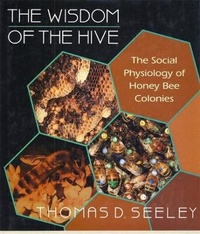
The Wisdom of the Hive
The Social Physiology of Honey Bee Colonies
Published on 15. February 1996
Book
Hardback
318 pages
978-0-674-95376-5 (ISBN)
Description
This book is about the inner workings of one of nature's most complex animal societies: the honey bee colony. It describes and illustrates the results of more than fifteen years of elegant experimental studies conducted by the author. In his investigations, Thomas Seeley has sought the answer to the question of how a colony of bees is organized to gather its resources. The results of his research-including studies of the shaking signal, tremble dance, and waggle dance, and other, more subtle means by which information is exchanged among bees-offer the clearest, most detailed picture available of how a highly integrated animal society works. By showing how several thousand bees function together as an integrated whole to collect the nectar, pollen, and water that sustain the life of the hive, Seeley sheds light on one of the central puzzles of biology: how units at one level of organization can work together to form a higher-level entity.
In explaining why a hive is organized the way it is, Seeley draws on the literature of molecular biology, cell biology, animal and human sociology, economics, and operations research. He compares the honey bee colony to other functionally organized groups: multicellular organisms, colonies of marine invertebrates, and human societies. All highly cooperative groups share basic problems: of allocating their members among tasks so that more urgent needs are met before less urgent ones, and of coordinating individual actions into a coherent whole. By comparing such systems in different species, Seeley argues, we can deepen our understanding of the mechanisms that make close cooperation a reality.
In explaining why a hive is organized the way it is, Seeley draws on the literature of molecular biology, cell biology, animal and human sociology, economics, and operations research. He compares the honey bee colony to other functionally organized groups: multicellular organisms, colonies of marine invertebrates, and human societies. All highly cooperative groups share basic problems: of allocating their members among tasks so that more urgent needs are met before less urgent ones, and of coordinating individual actions into a coherent whole. By comparing such systems in different species, Seeley argues, we can deepen our understanding of the mechanisms that make close cooperation a reality.
Reviews / Votes
Seeley's well-developed cycle of observation and experiment, modelling, computer simulation and prediction formulation shows an exemplary approach to sociobiology... The book is clearly a labour of love, recounting marvels of integration and making for a pleasing contrast to the spreading orthodoxy of the social insect colony as a cauldron of conflict, where insects stepping out of line are punished or have their eggs eaten. -- Ross H. Crozier * Nature * I recommend this book highly to behavioral biologists and all scientists interested in understanding the organization of complex systems, at both the macro- and microscopic levels... [An] important book... It is a labor of love that radiates Seeley's passion both for his beloved honey bees and for the research that can be performed with them to illuminate the mysteries of social life. -- Gene E. Robinson * American Scientist * This book is about the inner workings of one of nature's most complex animal societies: the honey bee colony. It describes and illustrates the results of more than fifteen years of elegant experimental studies conducted by the author. In his investigations, Thomas Seeley has sought the answer to the question of how a colony of bees is organized to gather its resources. The results of his research-including studies of the shaking signal, tremble dance, and waggle dance, and other, more subtle means by which information is exchanged among bees-offer the clearest, most detailed picture available of how a highly integrated animal society works. * American Bee Journal * [A] well-written book...contain[ing] a wealth of detail. * Apicultural Abstracts * They say good scientists are judged not by their answers but by their questions. By this measure Tom Seeley must be amongst the great bee scientists. He has asked the questions whose answers illustrate the great wisdom of the hive... Space here does not allow me to pay proper justice to this marvellous book. Most beekeepers already think their bees are pretty smart-this book will only increase your admiration. A good value textbook and essential reading for all who dare to lecture on honeybee biology. * Beekeeping & Development [UK] * A terrific contribution that will build on the work of Martin Lindauer and Karl von Frisch. Seeley stands on their shoulders, but he is seeing new vistas. Others have asked what bees know, but Seeley explores new ground, asking how bees handle information and how this leads to reallocation of labor in the hive. -- Timothy H. Goldsmith, Yale UniversityMore details
Language
English
Place of publication
Cambridge, Mass
United States
Target group
Professional and scholarly
US School Grade: College Graduate Student
Illustrations
6 color illustrations, 20 halftones, 116 line illustrations, 7 tables
Dimensions
Height: 241 mm
Width: 214 mm
Thickness: 28 mm
Weight
910 gr
ISBN-13
978-0-674-95376-5 (9780674953765)
Copyright in bibliographic data and cover images is held by Nielsen Book Services Limited or by the publishers or by their respective licensors: all rights reserved.
Schweitzer Classification
Other editions
Additional editions
E-Book
07/2009
Harvard University Press
€309.99
Available for download
Person
Thomas D. Seeley is Professor of Biology, Cornell University.
Content
PART I. INTRODUCTION 1. The Issues 1.1. The Evolution of Biological Organization 1.2. The Honey Bee Colony as a Unit of Function 1.3. Analytic Scheme 2. The Honey Bee Colony 2.1. Worker Anatomy and Physiology 2.2. Worker Life History 2.3. Nest Architecture 2.4. The Annual Cycle of a Colony 2.5. Communication about Food Sources 2.6. Food Collection and Honey Production 3. The Foraging Abilities of a Colony 3.1. Exploiting Food Sources over a Vast Region around the Hive 3.2. Surveying the Countryside for Rich Food Sources 3.3. Responding Quickly to Valuable Discoveries 3.4. Choosing among Food Sources 3.5. Adjusting Selectivity in Relation to Forage Abundance 3.6. Regulating Comb Construction 3.7. Regulating Pollen Collection 3.8. Regulating Water Collection Summary PART II. EXPERIMENTAL ANALYSIS 4. Methods and Equipment 4.1. The Observation Hive 4.2. The Hut for the Observation Hive 4.3. The Bees 4.4. Sugar Water Feeders 4.5. Labeling Bees 4.6. Measuring the Total Number of Bees Visiting a Feeder 4.7. Observing Bees of Known Age 4.8. Recording the Behavior of Bees in the Hive 4.9. The Scale Hive 4.10. Censusing a Colony 5. Allocation of Labor among Forage Sites How a Colony Acquires Information about Food Sources 5.1. Which Bees Gather the Information? 5.2. Which Information Is Shared? 5.3. Where Information Is Shared inside the Hive 5.4. The Coding of Information about Profitability 5.5. The Bees' Criterion of Profitability 5.6. The Relationship between Nectar-Source 5.7. The Adaptive Tuning of Dance Thresholds 5.8. How a Forager Determines the Profitability of a Nectar Source Summary How a Colony Acts on Information about Food Sources 5.9. Employed Foragers versus Unemployed Foragers 5.10. How Unemployed Foragers Read the Information on the Dance Floor? 5.11.