

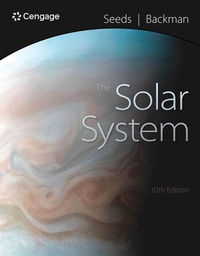
The Solar System
10th Edition
Will be published approx. on 1. January 2018
Book
Paperback/Softback
464 pages
978-1-337-39993-7 (ISBN)
Description
Fascinating, engaging and extremely visual,THE SOLAR SYSTEM, 10th Edition, is renowned for its current coverage, reader-friendly presentation and detailed--yet clear--explanations. The authors' goals are to help you use Astronomy to understand science, and use science to answer two fundamental questions: What are we? And how do we know? Available with WebAssign, the powerful digital solution that enriches the teaching and learning experience. It includes Virtual Astronomy Labs 3.0--a set of 20 interactive activities that combine analysis of real astronomical data with robust simulations--providing a true online laboratory experience for your Introductory Astronomy course.
More details
Edition
10th edition
Language
English
Place of publication
CA
United States
Publishing group
Cengage Learning, Inc
Target group
College/higher education
Product notice
Paperback (trade)
Unsewn / adhesive bound
Dimensions
Height: 231 mm
Width: 275 mm
Thickness: 13 mm
Weight
1043 gr
ISBN-13
978-1-337-39993-7 (9781337399937)
Copyright in bibliographic data and cover images is held by Nielsen Book Services Limited or by the publishers or by their respective licensors: all rights reserved.
Schweitzer Classification
Other editions
New editions
Michael Seeds | Dana Backman | Eric Wegryn
The Solar System
Book
05/2025
15th Edition
Brooks/Cole
€93.00
Shipment within 10-20 days
Person
Mike Seeds was a professor of physics and astronomy at Franklin and Marshall College (F&M) in Lancaster, Pennsylvania, from 1970 until his retirement in 2001. In 1989 he received F&M College's Lindback Award for Distinguished Teaching. Mike's love for the history of astronomy led him to create upper-level courses on archeoastronomy and on the Copernican Revolution ("Changing Concepts of the Universe"). His research interests focused on variable stars and automation of astronomical telescopes. Mike is coauthor with Dana Backman of FOUNDATIONS OF ASTRONOMY, 14th Edition (2019); STARS AND GALXIES, 10th Edition (2019); THE SOLAR SYSTEM, 10th Edition (2019); and ASTRO, 3rd Edition (2018), all published by Cengage. He was senior consultant for creation of the 20-episode telecourse accompanying his book HORIZONS: EXPLORING THE UNIVERSE. Mike Seeds was a professor of physics and astronomy at Franklin and Marshall College (F&M) in Lancaster, Pennsylvania, from 1970 until his retirement in 2001. In 1989 he received F&M College's Lindback Award for Distinguished Teaching. Mike's love for the history of astronomy led him to create upper-level courses on archeoastronomy and on the Copernican Revolution ("Changing Concepts of the Universe"). His research interests focused on variable stars and automation of astronomical telescopes. Mike is coauthor with Dana Backman of FOUNDATIONS OF ASTRONOMY, 14th Edition (2019); STARS AND GALXIES, 10th Edition (2019); THE SOLAR SYSTEM, 10th Edition (2019); and ASTRO, 3rd Edition (2018), all published by Cengage. He was senior consultant for creation of the 20-episode telecourse accompanying his book HORIZONS: EXPLORING THE UNIVERSE.
Content
PART I: THE SKY.
1. Here and Now.
2. A User's Guide to the Sky.
3. Moon Phases and Eclipses.
4. Origins of Modern Astronomy.
5. Gravity.
6. Light and Telescopes.
PART II: THE STARS.
7. Atoms and Spectra.
8. The Sun.
9. Origins of Stars, Galaxies, and the Universe.
PART III: THE SOLAR SYSTEM.
10. Origin of the Solar System and Extrasolar Planets.
11. Earth: The Active Planet.
12. The Moon and Mercury: Comparing Airless Worlds.
13. Venus and Mars.
14. Jupiter and Saturn.
15. Uranus, Neptune, Pluto, and the Kuiper Belt.
16. Meteorites, Asteroids, and Comets.
PART IV: LIFE.
17. Astrobiology: Life on Other Worlds.
1. Here and Now.
2. A User's Guide to the Sky.
3. Moon Phases and Eclipses.
4. Origins of Modern Astronomy.
5. Gravity.
6. Light and Telescopes.
PART II: THE STARS.
7. Atoms and Spectra.
8. The Sun.
9. Origins of Stars, Galaxies, and the Universe.
PART III: THE SOLAR SYSTEM.
10. Origin of the Solar System and Extrasolar Planets.
11. Earth: The Active Planet.
12. The Moon and Mercury: Comparing Airless Worlds.
13. Venus and Mars.
14. Jupiter and Saturn.
15. Uranus, Neptune, Pluto, and the Kuiper Belt.
16. Meteorites, Asteroids, and Comets.
PART IV: LIFE.
17. Astrobiology: Life on Other Worlds.