

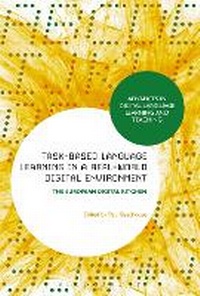
Task-Based Language Learning in a Real-World Digital Environment
The European Digital Kitchen
Published on 23. August 2018
Book
Paperback/Softback
304 pages
978-1-350-08212-0 (ISBN)
Description
How can you use the latest digital technology to create an environment in which people can learn European languages while performing a meaningful real-world task and experiencing the cultural aspect of learning to cook European dishes? This book explains how to do this from A to Z, covering how a real-world digital environment for language learning was designed, built and researched.
The project makes language learning motivational and fun by tapping into people's interest in both cooking and technology - you can learn a language while cooking and interacting with a speaking digital kitchen. The kitchens provide spoken instructions in the foreign language on how to prepare European cuisine. Digital sensors are inserted in or attached to all the kitchen equipment and ingredients, so the digital kitchen detects what learners are doing and gives them feedback. Learners are also able to communicate with the kitchens and can ask for help via photos and videos if they don't understand any foreign language words.
Based on two research grants, the book provides five research studies showing the learning experiences of users in five European countries. The book explains the principles and procedures involved in the project, enabling others to design and implement a real-world digital learning environment in the same way. It includes numerous photographs of the system in use and evidence of how and what 250 users actually learnt.
The project makes language learning motivational and fun by tapping into people's interest in both cooking and technology - you can learn a language while cooking and interacting with a speaking digital kitchen. The kitchens provide spoken instructions in the foreign language on how to prepare European cuisine. Digital sensors are inserted in or attached to all the kitchen equipment and ingredients, so the digital kitchen detects what learners are doing and gives them feedback. Learners are also able to communicate with the kitchens and can ask for help via photos and videos if they don't understand any foreign language words.
Based on two research grants, the book provides five research studies showing the learning experiences of users in five European countries. The book explains the principles and procedures involved in the project, enabling others to design and implement a real-world digital learning environment in the same way. It includes numerous photographs of the system in use and evidence of how and what 250 users actually learnt.
Reviews / Votes
This volume offers a fascinating example of the meaningful introduction of technology into the language classroom to provide contextualized, real-world scenarios that, while being authentic, allow a team of two students to socially create a language experience together ... A worthy addition to language learning with technology, and a valuable resource for those who want to create a similar project. * CALICO Journal * Overall, the volume represents a valuable addition to project- and task-based research scholarship in digital settings ... Due to its innovative design and careful implementation research agenda, the volume offers insightful ideas and perspectives to those interested in using real spaces to afford foreign language learning. * LINGUIST List * The book presents a convincing argument for the digital kitchen concept and its expansion into new areas of study. * International Journal of Computer-Assisted Language Learning and Teaching * The European Digital Kitchen Project manages to bring pervasive computing practices into the realm of language learning by integrating the everyday task of cooking (with real-world equipment) with language and culture learning through tasks.The chapters in the book not only build a mosaic that helps understand how people engage in a digital sensory environment, they demonstrate that experiential learning in a digital environment provides opportunities for language learning (mainly for lexical items).
The project and this book open an exciting research venue into digital sensor technology and how it can be applied for cultural and language learning beyond lexical development and into different environments. -- Marta Gonzalez-Lloret, Professor and Chair of Spanish & LAIS, University of Hawaii, USA This edited volume provides an innovative take on language and culture learning with technology in a unique context, the digital kitchen. It merges theories and concepts in human computer interaction, computer-assisted language learning, and task-based language teaching in the European digital kitchen to examine how ubiquitous and ambient technology, such as that found in our homes, can support language and culture learning through the cooking of national dishes. -- Shannon Sauro, Associate Professor in the Department of Culture, Languages and Media, Malmoe University, Sweden. An enjoyable initial interrogation. * BAAL Newsletter * A wonderful book that paints a bright future for how CALL and TBL can be combined in highly innovative ways. * CALL-EJ *
More details
Series
Language
English
Place of publication
London
United Kingdom
Publishing group
Bloomsbury Publishing PLC
Target group
College/higher education
Dimensions
Height: 234 mm
Width: 156 mm
Weight
431 gr
ISBN-13
978-1-350-08212-0 (9781350082120)
Copyright in bibliographic data and cover images is held by Nielsen Book Services Limited or by the publishers or by their respective licensors: all rights reserved.
Schweitzer Classification
Other editions
Additional editions
Paul Seedhouse
Task-Based Language Learning in a Real-World Digital Environment
The European Digital Kitchen
E-Book
02/2017
1st Edition
Bloomsbury Academic
€39.99
Available for download
Paul Seedhouse
Task-Based Language Learning in a Real-World Digital Environment
The European Digital Kitchen
E-Book
02/2017
1st Edition
Bloomsbury Academic
€39.99
Available for download
Person
Paul Seedhouse is Professor of Educational and Applied Linguistics and School Research Director in the School of Education, Communication and Language Sciences, Newcastle University, UK. His monograph "The Interactional Architecture of the Language Classroom" (2004) won the Modern Languages Association of America Mildenberger Prize.
Content
List of Illustrations
Notes on Contributors
Acknowledgements
Transcription Conventions
PART I: BACKGROUND
1. Introduction, Paul Seedhouse (Newcastle University, UK)
2. Locating the European Digital Kitchen in its research context, Sandra Morales Rios (Newcastle University, UK)
PART II: DESIGN
3. The Pedagogical Design of the Digital Kitchen, Paul Seedhouse (Newcastle University, UK)
4. The Technology behind the Digital Kitchen for Language Learning, Paul Seedhouse (Newcastle University, UK)
5. The Human Viewpoint and the System's Viewpoint, Gabriele Pallotti and Natacha Niemants. (University of Reggio Emilia, Italy)
PART III: IMPLEMENTATION
6. Assessing and promoting language development in an interactive learning environment, Jana Roos, Nina Reshoeft, Lea Hartung and Johanna Busswinkel (Paderborn University, Germany)
7. Cooking, Interaction and Learning: the Finnish Digital Kitchen as a Language Learning Environment, Salla Kurhila and Lari Kotilainen (University of Helsinki, Finland)
8. "The more I cook, the more I learn": Tracing Ava's Learning Itinerary through her Participation in Four Cooking Sessions, Dolors Masats, Marta Juanhuix and Javier Albines (Universtat Autonoma de Barcelona, Spain)
9. Vocabulary Learning in a Real-World Digital Environment, Gabriele Pallotti, Natacha Niemants (University of Modena and Reggio Emilia, Italy) and Paul Seedhouse (Newcastle University, UK)
10. Sight and Touch in Vocabulary Learning: The Korean Digital Kitchen, Jaeuk Park and Paul Seedhouse (Newcastle University, UK)
PART IV: CONCLUSIONS
11. Conclusions and Future Developments, Paul Seedhouse (Newcastle University, UK)
Index
Notes on Contributors
Acknowledgements
Transcription Conventions
PART I: BACKGROUND
1. Introduction, Paul Seedhouse (Newcastle University, UK)
2. Locating the European Digital Kitchen in its research context, Sandra Morales Rios (Newcastle University, UK)
PART II: DESIGN
3. The Pedagogical Design of the Digital Kitchen, Paul Seedhouse (Newcastle University, UK)
4. The Technology behind the Digital Kitchen for Language Learning, Paul Seedhouse (Newcastle University, UK)
5. The Human Viewpoint and the System's Viewpoint, Gabriele Pallotti and Natacha Niemants. (University of Reggio Emilia, Italy)
PART III: IMPLEMENTATION
6. Assessing and promoting language development in an interactive learning environment, Jana Roos, Nina Reshoeft, Lea Hartung and Johanna Busswinkel (Paderborn University, Germany)
7. Cooking, Interaction and Learning: the Finnish Digital Kitchen as a Language Learning Environment, Salla Kurhila and Lari Kotilainen (University of Helsinki, Finland)
8. "The more I cook, the more I learn": Tracing Ava's Learning Itinerary through her Participation in Four Cooking Sessions, Dolors Masats, Marta Juanhuix and Javier Albines (Universtat Autonoma de Barcelona, Spain)
9. Vocabulary Learning in a Real-World Digital Environment, Gabriele Pallotti, Natacha Niemants (University of Modena and Reggio Emilia, Italy) and Paul Seedhouse (Newcastle University, UK)
10. Sight and Touch in Vocabulary Learning: The Korean Digital Kitchen, Jaeuk Park and Paul Seedhouse (Newcastle University, UK)
PART IV: CONCLUSIONS
11. Conclusions and Future Developments, Paul Seedhouse (Newcastle University, UK)
Index