

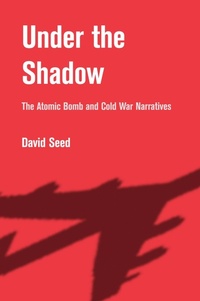
Under the Shadow
The Atomic Bomb and Cold War Narratives
Will be published approx. on 30. November 2012
Book
Hardback
384 pages
978-1-60635-146-8 (ISBN)
Description
In Pat Frank's 1959 novel Alas, Babylon, the character Helen says of her children: "All their lives, ever since they've known anything, they've lived under the shadow of war-atomic war. For them the abnormal has become normal." The threat of nuclear annihilation was a constant source of dread during the Cold War, and in Under the Shadow, author David Seed examines how authors and filmmakers made repeated efforts in their work to imagine the unimaginable.
Seed discusses classics of the period like Nevil Shute's On the Beach, but he also argues for recognition of less-known works such as Walter M. Miller's depiction of historical cycles in A Canticle for Leibowitz, Bernard Wolfe's black comedy of aggression in Limbo, or Mordecai Roshwald's satirical depiction of technology running out of human control in Level 7. Seed relates these literary works to their historical contexts and to their adaptations in film. Two prime examples of this interaction between media are the motion pictures Fail-Safeand Dr. Strangelove, which dramatise the threat posed by the arms race to rationality and ultimate human survival.
Seed addresses the attempts made by characters to remap America as a central part of their efforts to understand the horrors of the war. A particular subset of future histories is also examined: accounts of a Third World War, which draw on the conventions of military history and reportage to depict probable war scenarios. Under the Shadow concludes with a discussion of the recent fiction of nuclear terrorism.
Seed discusses classics of the period like Nevil Shute's On the Beach, but he also argues for recognition of less-known works such as Walter M. Miller's depiction of historical cycles in A Canticle for Leibowitz, Bernard Wolfe's black comedy of aggression in Limbo, or Mordecai Roshwald's satirical depiction of technology running out of human control in Level 7. Seed relates these literary works to their historical contexts and to their adaptations in film. Two prime examples of this interaction between media are the motion pictures Fail-Safeand Dr. Strangelove, which dramatise the threat posed by the arms race to rationality and ultimate human survival.
Seed addresses the attempts made by characters to remap America as a central part of their efforts to understand the horrors of the war. A particular subset of future histories is also examined: accounts of a Third World War, which draw on the conventions of military history and reportage to depict probable war scenarios. Under the Shadow concludes with a discussion of the recent fiction of nuclear terrorism.
More details
Language
English
Place of publication
Kent, OH
United States
Target group
Professional and scholarly
Product notice
sewn/stitched
Cloth over boards
With dust jacket
Dimensions
Height: 243 mm
Width: 165 mm
Thickness: 26 mm
Weight
653 gr
ISBN-13
978-1-60635-146-8 (9781606351468)
Copyright in bibliographic data and cover images is held by Nielsen Book Services Limited or by the publishers or by their respective licensors: all rights reserved.
Schweitzer Classification
Other editions
Additional editions
E-Book
02/2013
Kent State University Press
€40.99
Available for download
E-Book
02/2013
Kent State University Press
€40.99
Available for download
Person
David Seed holds a chair in American Literature at Liverpool University, UK. In addition to books on Thomas Pynchon, Joseph Heller, and others, he has written American Science Fiction and the Cold War, a precursor to the present study, Brainwashing: The Fictions of Mind Control (The Kent State University Press, 2004), and edited the Blackwell Companion to Twentieth-Century United States Fiction. He also edits the Science Fiction Texts and Studies series for Liverpool University Press.