

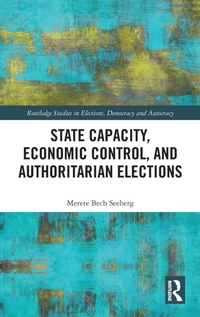
State Capacity, Economic Control, and Authoritarian Elections
1st Edition
Published on 13. March 2018
Book
Hardback
192 pages
978-1-138-20269-6 (ISBN)
Description
Although the phenomenon of authoritarian elections has been a focal point for the literature on authoritarian institutions for more than a decade, our understanding of the effect of authoritarian elections is still limited.
Combining evidence from cross-national studies with studies on selected cases relying on recent field work, this book suggests a solution to the "paradox of authoritarian elections". Rather than focusing on authoritarian elections as a uniform phenomenon, it focuses on the differing conditions under which authoritarian elections occur. It demonstrates that the capacities available to authoritarian rulers shape the effect of elections and high levels of state capacity and control over the economy increase the probability that authoritarian multi-party elections will stabilize the regime. Where these capacities are limited, the regime is more likely to succumb in the face of elections. The findings imply that although multi-party competition and state strength may be important prerequisites for democracy, they can under some circumstances obstruct democratization by preventing the demise of dictatorships.
This text will be of key interest to scholars, students and practitioners of democratization, and to those who study autocracy and electoral authoritarianism, as well as comparative politics more broadly.
Combining evidence from cross-national studies with studies on selected cases relying on recent field work, this book suggests a solution to the "paradox of authoritarian elections". Rather than focusing on authoritarian elections as a uniform phenomenon, it focuses on the differing conditions under which authoritarian elections occur. It demonstrates that the capacities available to authoritarian rulers shape the effect of elections and high levels of state capacity and control over the economy increase the probability that authoritarian multi-party elections will stabilize the regime. Where these capacities are limited, the regime is more likely to succumb in the face of elections. The findings imply that although multi-party competition and state strength may be important prerequisites for democracy, they can under some circumstances obstruct democratization by preventing the demise of dictatorships.
This text will be of key interest to scholars, students and practitioners of democratization, and to those who study autocracy and electoral authoritarianism, as well as comparative politics more broadly.
More details
Series
Language
English
Place of publication
London
United Kingdom
Publishing group
Taylor & Francis Ltd
Target group
College/higher education
Illustrations
20 s/w Abbildungen, 20 s/w Zeichnungen, 24 s/w Tabellen
24 Tables, black and white; 20 Line drawings, black and white; 20 Illustrations, black and white
Dimensions
Height: 240 mm
Width: 161 mm
Thickness: 16 mm
Weight
482 gr
ISBN-13
978-1-138-20269-6 (9781138202696)
Copyright in bibliographic data and cover images is held by Nielsen Book Services Limited or by the publishers or by their respective licensors: all rights reserved.
Schweitzer Classification
Other editions
Additional editions
Book
08/2020
1st Edition
Routledge
€65.10
Shipment within 15-20 days
E-Book
03/2018
1st Edition
Routledge
€59.49
Available for download
E-Book
03/2018
Routledge
€59.49
Available for download
Person
Merete Bech Seeberg is Assitant Professor at Aarhus University, Denmark.
Content
1. The Puzzle of Authoritarian Elections 2. Authoritarian Capacities and Regime Stabilization through Elections 3. State Capacity and the Effect of Elections in Authoritarian Regimes 4. Economic Control and the Effect of Elections in Authoritarian Regimes 5. State Capacity, Economic Control, and Two Divergent Elections in Malaysia and the Philippines 6. Electoral Ups and Downs, State Capacity and Economic Control in Zimbabwe 7. Conclusion: Authoritarian Elections, Capacities, and Regime Stability