

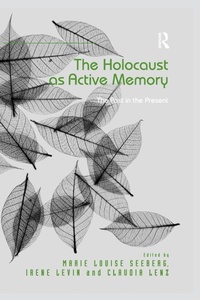
The Holocaust as Active Memory
The Past in the Present
1st Edition
Published on 30. June 2020
Book
Paperback/Softback
224 pages
978-0-367-60162-1 (ISBN)
Description
The ways in which memories of the Holocaust have been communicated, represented and used have changed dramatically over the years. From such memories being neglected and silenced in most of Europe until the 1970s, each country has subsequently gone through a process of cultural, political and pedagogical awareness-rising. This culminated in the 'Stockholm conference on Holocaust commemoration' in 2000, which resulted in the constitution of a task force dedicated to transmitting and teaching knowledge and awareness about the Holocaust on a global scale. The silence surrounding private memories of the Holocaust has also been challenged in many families. What are the catalysts that trigger a change from silence to discussion of the Holocaust? What happens when we talk its invisibility away? How are memories of the Holocaust reflected in different social environments? Who asks questions about memories of the Holocaust, and which answers do they find, at which point in time and from which past and present positions related to their societies and to the phenomenon in question? This book highlights the contexts in which such questions are asked. By introducing the concept of 'active memory', this book contributes to recent developments in memory studies, where memory is increasingly viewed not in isolation but as a dynamic and relational part of human lives.
Reviews / Votes
'This important and thought-provoking book addresses both personal and structural aspects of memory and history. It highlights how memories rendered or silences maintained about the Holocaust have both personal and public significance across national contexts. Drawing on biographical interviews and texts it also makes important contributions to methods discussions.' - Ann Nilsen, University of Bergen, Norway 'This important and thought-provoking book addresses both personal and structural aspects of memory and history. It highlights how memories rendered or silences maintained about the Holocaust have both personal and public significance across national contexts. Drawing on biographical interviews and texts it also makes important contributions to methods discussions.' - Ann Nilsen, University of Bergen, NorwayMore details
Language
English
Place of publication
London
United Kingdom
Publishing group
Taylor & Francis Ltd
Target group
College/higher education
Dimensions
Height: 234 mm
Width: 156 mm
Weight
410 gr
ISBN-13
978-0-367-60162-1 (9780367601621)
Copyright in bibliographic data and cover images is held by Nielsen Book Services Limited or by the publishers or by their respective licensors: all rights reserved.
Schweitzer Classification
Other editions
Additional editions
Marie Louise Seeberg | Irene Levin | Claudia Lenz
The Holocaust as Active Memory
The Past in the Present
E-Book
03/2016
Routledge
€58.99
Available for download
Marie Louise Seeberg | Irene Levin | Claudia Lenz
The Holocaust as Active Memory
The Past in the Present
E-Book
03/2016
Routledge
€59.49
Available for download
Marie Louise Seeberg | Irene Levin | Claudia Lenz
The Holocaust as Active Memory
The Past in the Present
Book
05/2013
1st Edition
Routledge
€217.50
Shipment within 10-20 days
Persons
Marie Louise Seeberg is Senior Researcher at NOVA (Norwegian Social Research), Norway.
Irene Levin is Professor of Social Work at the Graduate School for Social Work and Social Research at Oslo and Akershus University College, Norway.
Claudia Lenz is Research & Development Coordinator at the European Wergeland Centre for Education on Human Intercultural Understanding, Human Rights and Democratic Citizenship, Norway.
Irene Levin is Professor of Social Work at the Graduate School for Social Work and Social Research at Oslo and Akershus University College, Norway.
Claudia Lenz is Research & Development Coordinator at the European Wergeland Centre for Education on Human Intercultural Understanding, Human Rights and Democratic Citizenship, Norway.
Content
Introduction: The Holocaust as active memory 1. Linking religion and family memories of children hidden in Belgian convents during the Holocaust 2. Collective trajectory and generational work in families of Jewish displaced persons: Epistemological processes in the research situation 3. In a double voice: Representations of the Holocaust in Polish literature, 1980-2011 4. Winners once a year? How Russian-speaking Jews in Germany make sense of WWII and the Holocaust as part of transnational biographic experience 5. Women's peace activism and the Holocaust: Reversing the hegemonic Holocaust discourse in Israel 6. 'The history, the papers, let me see it!' Compensation processes: The second generation between archive truth and family speculations 7. From rescue to escape in 1943: On a path to de-victimizing the Danish Jews 8. Finland, the Vernichtungskrieg and the Holocaust 9. Swedish rescue operations during the Second World War: Accomplishments and aftermath 10. The social phenomenon of silence