

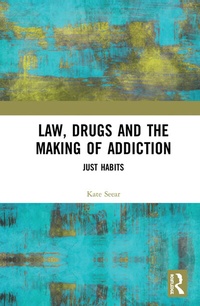
Law, Drugs and the Making of Addiction
Just Habits
1st Edition
Published on 27. June 2019
Book
Hardback
182 pages
978-1-138-32463-3 (ISBN)
Description
This book considers how largely accepted 'legal truths' about drugs and addiction are made and sustained through practices of lawyering.
Lawyers play a vital and largely underappreciated role in constituting legal certainties about substances and 'addiction', including links between alcohol and other drugs, and phenomena such as family violence. Such practices exacerbate, sustain and stabilise 'addicted' realities, with a range of implications - many of them seemingly unjust - for people who use alcohol and other drugs. This book explores these issues, drawing upon data collected for a major international study on alcohol and other drugs in the law, including interviews with lawyers, magistrates and judges; analyses of case law; and legislation. Focussing on an array of legal practices, including processes of law-making, human rights deliberations, advocacy and negotiation strategies, and the sentencing of offenders, and buttressed by overarching analyses of the ethics and politics of such practices, the book looks at how alcohol and other drug 'addiction' emerges and is concretised through the everyday work lawyers and decision makers do. Foregrounding 'practices', the book also shows that law is more fragile than we might assume. It concludes by presenting a blueprint for how lawyers can rethink their advocacy practices in light of this fragility and the opportunities it presents for remaking law and the subjects and objects shaped by it.
This ground-breaking book will be of interest not only to those studying and working within the field of alcohol and drug addiction but also to lawyers and judges practising in this area and to scholars in a range of disciplines, including law, science and technology studies, sociology, gender studies and cultural studies
Lawyers play a vital and largely underappreciated role in constituting legal certainties about substances and 'addiction', including links between alcohol and other drugs, and phenomena such as family violence. Such practices exacerbate, sustain and stabilise 'addicted' realities, with a range of implications - many of them seemingly unjust - for people who use alcohol and other drugs. This book explores these issues, drawing upon data collected for a major international study on alcohol and other drugs in the law, including interviews with lawyers, magistrates and judges; analyses of case law; and legislation. Focussing on an array of legal practices, including processes of law-making, human rights deliberations, advocacy and negotiation strategies, and the sentencing of offenders, and buttressed by overarching analyses of the ethics and politics of such practices, the book looks at how alcohol and other drug 'addiction' emerges and is concretised through the everyday work lawyers and decision makers do. Foregrounding 'practices', the book also shows that law is more fragile than we might assume. It concludes by presenting a blueprint for how lawyers can rethink their advocacy practices in light of this fragility and the opportunities it presents for remaking law and the subjects and objects shaped by it.
This ground-breaking book will be of interest not only to those studying and working within the field of alcohol and drug addiction but also to lawyers and judges practising in this area and to scholars in a range of disciplines, including law, science and technology studies, sociology, gender studies and cultural studies
More details
Language
English
Place of publication
London
United Kingdom
Publishing group
Taylor & Francis Ltd
Target group
College/higher education
Dimensions
Height: 234 mm
Width: 156 mm
Weight
540 gr
ISBN-13
978-1-138-32463-3 (9781138324633)
Copyright in bibliographic data and cover images is held by Nielsen Book Services Limited or by the publishers or by their respective licensors: all rights reserved.
Schweitzer Classification
Other editions
Additional editions
Book
03/2021
1st Edition
Routledge
€54.80
Shipment within 15-20 days
E-Book
06/2019
1st Edition
Routledge
€48.49
Available for download
E-Book
06/2019
1st Edition
Routledge
€48.49
Available for download
Person
Kate Seear is an Associate Professor in Law at Monash University, Australia. She is an Australian Research Council Discovery Early Career Researcher Award (DECRA) Fellow (2016-2019), the Academic Director of the Springvale Monash Legal Service, an Adjunct Research Fellow in the Social Studies of Addiction Concepts research programme at the National Drug Research Institute in the Faculty of Health Sciences at Curtin University and a practising lawyer. She is the author of Making Disease, Making Citizens: The Politics of Hepatitis C (with Suzanne Fraser) and The Makings of a Modern Epidemic: Endometriosis, Gender and Politics, and co-editor of the collection Critical Perspectives on Coercive Interventions: Law, Medicine and Society (with Claire Spivakovsky and Adrian Carter).
Content
Table of contents
Acknowledgments
Introduction: Slowing down. Peering in.
Legislative practices: On Human Rights, Jurimorphs and the Fragile Ontology of Law
Advocacy practices: On Legal Strategies, Habits and the Action of Anticipation
Negotiation practices: On Addiction Veridiction and the Gendering of Agency in Family Violence and Child Protection Cases
Sentencing practices: On Assembling 'Alcohol Effects' and the 'Aboriginal Community' in Criminal Law
Ethical practices: On Rules, Values and Ethics as a 'Matter of Concern'
Conclusion: Making Just Habits. A Blueprint for Onto-advocacy
Index
Acknowledgments
Introduction: Slowing down. Peering in.
Legislative practices: On Human Rights, Jurimorphs and the Fragile Ontology of Law
Advocacy practices: On Legal Strategies, Habits and the Action of Anticipation
Negotiation practices: On Addiction Veridiction and the Gendering of Agency in Family Violence and Child Protection Cases
Sentencing practices: On Assembling 'Alcohol Effects' and the 'Aboriginal Community' in Criminal Law
Ethical practices: On Rules, Values and Ethics as a 'Matter of Concern'
Conclusion: Making Just Habits. A Blueprint for Onto-advocacy
Index