

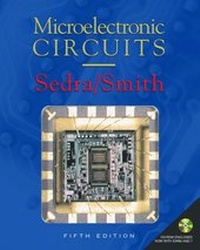
Microelectronic Circuits
5th Edition
Published in February 2004
Book
Hardback
1360 pages
978-0-19-514251-8 (ISBN)
Description
The fifth edition of "Microelectronic Circuits" provides a framework to develop the student's ability to analyze and design all kinds of electronic circuits. Thoroughly updated and revised, this edition features changes that are evident from the condensed table of contents, and a great deal more that are included in the actual chapters. All the revisions, organization, and topical coverage reflect changes in technology - CMOS technology in particular - by far the most significant development in the world of mainstream electrical engineering. With evenly balanced, streamlined organizational structure - in each chapter, the "must-cover" topics are placed first and the more specialized material appears last. In the first five chapters, Part I, are organized to form a coherent single-semester introductory course in electronics. Similarly, the next five chapters, Part II, present a body of material suitable for a second one-semester course.
The final four chapters, Part III, contain significant topics that can be used as enhancements or substitutes for some of the material in earlier chapters, as well as resources for project or thesis work; both the MOSFET and BJT chapters have been rewritten and updated, and remain independent of each other. The MOSFET coverage is placed first, but the two devices can be covered in any desired order; many more MOS circuit examples, which use numbers that reflect current technology, are provided throughout; chapters 6 and 7 have been completely rewritten to introduce ICMOS and bipolar amplifiers in an accessible, systematic way. In addition, frequency response is now covered where necessary (a "just-in-time" approach) rather than being deferred until much later. This includes brief coverage of the frequency responses of the common source and common emitter amplifiers in Chapters 4 and 5, respectively.
Student learning support is enhanced by: revising summary sections and including many more summary tables; increasing the number and variety of review exercises and end-of-chapter problems; adding more PSpice[registered] examples and problems with schematic captures; a new in-text student CD, including - free student versions of PSpice[registered] and "Electronics Workbench Multisim[registered] Textbook" edition (SPICE Simulator), new industry-based design examples, and data sheets from major industrial firms. Instructor support is enhanced by: improved organization, making it easy to select material to suit a variety of course orientations; a comprehensive typed Solutions Manual, including detailed answers to all problems in the text and overhead masters; a new CD and web site with PowerPoint[registered] slides and Lecture Outlines; and additional forthcoming ancillaries.
The final four chapters, Part III, contain significant topics that can be used as enhancements or substitutes for some of the material in earlier chapters, as well as resources for project or thesis work; both the MOSFET and BJT chapters have been rewritten and updated, and remain independent of each other. The MOSFET coverage is placed first, but the two devices can be covered in any desired order; many more MOS circuit examples, which use numbers that reflect current technology, are provided throughout; chapters 6 and 7 have been completely rewritten to introduce ICMOS and bipolar amplifiers in an accessible, systematic way. In addition, frequency response is now covered where necessary (a "just-in-time" approach) rather than being deferred until much later. This includes brief coverage of the frequency responses of the common source and common emitter amplifiers in Chapters 4 and 5, respectively.
Student learning support is enhanced by: revising summary sections and including many more summary tables; increasing the number and variety of review exercises and end-of-chapter problems; adding more PSpice[registered] examples and problems with schematic captures; a new in-text student CD, including - free student versions of PSpice[registered] and "Electronics Workbench Multisim[registered] Textbook" edition (SPICE Simulator), new industry-based design examples, and data sheets from major industrial firms. Instructor support is enhanced by: improved organization, making it easy to select material to suit a variety of course orientations; a comprehensive typed Solutions Manual, including detailed answers to all problems in the text and overhead masters; a new CD and web site with PowerPoint[registered] slides and Lecture Outlines; and additional forthcoming ancillaries.
More details
Edition
5th Revised edition
Language
English
Place of publication
New York
United States
Target group
College/higher education
Third and fourth year electrical engineering students. Computer engineering students and those interested in signal processing may only take one semester of digital electronics.
Edition type
Revised edition
Illustrations
1208 farbige Abbildungen
1208 2-color illus
ISBN-13
978-0-19-514251-8 (9780195142518)
Copyright in bibliographic data and cover images is held by Nielsen Book Services Limited or by the publishers or by their respective licensors: all rights reserved.
Schweitzer Classification
Other editions
New editions
Adel S. Sedra | Kenneth C. Smith
Microelectronic Circuits
Book
12/2007
5th Edition
Oxford University Press Inc
€91.61
No shipping information available
Persons
PROFESSOR ADEL S. SEDRA, Vice President, University of Toronto, and PROFESSOR KENNETH SMITH, University of Toronto
Content
CONDENSED TABLE OF CONTENTS; Preface; PART I: DEVICES AND BASIC CIRCUITS; 1. INTRODUCTION TO ELECTRONICS; 2. OPERATIONAL AMPLIFIERS; 3. DIODES; 4. THE MOS FIELD-EFFECT TRANSISTOR (MOSFET); 5. THE BIPOLAR JUNCTION TRANSISTOR (BJT); PART II: ANALOG AND DIGITAL INTEGRATED CIRCUITS; 1. SINGLE-STAGE INTEGRATED-CIRCUIT AMPLIFIERS; 2. DIFFERENTIAL AND MULTISTAGE AMPLIFIERS; 3. FEEDBACK; 4. OP-AMP AND DATA-CONVERTER CIRCUITS; 5. CMOS LOGIC CIRCUITS; PART III: SELECTED TOPICS; 1. MEMORY AND ADVANCED DIGITAL CIRCUITS; 2. SIGNAL GENERATORS AND WAVEFORM SHAPING CIRCUITS; 3. FILTERS AND TUNED AMPLIFIERS; 4. POWER AMPLIFIERS AND VOLTAGE REGULATORS; Appendices