

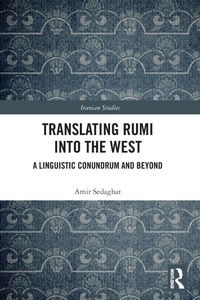
Translating Rumi into the West
A Linguistic Conundrum and Beyond
1st Edition
Published on 9. October 2024
Book
Paperback/Softback
312 pages
978-0-367-74453-3 (ISBN)
Description
Focusing on Rumi, the best-selling Persian mystical poet of the 13th century, this book investigates the reception of his work and thought in North America and Europe - and the phenomenon of 'Rumimania' - to elucidate the complexities of intercultural communication between the West and the Iranian and Islamic worlds.
Presenting tens of examples from the original and translated texts, the book is a critical analysis of various dimensions of this reception, outlining the difficulties of translating the text but also exploring how translators of various times and languages have performed, and explaining why the quality of reception varies. Topics analysed include the linguistic and pragmatic issues of translation, comparative stylistics and poetics, and non-textual factors like the translator's beliefs and the political and ideological aspects of translation. Using a broad theoretical framework, the author highlights the difficulties of intercultural communication from linguistic, semiotic, stylistic, poetic, ethical, and sociocultural perspectives. Ultimately, the author shares his reflections on the semiotic specificities of Rumi's mystical discourse and the ethics of translation generally.
The book will be valuable to scholars and students of Islamic philosophy, Iranian studies, and translation studies, but will appeal to anyone interested in the cultural dichotomies of the West and Islam.
Presenting tens of examples from the original and translated texts, the book is a critical analysis of various dimensions of this reception, outlining the difficulties of translating the text but also exploring how translators of various times and languages have performed, and explaining why the quality of reception varies. Topics analysed include the linguistic and pragmatic issues of translation, comparative stylistics and poetics, and non-textual factors like the translator's beliefs and the political and ideological aspects of translation. Using a broad theoretical framework, the author highlights the difficulties of intercultural communication from linguistic, semiotic, stylistic, poetic, ethical, and sociocultural perspectives. Ultimately, the author shares his reflections on the semiotic specificities of Rumi's mystical discourse and the ethics of translation generally.
The book will be valuable to scholars and students of Islamic philosophy, Iranian studies, and translation studies, but will appeal to anyone interested in the cultural dichotomies of the West and Islam.
Reviews / Votes
"Amir Sedaghat is one of the youngest scholars of the great Rumi in the Western academic world. He has already published important studies on the content and form of Rumi's complex and rich poetry, including its articulation with traditional Persian music. In this new book, based on his doctoral thesis at the Sorbonne University, he examines, through profound research, the various problems associated with the translation of this universal figure of Muslim mysticism into certain Western languages. He presents subtle and erudite reflections on the traductological, semiological, socio-cultural, political or ethical aspects of these problems."Mohammad Ali Amir-Moezzi, Universite PSL-Sorbonne, France
"This finely argued and well researched study is a "revelation". It makes a major contribution to understanding the translation of Sufism through the study of Rumi. It will be an invaluable resource for translation scholars."
Christine Raguet, Universite Sorbonne Nouvelle, France
More details
Series
Language
English
Place of publication
London
United Kingdom
Publishing group
Taylor & Francis Ltd
Target group
College/higher education
Professional and scholarly
Academic, Postgraduate, and Undergraduate Advanced
Illustrations
20 s/w Abbildungen, 20 s/w Zeichnungen, 57 s/w Tabellen
57 Tables, black and white; 20 Line drawings, black and white; 20 Illustrations, black and white
Dimensions
Height: 234 mm
Width: 156 mm
Thickness: 18 mm
Weight
506 gr
ISBN-13
978-0-367-74453-3 (9780367744533)
Copyright in bibliographic data and cover images is held by Nielsen Book Services Limited or by the publishers or by their respective licensors: all rights reserved.
Schweitzer Classification
Other editions
Additional editions
E-Book
02/2023
1st Edition
Routledge
€55.49
Available for download
E-Book
02/2023
1st Edition
Routledge
€55.49
Available for download
Book
02/2023
1st Edition
Routledge
€186.70
Shipment within 15-20 days
Person
Amir Sedaghat holds a PhD in translation studies and transcultural communication from the Universite Sorbonne Nouvelle, Paris 3. He teaches translation at the University of Toronto, Canada. Specialising in semiotics, he focuses his research on intercultural and interreligious relations between the West and the Islamic World.
Content
Introduction 1. First Order Linguistic Difficulties 2. Translation or the Retrieval of the Discoursive Form 3. Recreating the Poetics of Rumi 4. Translating Rumi's Rhetoric 5. Hermeneutics of Translating Rumi 6. On the Politics of Reception 7. Translation as an Ethical Locus Conclusion