

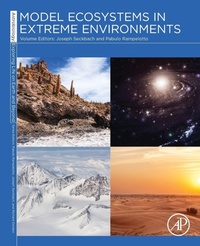
Model Ecosystems in Extreme Environments: Volume 2
Published on 29. May 2019
Book
Paperback/Softback
228 pages
978-0-12-812742-1 (ISBN)
Description
Model Ecosystems in Extreme Environments, Second Edition examines ecosystems at the most extreme habitats and their interaction with the environment, providing a key element in our understanding of the role and function of microorganisms in nature. The book highlights current topics in the field, such as biodiversity and the structure of microbial communities in extreme environments, the effects of extreme environmental conditions on microbial ecosystems, and ecological and evolutionary interactions in extreme environments, among other topics. It will be a valuable text for faculty and students working with extremophiles and/or microbial ecology and researchers, including astrobiologists, biologists, evolutionary scientists, astronomers, geochemists and oceanographers.
More details
Series
Language
English
Place of publication
San Diego
United States
Publishing group
Elsevier Science Publishing Co Inc
Target group
Professional and scholarly
Product notice
Paperback (trade)
Dimensions
Height: 235 mm
Width: 191 mm
Thickness: 12 mm
Weight
404 gr
ISBN-13
978-0-12-812742-1 (9780128127421)
Copyright in bibliographic data and cover images is held by Nielsen Book Services Limited or by the publishers or by their respective licensors: all rights reserved.
Schweitzer Classification
Other editions
Additional editions
Persons
Professor J. Seckbach is a retired senior academician at The Hebrew University of Jerusalem, Israel. He earned his MSc. & Ph.D. from the University of Chicago and did a post doctorate in the Division of Biology at Caltech, in Pasadena, CA. He led a group researching exobiology (extraterrestrial life) at UCLA. Seckbach was appointed to the Hebrew University, Jerusalem (as a senior Lecturer) and spent sabbaticals at UCLA and Harvard University. Dr. Seckbach enjoyed his DAAD-sponsored (The German Academic Exchange) periods in Tuebingen, Germany, and at LMU, Munich. He served at Louisiana State University (LSU), Baton Rouge, LA, USA, as the first selected Chair for the Louisiana Sea Grant and Technology transfer. Professor Joseph Seckbach has edited over 35 scientific books by various publishers (Springer, Elsevier, Wiley-Scrivener, World Scientific, Kluwer, Nova Hedwigia, U. of Freiburg and Geneva). Seckbach has published approximately 150 scientific articles on the topics of plant ferritin-(phytoferritin), cellular evolution, acidothermophilic algae, life in extreme environments, and astrobiology.
Recently he co-edited with Professor Richard Gordon several new series of Diatom books and with Professor Helga Stan-Lotter the volume of Extremophiles as Astronomical Models. In addition, to editing academic volumes, He also edited and translated several popular books and reviewed several chapters and volumes. His recent interest is in the field of enigmatic and extremophilic microorganisms and life in extreme environments and Astrobiology and is currently editing a few new volumes. Pabulo Henrique Rampelotto is Professor at the Center of Biotechnology and PPGBCM, Federal University of Rio Grande do Sul. He has been involved in extensive research in astrobiology, genomics, biotechnology, and life in extreme environments. Prof. Rampelotto has extensive editorial experience, including as Editor-in-Chief of Current Biotechnology and Editor of the book series Grand Challenges in Biology and Biotechnology. He also serves as Associate Editor, Guest Editor and member of the Editorial Board of several scientific journals in the field of Life Sciences and Biotechnology. His research interests encompass different fields of science, from basic to applied research, including: biotechnology, metagenomics, next generation sequencing, molecular biology and biochemistry of microorganisms, microbial ecology, extremophiles, origins of life, astrobiology, and space science (Solar System exploration). Most of his recent work has been dedicated to the editorial process of several scientific journals in life science and biotechnology, as well as on the organization of special issues on his fields of expertise. In his special issues, some of the most distinguished team leaders in the field have published their work, ideas and findings, including Nobel Laureates and several highly cited scientists according to the ISI Institute. His landmark work thus far is the special issue Grand Celebration: 10th Anniversary of the Human Genome Project.
Recently he co-edited with Professor Richard Gordon several new series of Diatom books and with Professor Helga Stan-Lotter the volume of Extremophiles as Astronomical Models. In addition, to editing academic volumes, He also edited and translated several popular books and reviewed several chapters and volumes. His recent interest is in the field of enigmatic and extremophilic microorganisms and life in extreme environments and Astrobiology and is currently editing a few new volumes. Pabulo Henrique Rampelotto is Professor at the Center of Biotechnology and PPGBCM, Federal University of Rio Grande do Sul. He has been involved in extensive research in astrobiology, genomics, biotechnology, and life in extreme environments. Prof. Rampelotto has extensive editorial experience, including as Editor-in-Chief of Current Biotechnology and Editor of the book series Grand Challenges in Biology and Biotechnology. He also serves as Associate Editor, Guest Editor and member of the Editorial Board of several scientific journals in the field of Life Sciences and Biotechnology. His research interests encompass different fields of science, from basic to applied research, including: biotechnology, metagenomics, next generation sequencing, molecular biology and biochemistry of microorganisms, microbial ecology, extremophiles, origins of life, astrobiology, and space science (Solar System exploration). Most of his recent work has been dedicated to the editorial process of several scientific journals in life science and biotechnology, as well as on the organization of special issues on his fields of expertise. In his special issues, some of the most distinguished team leaders in the field have published their work, ideas and findings, including Nobel Laureates and several highly cited scientists according to the ISI Institute. His landmark work thus far is the special issue Grand Celebration: 10th Anniversary of the Human Genome Project.
Content
1. Terrestrial systems of the Arctic as a model for growth and survival at low temperatures
2. Geothermal Steam Vents of Hawaii
3. Solar Salterns as Model Systems for the Study of Halophilic Microorganisms in their Natural Environments
4. Great Salt Lakes as a Model Hypersaline System
5. Plants and Salt: Plant Response and Adaptations to Salinity
6. Microbial Ecology of the Namib Desert
7. Endolithic Microbial Communities as Model Systems
8. Survival of Subsurface Microbial Communities over Geological Times and the Implications for Astrobiology
9. Under what kind of life system could space life emerge?
2. Geothermal Steam Vents of Hawaii
3. Solar Salterns as Model Systems for the Study of Halophilic Microorganisms in their Natural Environments
4. Great Salt Lakes as a Model Hypersaline System
5. Plants and Salt: Plant Response and Adaptations to Salinity
6. Microbial Ecology of the Namib Desert
7. Endolithic Microbial Communities as Model Systems
8. Survival of Subsurface Microbial Communities over Geological Times and the Implications for Astrobiology
9. Under what kind of life system could space life emerge?