

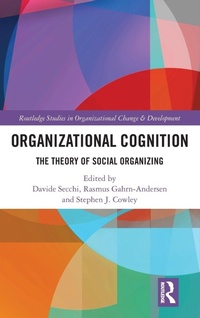
Organizational Cognition
The Theory of Social Organizing
1st Edition
Published on 30. September 2022
Book
Hardback
314 pages
978-0-367-76951-2 (ISBN)
Description
Cognition is usually associated with brain activity. Undoubtedly, some brain activity is necessary for it to function. However, the last thirty years have revolutionized the way we intend and think about cognition. These developments allow us to think of cognition as distributed in the sense that it needs tools, artifacts, objects, and other external entities to allow the brain to operate properly. Organizational Cognition: The Theory of Social Organizing takes this perspective and applies it to the organization by introducing a model that defines the elements that allow cognition to work. This model shows that cognition needs the combined and simultaneous presence of micro aspects-i.e. the biological individual-and macro super-structural elements-e.g. organizational climate, culture, norms, values, rules. These two become practice of cognition as they materialize in a meso domain-this is any action that allows individuals to perform their daily duties. Due to the micro-meso-macro interactions, this has been called the 3M Model. Most of what happens in the meso domain relates to exchanges between two or more people, i.e. it is a social activity. This is usually mentioned in the perspectives above, but it is rarely explored.
By bringing meso activities to the center of cognition, the book develops and presents the Theory of Social Organizing. Not only this is useful to organizational scholars, but it also opens a new path for cognition research.
By bringing meso activities to the center of cognition, the book develops and presents the Theory of Social Organizing. Not only this is useful to organizational scholars, but it also opens a new path for cognition research.
Reviews / Votes
"The book offers a timely and important discussion of the 3M approach to organisational cognition and psychology" - Jens Koed Madsen, Oxford UniversityMore details
Series
Language
English
Place of publication
London
United Kingdom
Publishing group
Taylor & Francis Ltd
Target group
College/higher education
Postgraduate
Illustrations
42 s/w Abbildungen, 16 s/w Photographien bzw. Rasterbilder, 26 s/w Zeichnungen, 11 s/w Tabellen
11 Tables, black and white; 26 Line drawings, black and white; 16 Halftones, black and white; 42 Illustrations, black and white
Dimensions
Height: 235 mm
Width: 157 mm
Thickness: 22 mm
Weight
633 gr
ISBN-13
978-0-367-76951-2 (9780367769512)
Copyright in bibliographic data and cover images is held by Nielsen Book Services Limited or by the publishers or by their respective licensors: all rights reserved.
Schweitzer Classification
Other editions
Additional editions
Davide Secchi | Rasmus Gahrn-Andersen | Stephen J. Cowley
Organizational Cognition
The Theory of Social Organizing
Book
05/2024
1st Edition
Routledge
€67.90
Shipment within 15-20 days
Davide Secchi | Rasmus Gahrn-Andersen | Stephen J. Cowley
Organizational Cognition
The Theory of Social Organizing
E-Book
09/2022
1st Edition
Routledge
€60.99
Available for download
Davide Secchi | Rasmus Gahrn-Andersen | Stephen J. Cowley
Organizational Cognition
The Theory of Social Organizing
E-Book
09/2022
1st Edition
Routledge
€60.99
Available for download
Persons
Davide Secchi is Associate Professor of Organizational Cognition in the Department of Language and Communication and Director of the Research Centre for Computational & Organisational Cognition at the University of Southern Denmark, Slagelse, Denmark.
Rasmus Gahrn-Andersen is Associate Professor of Organizational Communication at the University of Southern Denmark, Denmark.
Stephen J. Cowley is Professor of Organizational Cognition at the University of Southern Denmark, Denmark.
Rasmus Gahrn-Andersen is Associate Professor of Organizational Communication at the University of Southern Denmark, Denmark.
Stephen J. Cowley is Professor of Organizational Cognition at the University of Southern Denmark, Denmark.
Content
1. Setting the scene Part 1: Theoretical framework 2. Changing practices: Using the 3M model to engineer change 3. Perception as conceptual orderliness in enlanguaged practices 4. Computational revival: Why and how computation is still relevant to the study of recognition Part 2: Practice and applications 5. Reflections on social organizing 6. Theorizing transformative educational technology as a meso-related venture 7. Organization-cognition fit: Supplementing or complementing team's capabilities? 8. Thinking, faster and slower: Towards a dynamic view of organizational cognition 9. A dynamic view of organizing: An integrative approach 10. The primacy of "Disorganization" in social organizing 11. Sociotechnical dilemmas in healthcare: A cognitive ethnography 12. Cognitive cross-over: Implications for a Theory of Social Organizing 13. Enacting Ontological Design: a Vocabulary of Change from Organisms to organizations Part 3: Reflections and perspectives 14. Towards a science of the artificially organized