

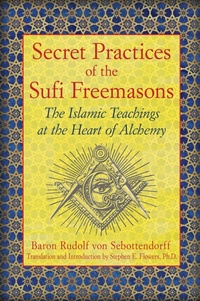
Secret Practices of the Sufi Freemasons
The Islamic Teachings at the Heart of Alchemy
Published on 17. January 2013
Book
Paperback/Softback
144 pages
978-1-59477-468-3 (ISBN)
Description
Reveals the secret spiritual exercises of the Bektashi Order of Sufis
* Shows how this order, also known as Oriental Freemasonry, preserves the ancient spiritual doctrines forgotten by modern Freemasonry
* Explains how to transform the soul into the alchemical Magnum Opus by combining Masonic grips and the abbreviated letters of the Qur'an
* Includes a detailed biography of Baron von Sebottendorff
Originally published in Germany in 1924, this rare book by Baron Rudolf von Sebottendorff reveals the secret spiritual exercises of the Bektashi Order of Sufis as well as how this order, also known as Oriental Freemasonry, preserves the ancient spiritual doctrines forgotten by modern Freemasonry. Sebottendorff explains how the mysterious abbreviated letters found in the Qur'an represent formulas for perfecting the spirit of the individual. When combined with Masonic hand signs and grips and conducted accordingly to a precise schedule, these formulas incorporate spiritual power into the body and transform the soul from its base state into a noble, godlike state: the Magnum Opus of the medieval alchemists.
Laying out the complete program of spiritual exercises, Sebottendorff explains each abbreviated word-formula in the Qur'an, the hand gestures that go with them, and the exact order and duration for each exercise. Including a detailed biography of Sebottendorff and an examination of alchemy's Islamic heritage, this book shows how the traditions of Oriental Freemasonry can ennoble the self and lead to higher knowledge.
* Shows how this order, also known as Oriental Freemasonry, preserves the ancient spiritual doctrines forgotten by modern Freemasonry
* Explains how to transform the soul into the alchemical Magnum Opus by combining Masonic grips and the abbreviated letters of the Qur'an
* Includes a detailed biography of Baron von Sebottendorff
Originally published in Germany in 1924, this rare book by Baron Rudolf von Sebottendorff reveals the secret spiritual exercises of the Bektashi Order of Sufis as well as how this order, also known as Oriental Freemasonry, preserves the ancient spiritual doctrines forgotten by modern Freemasonry. Sebottendorff explains how the mysterious abbreviated letters found in the Qur'an represent formulas for perfecting the spirit of the individual. When combined with Masonic hand signs and grips and conducted accordingly to a precise schedule, these formulas incorporate spiritual power into the body and transform the soul from its base state into a noble, godlike state: the Magnum Opus of the medieval alchemists.
Laying out the complete program of spiritual exercises, Sebottendorff explains each abbreviated word-formula in the Qur'an, the hand gestures that go with them, and the exact order and duration for each exercise. Including a detailed biography of Sebottendorff and an examination of alchemy's Islamic heritage, this book shows how the traditions of Oriental Freemasonry can ennoble the self and lead to higher knowledge.
Reviews / Votes
"The book is very insightful and I leaned so much. The author does an excellent job conveying the concepts." * David H., Book Bargains and Previews, May 2013 * "Touching on the spiritual ideas that lie beneath it, its relation to alchemy, and many other topics, Secret Practices of the Sufi Freemasons is a fascinating read for anyone curious about the old ways of the occult in history." * Midwestern Book Review, May 2013 *More details
Language
English
Place of publication
Rochester
United States
Product notice
Paperback (trade)
Dimensions
Height: 228 mm
Width: 153 mm
Thickness: 12 mm
Weight
244 gr
ISBN-13
978-1-59477-468-3 (9781594774683)
Copyright in bibliographic data and cover images is held by Nielsen Book Services Limited or by the publishers or by their respective licensors: all rights reserved.
Schweitzer Classification
Other editions
Additional editions
Baron Rudolf von Sebottendorff
Secret Practices of the Sufi Freemasons
The Islamic Teachings at the Heart of Alchemy
E-Book
01/2013
Simon + Schuster LLC
€9.88
Available for download
Persons
Baron Rudolf von Sebottendorff (1875-1945) was a Freemason and practitioner of alchemy. In 1900 he moved to Turkey where he met the Jewish Termudi family, who introduced him to Rosicrucianism and led to his initiation into a local Masonic lodge. In 1910 he founded a lodge of the Bektashi Order in Constantinople. Returning to Germany, in 1917 he founded the Thule Society, an occult organization that led to the German Workers' Party--joined in 1919 by Adolf Hitler, who transformed it into the Nazi Party. Sebottendorff left the Thule Society as it became increasingly political, fleeing to Turkey. Translator Stephen E. Flowers, Ph.D., received his doctorate in Germanic languages and medieval studies from the University of Texas at Austin and studied the history of occultism at the University of Goettingen, Germany. The author of more than two dozen books, including Lords of the Left-Hand Path, he lives near Austin, Texas.
Content
Introduction by Stephen E. Flowers
1 The Life of Rudolf von Sebottendorff
2 The Bektashi Sect of Sufism
3 The Mysteries of the Arabic Letters
4 Alchemy and Sufism
The Practice of Ancient Turkish Freemasonry
The Key to the Understanding of Alchemy
A Presentation of the Ritual, Doctrine, and Signs of Recognition among the Oriental Freemasons
By Baron Rudolf von Sebottendorff
Introduction
i Practice
ii Theory
iii Theory and Practice
Conclusion
Notes
Bibliography
Index
1 The Life of Rudolf von Sebottendorff
2 The Bektashi Sect of Sufism
3 The Mysteries of the Arabic Letters
4 Alchemy and Sufism
The Practice of Ancient Turkish Freemasonry
The Key to the Understanding of Alchemy
A Presentation of the Ritual, Doctrine, and Signs of Recognition among the Oriental Freemasons
By Baron Rudolf von Sebottendorff
Introduction
i Practice
ii Theory
iii Theory and Practice
Conclusion
Notes
Bibliography
Index