

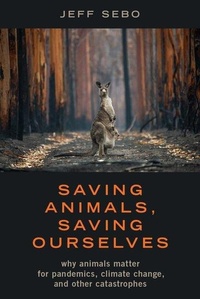
Saving Animals, Saving Ourselves
Why Animals Matter for Pandemics, Climate Change, and other Catastrophes
Published on 31. May 2022
Book
Hardback
272 pages
978-0-19-086101-8 (ISBN)
Description
In 2020, COVID-19, the Australia bushfires, and other global threats served as vivid reminders that human and nonhuman fates are increasingly linked. Human use of nonhuman animals contributes to pandemics, climate change, and other global threats which, in turn, contribute to biodiversity loss, ecosystem collapse, and nonhuman suffering.
Jeff Sebo argues that humans have a moral responsibility to include animals in global health and environmental policy. In particular, we should reduce our use of animals as part of our pandemic and climate change mitigation efforts and increase our support for animals as part of our adaptation efforts. Applying and extending frameworks such as One Health and the Green New Deal, Sebo calls for reducing support for factory farming, deforestation, and the wildlife trade; increasing support for humane, healthful, and sustainable alternatives; and considering human and nonhuman needs holistically. Sebo also considers connections with practical issues such as education, employment, social services, and infrastructure, as well as with theoretical issues such as well-being, moral status, political status, and population ethics. In all cases, he shows that these issues are both important and complex, and that we should neither underestimate our responsibilities because of our limitations, nor underestimate our limitations because of our responsibilities.
Both an urgent call to action and a survey of what ethical and effective action requires, Saving Animals, Saving Ourselves is an invaluable resource for scholars, advocates, policy-makers, and anyone interested in what kind of world we should attempt to build and how.
This is an open access title available under the terms of a CC BY-NC-ND 4.0 International license. It is free to read at Oxford Scholarship Online and offered as a free PDF download from OUP and selected open access locations.
Jeff Sebo argues that humans have a moral responsibility to include animals in global health and environmental policy. In particular, we should reduce our use of animals as part of our pandemic and climate change mitigation efforts and increase our support for animals as part of our adaptation efforts. Applying and extending frameworks such as One Health and the Green New Deal, Sebo calls for reducing support for factory farming, deforestation, and the wildlife trade; increasing support for humane, healthful, and sustainable alternatives; and considering human and nonhuman needs holistically. Sebo also considers connections with practical issues such as education, employment, social services, and infrastructure, as well as with theoretical issues such as well-being, moral status, political status, and population ethics. In all cases, he shows that these issues are both important and complex, and that we should neither underestimate our responsibilities because of our limitations, nor underestimate our limitations because of our responsibilities.
Both an urgent call to action and a survey of what ethical and effective action requires, Saving Animals, Saving Ourselves is an invaluable resource for scholars, advocates, policy-makers, and anyone interested in what kind of world we should attempt to build and how.
This is an open access title available under the terms of a CC BY-NC-ND 4.0 International license. It is free to read at Oxford Scholarship Online and offered as a free PDF download from OUP and selected open access locations.
Reviews / Votes
The book provokes scholars from across disciplines to think through in further detail the empirical, normative, and other questions that arise from its main propositions, and the general public to openly engage with its contents. * Charlotte E. Blattner, University of Bern, Society & Animals * The pandemic should have caused a global awakening to how our treatment of animals significantly causes human harm. In one way or another, the pandemic is rooted in animal exploitation. But the world remains largely silent on this connection. Ditto climate change. Ditto world hunger. Ditto environmental destruction. Maybe Jeff Sebo's new book, Saving Animals, Saving Ourselves, will end the silence. Sebo clearly shows how many of the most urgent public health issues we face today are directly related to our treatment of animals. This is a book that must be read. Time is running out - if we want to save ourselves, we have to save animals, too. * Aysha Akhtar, MD, MPH, Author of Our Symphony with Animals: On Health, Empathy and Our Shared Destinies * Jeff Sebo has been leading the conversation about the impacts of human behavior on animals and the environment for years. In Saving Animals, Saving Ourselves, he shows that when we accept our responsibilities as well as our limitations, we can bring about transformative change for everyone and build a more just and sustainable future-including for the most vulnerable among us. This book is a must-read for policy makers looking to chart a new path forward. * U.S. Senator Cory Booker * In Saving Animals, Saving Ourselves, Jeff Sebo argues forcefully that we have a responsibility to help everyone affected by human activity, including other animals. By reducing support for factory farming, deforestation, and the wildlife trade; increasing support for humane, healthful, and sustainable alternatives; and including the health and welfare of nonhuman animals in our advocacy and political agendas, we can create a better future for humans and nonhumans alike. This brilliant, wide-ranging book is essential for academics, advocates, policymakers, and anyone else with an interest in our shared future. * Dr. Jane Goodall, DBE, Founder of the Jane Goodall Institute & U. N. Messenger of Peace * In Saving Animals, Saving Ourselves, Jeff Sebo draws together a wealth of evidence to make an overwhelming case that the way we treat animals today is not only a grave moral wrong, but also a serious threat to our health, our well-being, and possibly our very existence. Every meat-eater and every policy-maker needs to read and ponder the evidence Sebo presents. * Peter Singer, Professor of Bioethics, Princeton University, and author of Animal Liberation * It makes a real contribution to understanding the problem of saving animals and ourselves. * Angus Taylor, Digitalcommons.calpoly * What I liked most about the book is the cautiousness, honesty and holism of Sebo's approach... It thereby lays valuable groundwork for more concrete and specific future investigations into how animals should be included in our ethical thinking about human-induced crises. * Thomas Poelzler, Ethical Theory and Moral Practice *More details
Language
English
Place of publication
New York
United States
Target group
Professional and scholarly
Dimensions
Height: 215 mm
Width: 146 mm
Thickness: 25 mm
Weight
430 gr
ISBN-13
978-0-19-086101-8 (9780190861018)
Copyright in bibliographic data and cover images is held by Nielsen Book Services Limited or by the publishers or by their respective licensors: all rights reserved.
Schweitzer Classification
Other editions
Additional editions
Jeff Sebo
Saving Animals, Saving Ourselves
Why Animals Matter for Pandemics, Climate Change, and other Catastrophes
E-Book
02/2022
OUP eBook
€15.49
Available for download
Jeff Sebo
Saving Animals, Saving Ourselves
Why Animals Matter for Pandemics, Climate Change, and other Catastrophes
E-Book
02/2022
OUP eBook
€15.49
Available for download
Person
Jeff Sebo is Clinical Associate Professor of Environmental Studies, Affiliated Professor of Bioethics, Medical Ethics, and Philosophy, and Director of the Animal Studies M.A. Program at New York University. He works primarily in bioethics, animal ethics, and environmental ethics. He is co-author of Chimpanzee Rights and Food, Animals, and the Environment. He is also an executive committee member at the NYU Center for Environmental and Animal Protection, an advisory board member at the Animals in Context series at NYU Press, a board member at Minding Animals International, a mentor at Sentient Media, and a senior research affiliate at the Legal Priorities Project.
Author
Clinical Associate Professor of Environmental Studies, Affiliated Professor of Bioethics, Medical Ethics, and Philosophy, and Director of the Animal Studies M.A. ProgramClinical Associate Professor of Environmental Studies, Affiliated Professor of Bioethics, Medical Ethics, and Philosophy, and Director of the Animal Studies M.A. Program, New York University
Content
Preface
Acknowledgements
Chapter 1. Introduction: Saving animals, saving ourselves
Chapter 2. Animal ethics in a human world
Chapter 3. Animals, pandemics, and climate change
Chapter 4. Limits on inclusion for animals
Chapter 5. Methods of inclusion for animals
Chapter 6. Animals, conflict, and politics
Chapter 7. Animals, well-being, and moral status
Chapter 8. Animals, creation ethics, and population ethics
Chapter 9. Conclusion: Of minks and men
Acknowledgements
Chapter 1. Introduction: Saving animals, saving ourselves
Chapter 2. Animal ethics in a human world
Chapter 3. Animals, pandemics, and climate change
Chapter 4. Limits on inclusion for animals
Chapter 5. Methods of inclusion for animals
Chapter 6. Animals, conflict, and politics
Chapter 7. Animals, well-being, and moral status
Chapter 8. Animals, creation ethics, and population ethics
Chapter 9. Conclusion: Of minks and men