

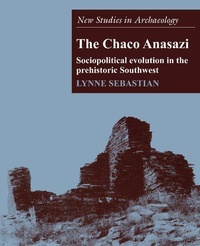
The Chaco Anasazi
Sociopolitical Evolution in the Prehistoric Southwest
Published on 28. August 1996
Book
Paperback/Softback
196 pages
978-0-521-57468-6 (ISBN)
Description
In the tenth century AD, a remarkable cultural development took place in the harsh and forbidding San Juan Basin of northwestern New Mexico. From small-scale, simply organised, prehistoric Pueblo societies, a complex and socially differentiated political system emerged which has become known as the Chaco Phenomenon. The origins, evolution, and decline of this system have long been the subject of intense archaeological debate. Lynne Sebastian examines the transition of the Chaco system from an acephalous society, in which leadership was situational and most decision making carried out within kinship structures, to a hierarchically organised political structure with institutional roles of leadership. She argues that harsh environmental factors were not the catalyst for the transition, as has previously been thought. Rather, the increasing political complexity was a consequence of improved rainfall in the region which permitted surplus production, thus allowing those farming the best land to capitalise on the material success. By combining information on political evolution with archaeological data and the results of a computer simulation, she is able to produce a sociopolitically based model of the rise, florescence, and decline of the Chaco Phenomenon.
Reviews / Votes
"By succinctly summarizing much background information and citing major sources for additional data, she has managed to concentrate on an alternative to existing explanations for the growth and nature of the Chacoan cultural system and on analyzing the political processes of small-scale sedentary societies....a major contribution to developing explanatory models." American Antiquity "In an easy-to-read and enjoyable book, especially the last two chapters, Sebastian has created a nontypological starting point for new, wide-ranging cultural-ecological-social-political debates about the nature and process of the Chacoan phenomenon....Geographers who work with prehistoric data will find this book to be, at least, thought provoking and, at best, a paradigm-revising addendum to their worldview of the prehistoric Southwest." The Geographical ReviewMore details
Series
Language
English
Place of publication
Cambridge
United Kingdom
Target group
Professional and scholarly
College/higher education
Product notice
Paperback (trade)
Illustrations
3 Maps; 12 Halftones, unspecified; 3 Line drawings, unspecified
Dimensions
Height: 235 mm
Width: 191 mm
Thickness: 11 mm
Weight
377 gr
ISBN-13
978-0-521-57468-6 (9780521574686)
Copyright in bibliographic data and cover images is held by Nielsen Book Services Limited or by the publishers or by their respective licensors: all rights reserved.
Schweitzer Classification
Other editions
Additional editions

Book
10/1992
Cambridge University Press
€55.80
Article exhausted; check for reprint
Previous edition
Book
10/1992
Cambridge University Press
€55.80
Article exhausted; check for reprint
Content
1. Introduction; 2. The Chaco Phenomenon: background and history of research; 3. Sociopolitical complexity and the Chaco system; 4. Routes to sociopolitical power; 5. Previous explanations for the Chaco Phenomenon; 6. Relations of power, labor investment, and the political evolution of the Chaco system; 7. Summary and new directions; Appendix: the computer simulation.