

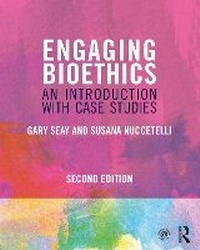
Engaging Bioethics
An Introduction With Case Studies
2nd Edition
Published on 31. August 2023
Book
Hardback
460 pages
978-1-032-18934-5 (ISBN)
Description
Presuming readers start with no background in philosophy, this enhanced introduction to bioethics first provides balanced, philosophically based coverage of moral reasoning, moral theories, and the law. It then leads the newly equipped reader to explore a range of important ethical issues in health care and biomedical research.
Engaging Bioethics, Second Edition is designed for undergraduates throughout the humanities and social sciences as well as for healthcare professionals-in-training, including students in medical school, pre-medicine, nursing, public health, and those studying to assist physicians in various capacities. Along with coverage of standard bioethical issues-such as vaccination, access to health care, new reproductive technologies, genetics, research on human and animal subjects, abortion, medical confidentiality, and disclosure-it now addresses ethical aspects of the Covid-19 pandemic, the US Supreme Court's Dobbs v Jackson decision, use of CRISPR for human gene editing, and the expansion of medically assisted death globally.
Key Features
Flexibility for the instructor, with chapters that can be read independently and in an order that fits the course structure
Integration with case studies and primary sources
Attention to issues of gender, race, cultural diversity, and justice in health care
Pedagogical features to help instructors and students
A companion website with a virtual anthology linking to key primary sources, a test bank, topics for papers, and PowerPoints for lectures and class discussion
Key Updates to the Second Edition
An expanded treatment of vaccination ethics
A new chapter wholly devoted to the tools of moral thinking
Additional topics on the patient-healthcare professional relationship such as social nudging in health care and public health, and the limits of beneficence in connection with the burnout of frontline healthcare workers during the Covid-19 pandemic
New, up-to-date cases and questions for further discussion throughout the chapters
Updated learning objectives and overviews for each chapter
Engaging Bioethics, Second Edition is designed for undergraduates throughout the humanities and social sciences as well as for healthcare professionals-in-training, including students in medical school, pre-medicine, nursing, public health, and those studying to assist physicians in various capacities. Along with coverage of standard bioethical issues-such as vaccination, access to health care, new reproductive technologies, genetics, research on human and animal subjects, abortion, medical confidentiality, and disclosure-it now addresses ethical aspects of the Covid-19 pandemic, the US Supreme Court's Dobbs v Jackson decision, use of CRISPR for human gene editing, and the expansion of medically assisted death globally.
Key Features
Flexibility for the instructor, with chapters that can be read independently and in an order that fits the course structure
Integration with case studies and primary sources
Attention to issues of gender, race, cultural diversity, and justice in health care
Pedagogical features to help instructors and students
A companion website with a virtual anthology linking to key primary sources, a test bank, topics for papers, and PowerPoints for lectures and class discussion
Key Updates to the Second Edition
An expanded treatment of vaccination ethics
A new chapter wholly devoted to the tools of moral thinking
Additional topics on the patient-healthcare professional relationship such as social nudging in health care and public health, and the limits of beneficence in connection with the burnout of frontline healthcare workers during the Covid-19 pandemic
New, up-to-date cases and questions for further discussion throughout the chapters
Updated learning objectives and overviews for each chapter
Reviews / Votes
"Seay and Nuccetelli have done an admirable job at distilling and making accessible a large body of medical information, complex case law, and philosophical ethics. Their text makes the project of developing competence and understanding in bioethics a lot less daunting, without simplifying the philosophical and scientific issues. The book is organized so that instructors can easily design a course around a subset of the topics covered, and its teaching and learning resources are outstanding. This is the best bioethics textbook I am aware of, for students and teachers alike."Brandon Cooke, Professor & Chair (Philosophy), Minnesota State University, Mankato
"This is a concise introduction to bioethics that covers a lot of ground. The chapters are sufficiently self-contained so that the text can be adapted to different course designs, and the boxes and figures throughout are helpful learning aids. Important cases are discussed but don't dominate the discussion, so the emphasis remains on the philosophical arguments and issues."
William A. Bauer, North Carolina State University
"Seay and Nuccetelli offer a refreshing and bold approach to bioethics that confronts readers directly, requiring them to intimately wrestle with the most pressing issues through numerous case studies and a nuanced analysis of the core concepts and principles. The authors strike a delicate balance between accessibility and depth, with the results being a text that is eminently readable. This is not easy material, but the authors have created a text open to readers with little or no philosophical background without sacrificing the complexity found in these important discussions. They also offer an expansive and up-to-date sourcebook to find primary sources online in the companion website."
Scott O'Leary, University of Saint Mary
More details
Edition
2nd edition
Language
English
Place of publication
London
United Kingdom
Publishing group
Taylor & Francis Ltd
Target group
College/higher education
General, Professional, Undergraduate Advanced, and Undergraduate Core
Illustrations
35 s/w Abbildungen, 23 s/w Photographien bzw. Rasterbilder, 12 s/w Zeichnungen
12 Line drawings, black and white; 23 Halftones, black and white; 35 Illustrations, black and white
Dimensions
Height: 234 mm
Width: 187 mm
Weight
1300 gr
ISBN-13
978-1-032-18934-5 (9781032189345)
Copyright in bibliographic data and cover images is held by Nielsen Book Services Limited or by the publishers or by their respective licensors: all rights reserved.
Schweitzer Classification
Other editions
Additional editions
Book
08/2023
2nd Edition
Routledge
€84.47
Shipment within 10-20 days
E-Book
08/2023
2nd Edition
Routledge
€72.49
Available for download
E-Book
08/2023
2nd Edition
Routledge
€72.49
Available for download
Previous edition
Book
02/2017
1st Edition
Routledge
€245.53
Shipment within 15-20 days
Persons
Gary Seay is Professor Emeritus of Philosophy at Medgar Evers College of the City University of New York. He is co-author of a logic book, co-editor of two ethics volumes, and the author of several journal articles. He has served on the American Philosophical Association's Committee on Philosophy and Medicine and was consulting bioethicist on the Ethics Committee of the New York Hospital Medical Center of Queens.
Susana Nuccetelli is Professor of Philosophy at St. Cloud State University in Minnesota. Her articles in many areas of ethics, including bioethics, have appeared in edited volumes and journals. Her recent books are The Routledge Guidebook to Moore's Principia Ethica (Routledge, 2022) and An Introduction to Latin American Philosophy (Cambridge University Press, 2020).
Susana Nuccetelli is Professor of Philosophy at St. Cloud State University in Minnesota. Her articles in many areas of ethics, including bioethics, have appeared in edited volumes and journals. Her recent books are The Routledge Guidebook to Moore's Principia Ethica (Routledge, 2022) and An Introduction to Latin American Philosophy (Cambridge University Press, 2020).
Content
1. From Vaccination Ethics to Bioethics and Ethics 2. The Tools of Ethical Inquiry 3. Philosophical Accounts of Morality 4. Principle-Oriented and Case-Oriented Bioethics 5. Managing Personal Medical Information 6. Consent with Competence and Without 7. Death and Dying 8. When Life Supports Are Futile or Refused 9. Medically Assisted Death 10. End-of-Life Measures for Severely Compromised Newborns 11. Morality and the Law in the Typical Case of Abortion 12. Morality and the Law in Hard Cases of Abortion 13. New Reproductive Technologies 14. The Genetic Revolution 15. Biomedical Research on Animals 16. Biomedical Research on Humans 17. Justice in Health Care