

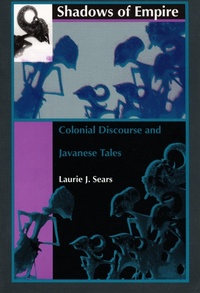
Shadows of Empire
Colonial Discourse and Javanese Tales
Will be published approx. on 20. March 1996
Book
Paperback/Softback
376 pages
978-0-8223-1697-8 (ISBN)
Description
Shadows of Empire explores Javanese shadow theater as a staging area for negotiations between colonial power and indigenous traditions. Charting the shifting boundaries between myth and history in Javanese Mahabharata and Ramayana tales, Laurie J. Sears reveals what happens when these stories move from village performances and palace manuscripts into colonial texts and nationalist journals and, most recently, comic books and novels. Historical, anthropological, and literary in its method and insight, this work offers a dramatic reassessment of both Javanese literary/theatrical production and Dutch scholarship on Southeast Asia.
Though Javanese shadow theater (wayang) has existed for hundreds of years, our knowledge of its history, performance practice, and role in Javanese society only begins with Dutch documentation and interpretation in the nineteenth century. Analyzing the Mahabharata and Ramayana tales in relation to court poetry, Islamic faith, Dutch scholarship, and nationalist journals, Sears shows how the shadow theater as we know it today must be understood as a hybrid of Javanese and Dutch ideas and interests, inseparable from a particular colonial moment. In doing so, she contributes to a re-envisioning of European histories that acknowledges the influence of Asian, African, and New World cultures on European thought-and to a rewriting of colonial and postcolonial Javanese histories that questions the boundaries and content of history and story, myth and allegory, colonialism and culture.
Though Javanese shadow theater (wayang) has existed for hundreds of years, our knowledge of its history, performance practice, and role in Javanese society only begins with Dutch documentation and interpretation in the nineteenth century. Analyzing the Mahabharata and Ramayana tales in relation to court poetry, Islamic faith, Dutch scholarship, and nationalist journals, Sears shows how the shadow theater as we know it today must be understood as a hybrid of Javanese and Dutch ideas and interests, inseparable from a particular colonial moment. In doing so, she contributes to a re-envisioning of European histories that acknowledges the influence of Asian, African, and New World cultures on European thought-and to a rewriting of colonial and postcolonial Javanese histories that questions the boundaries and content of history and story, myth and allegory, colonialism and culture.
Reviews / Votes
"Shadows of Empire casts new light on the history of Java and analyzes historiographical method in the light of theoretical developments in the study of colonial history. Its emphasis on shadow theatre as text, as performance, and as oral tradition makes an important new contribution."-Jean Gelman Taylor, University of New South Wales "A challenging book. Laurie Sears provides a wide range of provocative insights into Javanese and colonial culture and a radical rethinking about the wayang as a major area for the negotiation of power relationships between the Javanese and the Dutch."-Amin Sweeney, University of California, BerkeleyMore details
Language
English
Place of publication
North Carolina
United States
Target group
Professional and scholarly
Product notice
Paperback (trade)
Illustrations
23 b&w photographs
Dimensions
Height: 234 mm
Width: 156 mm
Thickness: 27 mm
Weight
640 gr
ISBN-13
978-0-8223-1697-8 (9780822316978)
Copyright in bibliographic data and cover images is held by Nielsen Book Services Limited or by the publishers or by their respective licensors: all rights reserved.
Schweitzer Classification
Other editions
Additional editions
E-Book
03/1996
1st Edition
Duke University Press Books
€208.99
Available for download
Person
Laurie J. Sears is Associate Professor of History at the University of Washington. She is editor of Fantasizing the Feminine in Indonesia, also published by Duke University Press.
Content
Note on Spelling and Translations vii
Preface ix
Acknowledgments xix
Introduction: Histories, Mythologies, and Javanese Tales 1
1. Hearing Islamic Voices in "Hindu-Javanese" Tales 34
2. Colonial Discourse and Javanese Shadow Theatre 75
3. Failed Narratives of the Nation or the New "Essence" of Java? 121
4. Javanese Storytellers, Colonial Categories, Mahabharata Tales 170
5. Revolutionary Rhetoric and Postcolonial Performance Domains 214
6. Fictions, images, and Allegories 266
Selected Glossary 303
Selected Bibliography 311
Index 335
Preface ix
Acknowledgments xix
Introduction: Histories, Mythologies, and Javanese Tales 1
1. Hearing Islamic Voices in "Hindu-Javanese" Tales 34
2. Colonial Discourse and Javanese Shadow Theatre 75
3. Failed Narratives of the Nation or the New "Essence" of Java? 121
4. Javanese Storytellers, Colonial Categories, Mahabharata Tales 170
5. Revolutionary Rhetoric and Postcolonial Performance Domains 214
6. Fictions, images, and Allegories 266
Selected Glossary 303
Selected Bibliography 311
Index 335