

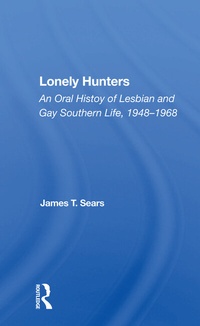
Lonely Hunters
An Oral History Of Lesbian And Gay Southern Life, 1948-1968
1st Edition
Published on 19. October 2020
Book
Paperback/Softback
324 pages
978-0-367-15981-8 (ISBN)
Description
This book documents Southern gay history and culture during the Cold War/pre-Stonewall era. It provides a rich historical tapestry through the use of personal reminiscences, private letters, subpoenaed testimony and unpublished court and legislative documents, and newspaper stories.
More details
Language
English
Place of publication
London
United Kingdom
Publishing group
Taylor & Francis Ltd
Target group
College/higher education
Dimensions
Height: 225 mm
Width: 140 mm
Weight
430 gr
ISBN-13
978-0-367-15981-8 (9780367159818)
Copyright in bibliographic data and cover images is held by Nielsen Book Services Limited or by the publishers or by their respective licensors: all rights reserved.
Schweitzer Classification
Other editions
Additional editions
Book
04/2019
1st Edition
Routledge
€179.51
Shipment within 15-20 days
E-Book
04/2019
1st Edition
Routledge
€59.49
Available for download
E-Book
04/2019
1st Edition
Routledge
€59.49
Available for download
Person
James T. Sears is a professor at the University of South Carolina, where a course he taught on Christian fundamentalism attracted national attention and the ire of Pat Robertson, who dubbed Sears Satan in the university. Sears resides on the sea islands near Charleston and in cyberspace at http://www.jtsears.com.
Content
Introduction 1. Purging Perverts in Paradise: The 22nd Street Beach, Coupon-Clippers, and the Tongueston Trio 2. Dark Nights of the Soul: Charley Johns and the Chicken Ranch 3. Ferreting Out the Lesbian Menace: The Purple Pamphlet and the Deans of Women 4. The Father, Son, and Holy Ghost: The City on the Hill Struggles with Civil Rights and Civilities 5. Dawn Arises in Aristocratic Charleston: The Gordon Langley Hall Affair 6. The Blue Fairy and the Making of a New Activist Generation 7. The Mississippi of the Homosexual and the Politics of Dialectics 8. Afterword: A Conversation with Barbara Gittings