

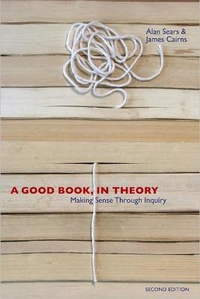
A Good Book, in Theory
Making Sense Through Inquiry
2nd Edition
Published on 1. April 2010
Book
Paperback/Softback
206 pages
978-1-4426-0156-7 (ISBN)
Description
This brief and engagingly written book provides a unique introduction to the process of social inquiry and the theoretical and methodological frameworks that support that inquiry, offering a strong foundation in critical thinking that is rooted in the social sciences but maintains relevance across the disciplines.
More details
Edition
2nd Revised edition
Language
English
Place of publication
Toronto
Canada
Target group
College/higher education
Professional and scholarly
Edition type
Revised edition
Product notice
Paperback (trade)
Dimensions
Height: 216 mm
Width: 140 mm
Thickness: 12 mm
Weight
260 gr
ISBN-13
978-1-4426-0156-7 (9781442601567)
Copyright in bibliographic data and cover images is held by Nielsen Book Services Limited or by the publishers or by their respective licensors: all rights reserved.
Schweitzer Classification
Other editions
New editions
Book
03/2015
3rd Edition
University of Toronto Press
€38.50
Shipment within 10-20 days
Previous edition
Book
01/2005
University of Toronto Press
€34.84
No shipping information available
Persons
Alan Sears is Professor of Sociology at Ryerson University, Toronto. He is the author of Retooling the Mind Factory: Education in a Lean State (UTP, 2003) and co-author with James Cairns of The Democratic Imagination (UTP, 2012). James Cairns is Assistant Professor in the Contemporary Studies Department at Wilfrid Laurier University, Brantford. He is the co-author, with Alan Sears, of The Democratic Imagination (UTP, 2012).
Content
Acknowledgements Preface to the First Edition: Users' Guide for Students and Instructors Preface to the Second Edition 1. An Interesting Idea, In Theory 2. But How Do You Know? 3. You Are Here: Mapping Social Relations 4. The Real World: Making Sense of Perceptions 5. Nature and Culture: The Social Construction of Distinctions 6. Making Time: Clocking Social Relations 7. Conclusion: So Many Theories, So Little Time Glossary References Index