

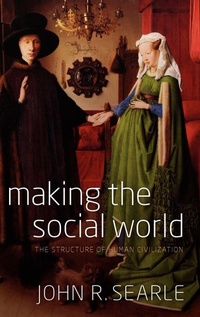
Making the Social World
The Structure of Human Civilization
1st Edition
Published on 14. January 2010
Book
Hardback
224 pages
978-0-19-957691-3 (ISBN)
Description
The renowned philosopher John Searle reveals the fundamental nature of social reality. What kinds of things are money, property, governments, nations, marriages, cocktail parties, and football games? Searle explains the key role played by language in the creation, constitution, and maintenance of social reality.
We make statements about social facts that are completely objective, for example: Barack Obama is President of the United States, the piece of paper in my hand is a twenty-dollar bill, I got married in London, etc. And yet these facts only exist because we think they exist. How is it possible that we can have factual objective knowledge of a reality that is created by subjective opinions? This is part of a much larger question: How can we give an account of ourselves, with our peculiar human traits - mind, reason, freedom, society - in a world that we know independently consists of mindless, meaningless particles? How can we account for our social and mental existence in a realm of brute physical facts?
In answering this question, Searle avoids postulating different realms of being, a mental and a physical, or worse yet, a mental, a physical, and a social. There is just one reality: Searle shows how the human reality fits into that one reality. Mind, language, and civilization are natural products of the basic facts of the physical world described by physics, chemistry and biology. Searle explains how language creates and maintains the elaborate structures of human social institutions. These institutions serve to create and distribute power relations that are pervasive and often invisible. These power relations motivate human actions in a way that provides the glue that holds human civilization together. Searle shows how this account illuminates human rationality, free will, political power, and human rights. Our social world is a world created and maintained by language.
We make statements about social facts that are completely objective, for example: Barack Obama is President of the United States, the piece of paper in my hand is a twenty-dollar bill, I got married in London, etc. And yet these facts only exist because we think they exist. How is it possible that we can have factual objective knowledge of a reality that is created by subjective opinions? This is part of a much larger question: How can we give an account of ourselves, with our peculiar human traits - mind, reason, freedom, society - in a world that we know independently consists of mindless, meaningless particles? How can we account for our social and mental existence in a realm of brute physical facts?
In answering this question, Searle avoids postulating different realms of being, a mental and a physical, or worse yet, a mental, a physical, and a social. There is just one reality: Searle shows how the human reality fits into that one reality. Mind, language, and civilization are natural products of the basic facts of the physical world described by physics, chemistry and biology. Searle explains how language creates and maintains the elaborate structures of human social institutions. These institutions serve to create and distribute power relations that are pervasive and often invisible. These power relations motivate human actions in a way that provides the glue that holds human civilization together. Searle shows how this account illuminates human rationality, free will, political power, and human rights. Our social world is a world created and maintained by language.
Reviews / Votes
Searle's is a philosophy not only of language, but also of mind. * N.J.Enfield, Times Literary Supplement * Making of the Social World is graced with a positive charm with which Searle confronts the cynicism if our time. * Tribune *More details
Language
English
Place of publication
Oxford
United Kingdom
Target group
College/higher education
Professional and scholarly
Anyone interested in the relations between language, mind, and society.
Dimensions
Height: 240 mm
Width: 161 mm
Thickness: 17 mm
Weight
505 gr
ISBN-13
978-0-19-957691-3 (9780199576913)
Copyright in bibliographic data and cover images is held by Nielsen Book Services Limited or by the publishers or by their respective licensors: all rights reserved.
Schweitzer Classification
Other editions
Additional editions
Book
08/2011
1st Edition
Oxford University Press
€16.00
Shipment within 15-20 days
Person
John Searle is Slusser Professor of Philosophy at the University of California, Berkeley.
Content
1. The Purpose of this Book ; 2. Intentionality ; 3. Collective Intentionality and the Assignment of Function ; 4. Language as Bilogical and Social ; 5. The General Theory of Institutions and Institutional Facts: Language and Social Reality ; 6. Free Will, Rationality and Institutional Facts ; 7. Deontic, Background, Political and Other