

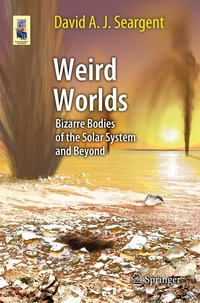
Weird Worlds
Bizarre Bodies of the Solar System and Beyond
1st Edition
Published on 18. April 2013
Book
Paperback/Softback
XIII, 309 pages
978-1-4614-7063-2 (ISBN)
Description
"Weird Worlds" is the third book in David Seargent's "Weird" series. This book assumes a basic level of astronomical understanding and concentrates on the "odd and interesting" aspects of planetary bodies, including asteroids and moons. From our viewpoint here on Earth, this work features the most unusual features of these worlds and the ways in which they appear "weird" to us. Within our own Solar System, odd facts such as the apparent reversal of the Sun in the skies of Mercury, CO2-driven fountains of dust on Mars, possible liquid water (and perhaps primitive life!) deep within the dwarf planet Ceres, and a variety of odd facts about the planetary moons are all discussed. A special chapter is devoted to Saturn's giant moon Titan, and its methane-based weather system and "hydrological" cycle. This chapter also includes recent speculation on the possibility of methane-based organisms and the form that these might take, if they really do exist. Beyond our Solar System, the book looks at the range of worlds discovered and hypothesized.
In "Weird Worlds," the author discusses planets where temperatures are so high that it rains molten iron, and others so cold that liquid methane floods across plains of ice! Worlds are described where the lightest element acts like a metal and where winds blow at thousands of miles per hour - as well as possible planets whose orbits are essentially parabolic.
In keeping with previous titles in David Seargent's "Weird" series, "Weird Worlds" contains several projects that astronomers of all levels can undertake.
In "Weird Worlds," the author discusses planets where temperatures are so high that it rains molten iron, and others so cold that liquid methane floods across plains of ice! Worlds are described where the lightest element acts like a metal and where winds blow at thousands of miles per hour - as well as possible planets whose orbits are essentially parabolic.
In keeping with previous titles in David Seargent's "Weird" series, "Weird Worlds" contains several projects that astronomers of all levels can undertake.
Reviews / Votes
From the reviews:
"David Seargent has the enviable ability to pick his way through an enormous amount of detail and to spice up our understanding of planets, moons, asteroids, and comets with the odd and interesting aspects of their physics and chemistry. He expertly balances the depth of our knowledge against the huge number of unknowns. . this engagingly written, introductory-level, and extremely accessible book will do much to encourage more people to investigate planets." (David W. Hughes, The Observatory, Vol. 134 (1239), April, 2014)
"Seargent (Australian Sky and Telescope) begins with the most curious features of the major planets, and then leads readers to some of the innumerable minor bodies in the solar system, such as asteroids, comets, moons, Kuiper Belt objects, and dwarf planets like Pluto and Ceres. . While Weird Worlds is certainly an excellent introduction to planetary science, it is really a tour guide of the solar system--and beyond. Summing Up: Recommended. All levels/libraries." (T. D. Oswalt, Choice, Vol. 51 (4), December, 2013)More details
Series
Language
English
Place of publication
New York
United States
Target group
Popular/general
Illustrations
28 s/w Abbildungen, 23 farbige Abbildungen
XIII, 309 p. 51 illus., 23 illus. in color.
Dimensions
Height: 235 mm
Width: 155 mm
Thickness: 17 mm
Weight
552 gr
ISBN-13
978-1-4614-7063-2 (9781461470632)
DOI
10.1007/978-1-4614-7064-9
Schweitzer Classification
Other editions
Additional editions
E-Book
04/2013
1st Edition
Springer
€37.44
Available for download
Person
David A. J. Seargent holds an MA and Ph.D., both in Philosophy from the University of Newcastle NSW, where he formerly worked as a tutor in Philosophy for the Department of Community of Programs/Worker's Educational Association external education program. As an amateur astronomer, he is known for his observations of comets, one of which he discovered in 1978. He is the author of four astronomy books: "Comets - Vagabonds in Space" (Doubleday, 1982), "The Greatest Comets in History" (Springer, 2008), "Weird Astronomy" (Springer, 2010), and most recently "Weird Weather" (Springer, 2012). He is the author of a regular column in "Australian Sky and Telescope" magazine.
Content
Oddities of the Inner Worlds.- Strange Little Worlds - Asteroids and Their Kin.- The Many Moons of the Solar System.- Titan - Weirdest World of Them All?.- Oddities of the Outer Worlds.- Strange Worlds Afar.- Observational Projects.