

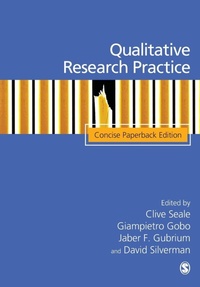
Qualitative Research Practice
Concise Paperback Edition
Published on 15. November 2006
Book
Paperback/Softback
552 pages
978-1-4129-3420-6 (ISBN)
Description
'This book is jam-packed with a wide range of material related to qualitative research.... [T]his is a quality text and has much to offer the reader, especially the novice researcher' - Nurse Researcher
`This comprehensive collection of almost 40 chapters - each written by a leading expert in the field - is the essential reference for anyone undertaking or studying qualitative research. It covers a diversity of methods and a variety of perspectives and is a very practical and informative guide for newcomers and experienced researchers alike' - John Scott, University of Essex
`The best ways in which to understand the issues and processes informing qualitative research is to learn from the accounts of its leading practitioners. Here they come together in what is a distinctive and wide-ranging collection that will appeal to postgraduates and social researchers in general' - Tim May, University of Salford
`This excellent guide engages in a dialogue with a wide range of expert qualitative researchers, each of whom considers their own practice in an illuminating and challenging way. Overall, the book constitutes an authoritative survey of current methods of qualitative research data collection and analysis' - Nigel Gilbert, University of Surrey
This concise paperback edition of the best selling handbook, Qualitative Research Practice, is particularly aimed at the student reader. The chapters are written by leading, internationally distinguished qualitative researchers who recount and reflect on their own research experiences as well as others, past and present, from whom they have learned. It demonstrates the benefits of using particular methods from the viewpoint of real-life experience. This is also a good philosophy for students to adopt in planing research work: to begin from a practical conception of the research process and to treat a book like this as an opportunity to learn a valuable craft.
From the outside, good research seems to be produced through practitioners learning and following standard theoretical, empirical and procedural formats. But from the inside we learn that qualitative research (like other forms of scientific endeavour) is also a biographical engagement, rendering its scholarly and practical contributions in its own terms. Standards take on practical meaning as the distinct activities of qualitative research resonate throughout the enterprise, complicating its accountability to itself and to others. In an authoritative yet accessible manner, Qualitative Research Practice reveals the special features of this engagement, teaching us that qualitative research is as much a craft and practice as it is a way of knowing.
Presenting a comprehensive examination of contemporary and traditional varieties of qualitative research practice, Qualitative Research Practice will be an invaluable resource for advanced students and researchers in any discipline. It is an essential and definitive guide to the major forms of qualitative methods in use today, written by leaders in the relevant fields of research practice.
`This comprehensive collection of almost 40 chapters - each written by a leading expert in the field - is the essential reference for anyone undertaking or studying qualitative research. It covers a diversity of methods and a variety of perspectives and is a very practical and informative guide for newcomers and experienced researchers alike' - John Scott, University of Essex
`The best ways in which to understand the issues and processes informing qualitative research is to learn from the accounts of its leading practitioners. Here they come together in what is a distinctive and wide-ranging collection that will appeal to postgraduates and social researchers in general' - Tim May, University of Salford
`This excellent guide engages in a dialogue with a wide range of expert qualitative researchers, each of whom considers their own practice in an illuminating and challenging way. Overall, the book constitutes an authoritative survey of current methods of qualitative research data collection and analysis' - Nigel Gilbert, University of Surrey
This concise paperback edition of the best selling handbook, Qualitative Research Practice, is particularly aimed at the student reader. The chapters are written by leading, internationally distinguished qualitative researchers who recount and reflect on their own research experiences as well as others, past and present, from whom they have learned. It demonstrates the benefits of using particular methods from the viewpoint of real-life experience. This is also a good philosophy for students to adopt in planing research work: to begin from a practical conception of the research process and to treat a book like this as an opportunity to learn a valuable craft.
From the outside, good research seems to be produced through practitioners learning and following standard theoretical, empirical and procedural formats. But from the inside we learn that qualitative research (like other forms of scientific endeavour) is also a biographical engagement, rendering its scholarly and practical contributions in its own terms. Standards take on practical meaning as the distinct activities of qualitative research resonate throughout the enterprise, complicating its accountability to itself and to others. In an authoritative yet accessible manner, Qualitative Research Practice reveals the special features of this engagement, teaching us that qualitative research is as much a craft and practice as it is a way of knowing.
Presenting a comprehensive examination of contemporary and traditional varieties of qualitative research practice, Qualitative Research Practice will be an invaluable resource for advanced students and researchers in any discipline. It is an essential and definitive guide to the major forms of qualitative methods in use today, written by leaders in the relevant fields of research practice.
Reviews / Votes
'This book is jam-packed with a wide range of material related to qualitative research.... [T]his is a quality text and has much to offer the reader, especially the novice researcher' - Nurse ResearcherMore details
Edition
Abridged edition
Language
English
Place of publication
Thousand Oaks
United States
Target group
Professional and scholarly
Edition type
Abridged edition
Dimensions
Height: 244 mm
Width: 170 mm
Thickness: 30 mm
Weight
944 gr
ISBN-13
978-1-4129-3420-6 (9781412934206)
Copyright in bibliographic data and cover images is held by Nielsen Book Services Limited or by the publishers or by their respective licensors: all rights reserved.
Schweitzer Classification
Other editions
Additional editions
Clive Seale | Giampietro Gobo | Jaber F. Gubrium
Qualitative Research Practice
Concise Paperback Edition
E-Book
11/2006
SAGE Publications Ltd
from
€60.69
Available for download
Clive Seale | David Silverman | Jaber F. Gubrium
Qualitative Research Practice
Concise Paperback Edition
E-Book
11/2006
SAGE Publications Ltd
€60.69
Available for download
Persons
Clive Seale has been Professor of Sociology (or Medical Sociology) at Goldsmiths and Queen Mary's (both University of London) and Brunel University. His work has concerned communication in health care and death in modern society. He has published extensively on research methods. His books include Constructing Death: the sociology of dying and bereavement (Cambridge University Press, 1998), The Quality of Qualitative Research (Sage, 1999), Media and Health (Sage, 2003) and Gender and the Language of Illness (Palgrave-Macmillan, 2010, with Jonathan Charteris-Black). Recently, he has turned to fiction, publishing a novel, Interrogating Ellie (Cloiff Books, 2015) using the pen name Julian Gray. He is currently writing another novel.
David Silverman trained as a sociologist at the London School of Economics and the University of California, Los Angeles. He taught for 32 years at Goldsmiths, University of London. He is interested in conversation and discourse analysis and he has researched medical consultations and HIV-test counselling.
He is the author of Interpreting Qualitative Data (Seventh Edition, 2024) and A Very Short, Fairly Interesting and Reasonably Cheap Book about Qualitative Research (Second Edition, 2013). He is also the editor of Qualitative Research (Sixth Edition, 2026) and the Sage series, Introducing Qualitative Methods. In recent years, he has offered short, hands-on workshops in qualitative research for research students and faculty at universities in Europe, Asia, Africa and Australia.
Now retired from full-time work, David aims to watch one hundred days of cricket a year. He also enjoys voluntary work in an old people's home where he sings with residents with dementia and strokes.
Jaber F. Gubrium is professor and chair of sociology at the University of Missouri. He has an extensive record of research on the social organization of care in human service institutions. His publications include numerous books and articles on aging, family, the life course, medicalization, and representational practice in therapeutic context. Giampietro Gobo is Professor of Methodology of Social Research and Sociology of Science at the University of Milan (Italy). He was one of the founders of the 'Qualitative Methods' Research Network of the European Sociological Association.
His interests concern scientific controversies on health issues and workplace studies. He is currently undertaking projects on immunization and COVID-19 policies, and ethnographic experiments in the area of cooperation in small teamwork. His books include Doing Ethnography (Sage, 2008), Qualitative Research Practice (co-edited with C. Seale, J. F. Gubrium and D. Silverman, Sage, 2004) and Constructing Survey Data: An Interactional Approach (with S. Mauceri, Sage, 2014).
David Silverman trained as a sociologist at the London School of Economics and the University of California, Los Angeles. He taught for 32 years at Goldsmiths, University of London. He is interested in conversation and discourse analysis and he has researched medical consultations and HIV-test counselling.
He is the author of Interpreting Qualitative Data (Seventh Edition, 2024) and A Very Short, Fairly Interesting and Reasonably Cheap Book about Qualitative Research (Second Edition, 2013). He is also the editor of Qualitative Research (Sixth Edition, 2026) and the Sage series, Introducing Qualitative Methods. In recent years, he has offered short, hands-on workshops in qualitative research for research students and faculty at universities in Europe, Asia, Africa and Australia.
Now retired from full-time work, David aims to watch one hundred days of cricket a year. He also enjoys voluntary work in an old people's home where he sings with residents with dementia and strokes.
Jaber F. Gubrium is professor and chair of sociology at the University of Missouri. He has an extensive record of research on the social organization of care in human service institutions. His publications include numerous books and articles on aging, family, the life course, medicalization, and representational practice in therapeutic context. Giampietro Gobo is Professor of Methodology of Social Research and Sociology of Science at the University of Milan (Italy). He was one of the founders of the 'Qualitative Methods' Research Network of the European Sociological Association.
His interests concern scientific controversies on health issues and workplace studies. He is currently undertaking projects on immunization and COVID-19 policies, and ethnographic experiments in the area of cooperation in small teamwork. His books include Doing Ethnography (Sage, 2008), Qualitative Research Practice (co-edited with C. Seale, J. F. Gubrium and D. Silverman, Sage, 2004) and Constructing Survey Data: An Interactional Approach (with S. Mauceri, Sage, 2014).
Content
Introduction - Clive Seale et al
Inside Qualitative Research
PART ONE: ENCOUNTERING METHOD
Interviews - Tim Rapley
Oral History - Joanna Bornat
Biographical Research - Gabriele Rosenthal
Focus Groups - Phil Macnaghten and Greg Myers
Grounded Theory - Ian Dey
PART TWO: ANALYTIC FRAMEWORKS
Narrative Research - Molly Andrews et al
Feminist Approaches - Celia Kitzinger
The Foucaultian Framework - Gavin Kendall and Gary Wickham
Ethnomethodology - Paul ten Have
Conversation Analysis - Anssi Peraekylae
Discourse Analytic Practice - Alexa Hepburn and Jonathan Potter
Critical Discourse Analysis - Ruth Wodak
PART THREE: FIELD RELATIONS
Ethnography and Participant Observation - Sara Delamont
Ethical Issues - Anne Ryen
Working in Hostile Environments - Nigel Fielding
Politics, Research and Understanding - Les Back
PART FOUR: CONTEXT AND METHOD
Context - James A Holstein and Jaber F Gubrium
Working It Up, Down and Across
Working Qualitatively and Quantitatively - Julia Brannen
Secondary Analysis of Archived Data - Louise Corti and Paul Thompson
Reanalysis of Previously Collected Material - Malin Akerstroem, Katarina Jacobsson and David Waesterfors
The Internet as Research Context - Annette N Markham
Documents - Lindsay Prior
Visual Methods - Sarah Pink
PART FIVE: QUALITY AND CREDIBILITY
Quality in Qualitative Research - Clive Seale
Five Misunderstandings about Case-Study Research - Bent Flyvbjerg
Sampling, Representatives and Generalizability - Giampietro Gobo
Working with 'Key Incidents' - Robert M Emerson
Computer-Assisted Qualitative Data Analysis - Udo Kelle
PART SIX: AUDIENCES AND APPLICATIONS AND THE INTERNATIONAL CONTEXT
Qualitative Evaluation Research - Moira J Kelly
Action Research - Donna Ladkin
Publishing Qualitative Manuscripts - Donileen R Loseke and Spencer E Cahill
Lessons Learned
The Globalization of Qualitative Research - Pertti Alasuutari
Inside Qualitative Research
PART ONE: ENCOUNTERING METHOD
Interviews - Tim Rapley
Oral History - Joanna Bornat
Biographical Research - Gabriele Rosenthal
Focus Groups - Phil Macnaghten and Greg Myers
Grounded Theory - Ian Dey
PART TWO: ANALYTIC FRAMEWORKS
Narrative Research - Molly Andrews et al
Feminist Approaches - Celia Kitzinger
The Foucaultian Framework - Gavin Kendall and Gary Wickham
Ethnomethodology - Paul ten Have
Conversation Analysis - Anssi Peraekylae
Discourse Analytic Practice - Alexa Hepburn and Jonathan Potter
Critical Discourse Analysis - Ruth Wodak
PART THREE: FIELD RELATIONS
Ethnography and Participant Observation - Sara Delamont
Ethical Issues - Anne Ryen
Working in Hostile Environments - Nigel Fielding
Politics, Research and Understanding - Les Back
PART FOUR: CONTEXT AND METHOD
Context - James A Holstein and Jaber F Gubrium
Working It Up, Down and Across
Working Qualitatively and Quantitatively - Julia Brannen
Secondary Analysis of Archived Data - Louise Corti and Paul Thompson
Reanalysis of Previously Collected Material - Malin Akerstroem, Katarina Jacobsson and David Waesterfors
The Internet as Research Context - Annette N Markham
Documents - Lindsay Prior
Visual Methods - Sarah Pink
PART FIVE: QUALITY AND CREDIBILITY
Quality in Qualitative Research - Clive Seale
Five Misunderstandings about Case-Study Research - Bent Flyvbjerg
Sampling, Representatives and Generalizability - Giampietro Gobo
Working with 'Key Incidents' - Robert M Emerson
Computer-Assisted Qualitative Data Analysis - Udo Kelle
PART SIX: AUDIENCES AND APPLICATIONS AND THE INTERNATIONAL CONTEXT
Qualitative Evaluation Research - Moira J Kelly
Action Research - Donna Ladkin
Publishing Qualitative Manuscripts - Donileen R Loseke and Spencer E Cahill
Lessons Learned
The Globalization of Qualitative Research - Pertti Alasuutari