

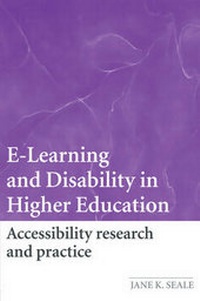
E-Learning and Disability in Higher Education
Accessibility Research and Practice
Published on 18. May 2006
Book
Hardback
240 pages
978-0-415-38309-7 (ISBN)
Description
Most practitioners know that they should make e-learning accessible to students with disabilities, yet it is not always clear exactly how this should be done. E-Learning and Disability in Higher Education evaluates current practice and provision and explores the tools, methods and approaches available for improving accessible practice.
Examining the social, educational and political background behind making e-learning accessible in higher and further education, this book considers the role of and provides advice for, the key stake-holders involved in e-learning provision: lecturers, learning technologists, student support services, staff developers and senior managers.
Key topics covered include:
the opportunites that e-learning can offer students with disabilities
the impact of accessibility legislation, guidelines and standards on current e-learning practices
the reliability and validity of accessibility related evaluation and repair tools
practical guidelines for 'best practice' in providing accessible e-learning experiences.
E-Learning and Disability in Higher Education is valuable reading for all practitioners and researchers involved in the design and delivery of accessible e-learning in higher, further and distance education.
Examining the social, educational and political background behind making e-learning accessible in higher and further education, this book considers the role of and provides advice for, the key stake-holders involved in e-learning provision: lecturers, learning technologists, student support services, staff developers and senior managers.
Key topics covered include:
the opportunites that e-learning can offer students with disabilities
the impact of accessibility legislation, guidelines and standards on current e-learning practices
the reliability and validity of accessibility related evaluation and repair tools
practical guidelines for 'best practice' in providing accessible e-learning experiences.
E-Learning and Disability in Higher Education is valuable reading for all practitioners and researchers involved in the design and delivery of accessible e-learning in higher, further and distance education.
Reviews / Votes
'Here is a very timely book (though even more timely would be such a careful and thoughtful coverage on disabled students in conventional classrooms, labs and libraries). The author's main area is educational innovation, though she has a strong proactive interest in barriers to learning and assistive technology ... but, of course, overcoming students' disabilities at university would indeed be educational innovation.' - British Journal of Educational Technology, Vol 38 No 2 2007More details
Language
English
Place of publication
London
United Kingdom
Publishing group
Taylor & Francis Ltd
Target group
College/higher education
Professional and scholarly
Illustrations
4 s/w Zeichnungen, 5 s/w Tabellen
4 Line drawings, black and white; 5 Tables, black and white
Dimensions
Height: 229 mm
Width: 152 mm
Weight
506 gr
ISBN-13
978-0-415-38309-7 (9780415383097)
Copyright in bibliographic data and cover images is held by Nielsen Book Services Limited or by the publishers or by their respective licensors: all rights reserved.
Schweitzer Classification
Other editions
New editions

Book
08/2013
2nd Edition
Routledge
€206.60
Shipment within 15-20 days
Additional editions
Book
06/2006
Routledge
€63.32
Article exhausted; check for reprint
Person
Content
Section 1: Contextualising the Scene 1. Introduction 2. Disability 3. Accessibility 4. E-Learning Section 2: Surveying the Scene 5. The Student's Perspective 6. The Lecturer's Perspective 7. The Senior Manager's Perspective 8. The Staff and Educational Developer's Perspective 9. The Student Support Service's Perspective 10. The Learning Technologist's Perspective Section 3: Conceptualising the Scene 11. Politics, Games and Rules 12. Communities, Enterprises and Boundary Practices 13. Products or Practices? 14. Conclusions