

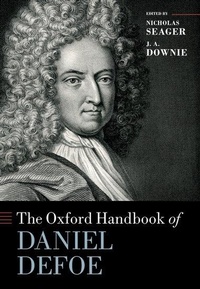
The Oxford Handbook of Daniel Defoe
Published on 14. December 2023
Book
Hardback
720 pages
978-0-19-882717-7 (ISBN)
Description
The Oxford Handbook of Daniel Defoe is the most comprehensive overview available of the author's life, times, writings, and reception. Daniel Defoe (1660-1731) is a major author in world literature, renowned for a succession of novels including Robinson Crusoe, Moll Flanders, and A Journal of the Plague Year, but more famous in his lifetime as a poet, journalist, and political agent. Across his vast oeuvre, which includes books, pamphlets, and periodicals, Defoe commented on virtually every development and issue of his lifetime, a turbulent and transformative period in British and global history. Defoe has proven challenging to position--in some respects he is a traditional and conservative thinker, but in other ways he is a progressive and innovative writer. He therefore benefits from the range of critical appraisals offered in this Handbook.
The Handbook ranges from concerns of gender, class, and race to those of politics, religion, and economics. In accessible but learned chapters, contributors explore salient contexts in ways that show how they overlap and intersect, such as in chapters on science, environment, and empire. The Handbook provides both a thorough introduction to Defoe and to early eighteenth-century society, culture, and literature more broadly. Thirty-six chapters by leading literary scholars and historians explore the various genres in which Defoe wrote; the sociocultural contexts that inform his works; his writings on different locales, from the local to the global; and the posthumous reception and creative responses to his works.
The Handbook ranges from concerns of gender, class, and race to those of politics, religion, and economics. In accessible but learned chapters, contributors explore salient contexts in ways that show how they overlap and intersect, such as in chapters on science, environment, and empire. The Handbook provides both a thorough introduction to Defoe and to early eighteenth-century society, culture, and literature more broadly. Thirty-six chapters by leading literary scholars and historians explore the various genres in which Defoe wrote; the sociocultural contexts that inform his works; his writings on different locales, from the local to the global; and the posthumous reception and creative responses to his works.
Reviews / Votes
The book offers a summative report on the current state of Defoe studies while also elucidating future forms of inquiry in several different directions. The Oxford Handbook of Daniel Defoe aptly demonstrates the range as well as the depth of understanding found in thismost prolific of literary authors.Indeed, due to Defoe's intimate acquaintance with and participation in most aspects of his world, the Handbook, while brilliantly illuminating Defoe, exhibits a panoramic primer of the late Restoration and early Augustan periods. * Modern Philology *More details
Series
Language
English
Place of publication
Oxford
United Kingdom
Target group
College/higher education
Product notice
sewn/stitched
Cloth over boards
Illustrations
13 Illustrations
Dimensions
Height: 239 mm
Width: 183 mm
Thickness: 71 mm
Weight
1429 gr
ISBN-13
978-0-19-882717-7 (9780198827177)
Copyright in bibliographic data and cover images is held by Nielsen Book Services Limited or by the publishers or by their respective licensors: all rights reserved.
Schweitzer Classification
Other editions
Additional editions
E-Book
11/2023
1st Edition
OUP eBook
€128.99
Available for download
E-Book
11/2023
1st Edition
OUP eBook
€128.99
Available for download
Persons
Nicholas Seager is Professor of English Literature and Head of the School of Humanities at Keele University. He has published on literature of the long eighteenth century, including Bunyan, Swift, Defoe, Richardson, Johnson, Sterne, Goldsmith, and Austen. He is the editor of The Cambridge Edition of the Correspondence of Daniel Defoe (2022), and co-editor of The Afterlives of Eighteenth-Century Fiction (2015) and The Cambridge Companion to Gulliver's Travels (2023). He has recently completed an edition of Defoe's The Fortunate Mistress for Oxford World's Classics.
J. A. Downie is Emeritus Professor of English at Goldsmiths, University of London, where he was Dean of the Faculty of Arts from 1991 to 1995 and Pro-Warden (Academic) from 1995 to 2002. His books include Robert Harley and the Press (1979), Jonathan Swift, Political Writer (1984), To Settle the Succession of the State: Literature and Politics, 1678-1750 (1994), and A Political Biography of Henry Fielding (2009). He edited two volumes in the Pickering Masters edition of The Works of Daniel Defoe. He also edited of The Oxford Handbook of the Eighteenth-Century Novel (2016).
J. A. Downie is Emeritus Professor of English at Goldsmiths, University of London, where he was Dean of the Faculty of Arts from 1991 to 1995 and Pro-Warden (Academic) from 1995 to 2002. His books include Robert Harley and the Press (1979), Jonathan Swift, Political Writer (1984), To Settle the Succession of the State: Literature and Politics, 1678-1750 (1994), and A Political Biography of Henry Fielding (2009). He edited two volumes in the Pickering Masters edition of The Works of Daniel Defoe. He also edited of The Oxford Handbook of the Eighteenth-Century Novel (2016).
Content
1: Brian Cowan: Defoe's Life and Times Part I. Genres 2: Maximillian E. Novak: Defoe's Poetry 3: Geoffrey Sill: Defoe, Prose Fiction, and the Novel 4: Cynthia Wall: Defoe and Drama 5: Penny Pritchard: Dialogue and Didacticism: Defoe's Conduct and Advice Literature 6: Jeffrey Hopes: The Great Polemicist: Defoe's Pamphlets and Tracts 7: Ashley Marshall: Defoe's Periodical Journalism 8: Paul Baines: Defoe and the Idea of Travel 9: Rebecca Bullard: Defoe as Historian 10: Marc Mierowsky: The Style of Defoe's Correspondence 11: Joseph Hone: Defoe and Satire Part II. Contexts 12: Pat Rogers: Defoe and the Book Trade 13: J. A. Downie: Daniel Defoe and the Social Structure of Pre-Industrial England 14: Nicholas Seager: Defoe and Economics: Industry, Trade, and Finance 15: Paula R. Backscheider: Gender, Sexuality, and the Status of Women in Defoe's Writings 16: Liz Bellamy: Family and Domesticity in Defoe's Writings 17: David Walker: Defoe and Christianity 18: John Richetti: Defoe, Philosophy, and Religion 19: Christopher F. Loar: Defoe, Science, and Technology 20: D. W. Hayton: Defoe and Government: Propaganda and Principle 21: Katherine Ellison: Intelligence, Espionage, and the Ethics of Surveillance in Defoe's Writings 22: Sharon Alker and Holly Faith Nelson: Defoe and War 23: Kate Loveman: Crime and the Law in Defoe's Works 24: Srividhya Swaminathan: Racial and National Identities in Defoe's Writings 25: Lucinda Cole: Defoe and Ecology Part III. Places 26: Brean S. Hammond: Defoe and London 27: Adam Sills: Defoe and Britain 28: Andreas K. E. Mueller: Defoe's Europe: Allies and Enemies 29: Markman Ellis: Defoe and Colonialism 30: Robert Markley: Defoe and the Pacific 31: Rebekah Mitsein and Manushag N. Powell: Africa and the Levant in Defoe's Writings Part IV. Afterlives 32: Nicholas Seager: The Celebrated Daniel De Foe: Publication History, 1731-1945 33: Kit Kincade: Defoe's Critical Reception, 1731-1945 34: Benjamin F. Pauley: Attribution and the Defoe Canon 35: Rivka Swenson: Habits of Gender and Genre in Three Female Robinsonades, 1767-1985 36: Robert Mayer: Defoe on Screen: Robinson Crusoe, The Red Turtle, and Animal Rights