

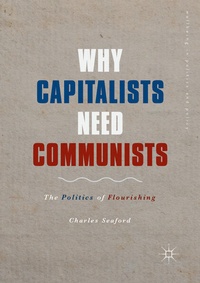
Why Capitalists Need Communists
The Politics of Flourishing
Published on 22. February 2019
Book
Paperback/Softback
XVIII, 244 pages
978-3-319-98754-5 (ISBN)
Description
Britain faces huge challenges: inequality, public services under constant pressure, climate change - and in the long term, the impacts of automation and artificial intelligence. At the same time, the political and economic elite seem to have reached an impasse: there is a sense that things can only get worse. In
Why Capitalists Need Communists
, Charles Seaford demonstrates that this need not be, that radical, progressive change is perfectly possible and that the polarisation and nostalgia afflicting us is not inevitable. History shows that it is precisely when the ruling elite loses confidence - which it has - that significant change happens and that new alliances are formed to take over. Tackling the challenges will take planning, redistribution, re-fashioned business and finance, and a new ideology - one which confirms that we really can create the conditions for more people to flourish. But this is not a pipe-dream. This book sets out just how this can come about, based on interviews with over 50 business people, politicians, analysts and activists. Everyone with an interest in the future should read it.
Reviews / Votes
"Big moments, when we face both huge problems and opportunities, require big books about how we make the desirable feasible. Why Capitalists Need Communists meets the challenge of the moment by addressing key issues, not just posing the problem but offering answers. Charles Seaford has done the progressive community a great service." (Neal Lawson, Director, Compass, UK) "Charles Seaford clearly and intelligently articulates the challenges that the capitalist system is facing today and manages to thread together the thoughts of those (from both sides of the divide, so to speak) who can see this failure and wish to put the system back on a more sustainable tack that serves the majority of citizens rather than a small minority; and weaves a plausible road map of how we can help heal our society. This is a must read for politicians, professional investors and civil society activists who are looking to get a better understanding of the challenge facing us and a glimmer of an idea of how we can tackle it." (Saker Nusseibeh, Chief Executive, Hermes Investment Management, UK) "Speaking as one of what Charles Seaford describes as market liberals who believe that markets are almost always the best way of organising economic activity, but also that governments have to intervene in them, and that governments have to invest in public services, I can say that I see absolutely no need for the new ideology he promotes in this book; but I can say with equal certainty that his thesis deserves to be debated, and that anyone with a serious interest in political ideas will find this book well written and highly stimulating?" (Oliver Letwin, Conservative MP for West Dorset) "Free market capitalism is failing and ruling elites are losing their nerve. What better time for progressives to strike back? From workers on boards to resurgent trade unionism, this book signposts the way to a greener, fairer economy." (Frances O'Grady, General Secretary, the TUC)More details
Series
Edition
2019 ed.
Language
English
Place of publication
Cham
Switzerland
Publishing group
Springer International Publishing
Illustrations
1 s/w Abbildung, 2 farbige Abbildungen
XVIII, 244 p. 3 illus., 2 illus. in color.
Dimensions
Height: 210 mm
Width: 148 mm
Thickness: 15 mm
Weight
346 gr
ISBN-13
978-3-319-98754-5 (9783319987545)
DOI
10.1007/978-3-319-98755-2
Schweitzer Classification
Other editions
Additional editions
E-Book
02/2019
1st Edition
Palgrave Macmillan
€24.60
Available for download
Person
Charles Seaford is a co-investigator at the Centre for Understanding Sustainable Prosperity, UK, and was formerly Head of the Centre for Wellbeing at the New Economics Foundation.
Content
1: Introduction.- 2: Dystopia and Utopia.- 3: Flourishing and its Role.- 4: Change in the Past (1).- 5: Change in the Past (2).- 6: A Stagnant Society?.- 7: Planning.- 8: Redistribution.- 9: The System's Limits.- 10: Structural Change.- Epilogue: Where Now?.