

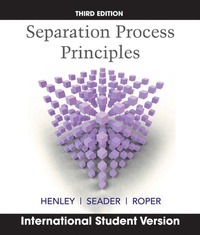
Separation Process Principles
International Student Version
3rd Edition
Published on 8. March 2011
Book
Paperback/Softback
936 pages
978-0-470-64611-3 (ISBN)
Description
Completely rewritten to enhance clarity, this third edition provides engineers with a strong understanding of the field. With the help of an additional co-author, the text presents new information on bioseparations throughout the chapters. A new chapter on mechanical separations covers settling, filtration, and centrifugation, including mechanical separations in biotechnology and cell lysis. Boxes help highlight fundamental equations. Numerous new examples and exercises are integrated throughout as well. In addition, frequent references are made to the software products and simulators that will help engineers find the solutions they need.
More details
Edition
3., Auflage
Language
English
Place of publication
Chichester
United Kingdom
Publishing group
John Wiley and Sons Ltd
Target group
Professional and scholarly
Illustrations
ill
Dimensions
Height: 25.1 cm
Width: 21.4 cm
Thickness: 30 mm
Weight
1660 gr
ISBN-13
978-0-470-64611-3 (9780470646113)
Schweitzer Classification
Other editions
New editions
J. D. Seader | Ernest J. Henley | D. Keith Roper
Separation Process Principles
With Applications Using Process Simulators, EMEA Edition
Book
07/2019
4th Edition
Wiley
€63.50
Shipment within 15-20 days
Content
1. Separation Processes.
2. Thermodynamics of Separation Operations.
3. Mass Transfer and Diffusion.
4. Single Equilibrium Stages and Flash Calculations.
5. Cascades and Hybrid Systems.
6. Absorption and Stripping of Dilute Mixtures.
7. Distillation of Binary Mixtures.
8. Liquid-Liquid Extraction with Ternary Systems.
9. Approximate Methods for Multicomponent, Multistage Separations.
10. Equilibrium-Based Methods for Multicomponent Absorption, Stripping,
11. Enhanced Distillation and Supercritical Extraction.
12. Rate-Based Models for Vapor-Liquid Separation Operations.
13. Batch Distillation.
14. Membrane Separations.
15. Adsorption, Ion Exchange, Chromatography, and Electrophoresis.
16. Leaching and Washing.
17. Crystallization, Desublimation, and Evaporation.
18. Drying of Solids.
19. Mechanical Phase Separations.