

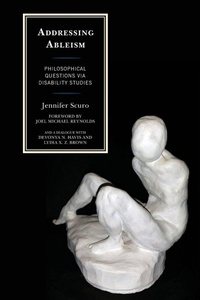
Addressing Ableism
Philosophical Questions via Disability Studies
Published on 31. May 2019
Book
Paperback/Softback
276 pages
978-1-4985-4076-6 (ISBN)
Description
Addressing Ableism is a set of philosophical meditations outlining the scale and scope of ableism. By explicating concepts like experience, diagnosis, precariousness, and prosthesis, Scuro maps out the institutionalized and intergenerational forms of this bias as it is analogous and yet also distinct from other kinds of dehumanization, discrimination, and oppression. This project also includes a dialogical chapter on intersectionality with Devonya Havis and Lydia Brown, a philosopher and writer/activist respectively. Utilizing theorists like Judith Butler, Tobin Siebers, Emmanuel Levinas, and Hannah Arendt to address ableism, Scuro thoroughly critiques the neoliberal culture and politics that underwrites ableist affections and phobias. This project exposes the many material and non-material harms of ableism, and it offers multiple avenues to better confront and resist ableism in its many forms. Scuro provides crucial insights into the many uninhabitable and unsustainable effects of ableism and how we might revise our intentions and desires for the sake of a less ableist world.
Reviews / Votes
Addressing Ableism is a transformative work. The book provides a detailed and rigorous archaeology of contemporary ableism, and compellingly argues for the ethical imperative to resist it. It provides a powerful framework for such resistance in not only in its content but also its form. Its fusion of philosophical analysis with memoir and social critique make it both intellectually and emotionally affecting, and Scuro's dialogue with Lydia Brown and Devonya Havis models the kinds of conversations she hopes to provoke. This book is a major contribution to disability studies, and its insights expand the customary boundaries of the field. -- Harold Braswell, St. Louis University Addressing Ableism: Philosophical Questions via Disability Studies, by Jennifer Scuro in collaboration with Devonya Havis and Lydia X. Brown, is a vital new contribution to the annals of philosophy of disability and to philosophical discourse more generally. . . The book spans a wide spectrum of issues and concerns that the disability studies community has introduced into academic discourse, considers the political character of the ontological and ethical claims of other philosophers of disability, incorporates Scuro's personal reflections on her own social and institutional position as a white, nondisabled philosopher of disability with a disabled child, and highlights a fascinating and provocative dialogue that Scuro engages in with Havis, a Black disabled woman, and Brown, a disabled queer of color. Indeed, the attention that Scuro gives to the details of oft-overlooked conflicts and controversies that surround critical work on disability, the diversity and volume of research that she uses throughout the book, and the centrality to the aims and design of the book of the dialogue among Scuro and her interlocutors are among the book's most notable strengths. Taken together, these elements of Addressing Ableism combine to make it a unique philosophical journey. * Hypatia: A Journal of Feminist Philosophy *More details
Language
English
Place of publication
United States
Publishing group
Bloomsbury Publishing Plc
Target group
Professional and scholarly
Illustrations
9 b/w photos;
Dimensions
Height: 229 mm
Width: 152 mm
Thickness: 16 mm
Weight
456 gr
ISBN-13
978-1-4985-4076-6 (9781498540766)
Copyright in bibliographic data and cover images is held by Nielsen Book Services Limited or by the publishers or by their respective licensors: all rights reserved.
Schweitzer Classification
Other editions
Additional editions
E-Book
10/2017
1st Edition
Bloomsbury eBooks US
€42.49
Available for download
Persons
Content
Foreword by Joel Michael Reynolds
Prologue: the scale and scope of ableism
One: experience
Two: diagnosis
Three: intersectionality - a dialogue with Devonya N. Havis and Lydia X. Z. Brown
Four: precariousness
Five: prosthesis
Epilogue: parts and wholes
Prologue: the scale and scope of ableism
One: experience
Two: diagnosis
Three: intersectionality - a dialogue with Devonya N. Havis and Lydia X. Z. Brown
Four: precariousness
Five: prosthesis
Epilogue: parts and wholes