

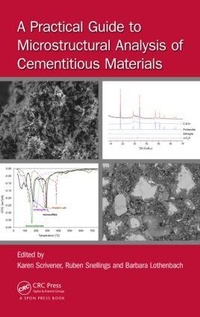
A Practical Guide to Microstructural Analysis of Cementitious Materials
1st Edition
Published on 22. December 2015
Book
Hardback
540 pages
978-1-4987-3865-1 (ISBN)
Description
A Practical Guide from Top-Level Industry Scientists
As advanced teaching and training in the development of cementitious materials increase, the need has emerged for an up-to-date practical guide to the field suitable for graduate students and junior and general practitioners.
Get the Best Use of Different Techniques and Interpretations of the Results
This edited volume provides the cement science community with a state-of-the-art overview of analytical techniques used in cement chemistry to study the hydration and microstructure of cements. Each chapter focuses on a specific technique, not only describing the basic principles behind the technique, but also providing essential, practical details on its application to the study of cement hydration. Each chapter sets out present best practice, and draws attention to the limitations and potential experimental pitfalls of the technique. Databases that supply examples and that support the analysis and interpretation of the experimental results strengthen a very valuable ready reference.
Utilizing the day-to-day experience of practical experts in the field, this book:
Covers sample preparation issues
Discusses commonly used techniques for identifying and quantifying the phases making up cementitious materials (X-ray diffraction and thermogravimetric analysis)
Presents good practice oncalorimetry and chemical shrinkage methods for studying cement hydration kinetics
Examines two different applications of nuclear magnetic resonance (solid state NMR and proton relaxometry)
Takes a look at electron microscopy, the preeminent microstructural characterization technique for cementitious materials
Explains how to use and interpret mercury intrusion porosimetry
Details techniques for powder characterization of cementitious materials
Outlines the practical application of phase diagrams for hydrated cements
Avoid common pitfalls by using A Practical Guide to Microstructural Analysis of Cementitious Materials. A one-of-a-kind reference providing the do's and don'ts of cement chemistry, the book presents the latest research and development of characterisation techniques for cementitious materials, and serves as an invaluable resource for practicing professionals specializing in cement and concrete materials and other areas of cement and concrete technology.
As advanced teaching and training in the development of cementitious materials increase, the need has emerged for an up-to-date practical guide to the field suitable for graduate students and junior and general practitioners.
Get the Best Use of Different Techniques and Interpretations of the Results
This edited volume provides the cement science community with a state-of-the-art overview of analytical techniques used in cement chemistry to study the hydration and microstructure of cements. Each chapter focuses on a specific technique, not only describing the basic principles behind the technique, but also providing essential, practical details on its application to the study of cement hydration. Each chapter sets out present best practice, and draws attention to the limitations and potential experimental pitfalls of the technique. Databases that supply examples and that support the analysis and interpretation of the experimental results strengthen a very valuable ready reference.
Utilizing the day-to-day experience of practical experts in the field, this book:
Covers sample preparation issues
Discusses commonly used techniques for identifying and quantifying the phases making up cementitious materials (X-ray diffraction and thermogravimetric analysis)
Presents good practice oncalorimetry and chemical shrinkage methods for studying cement hydration kinetics
Examines two different applications of nuclear magnetic resonance (solid state NMR and proton relaxometry)
Takes a look at electron microscopy, the preeminent microstructural characterization technique for cementitious materials
Explains how to use and interpret mercury intrusion porosimetry
Details techniques for powder characterization of cementitious materials
Outlines the practical application of phase diagrams for hydrated cements
Avoid common pitfalls by using A Practical Guide to Microstructural Analysis of Cementitious Materials. A one-of-a-kind reference providing the do's and don'ts of cement chemistry, the book presents the latest research and development of characterisation techniques for cementitious materials, and serves as an invaluable resource for practicing professionals specializing in cement and concrete materials and other areas of cement and concrete technology.
Reviews / Votes
"If we want to develop a true science of Portland cement and concrete we must rely on reliable test methods. This is what this book does. ...A must in any laboratory involved in Portland cement and concrete characterization."-Pierre-Claude Aitcin, Professor Emeritus Universite de Sherbrooke, Canada
"The book is written on a high scientific level. ... It incorporates all advanced testing techniques which are used in modern well-equipped laboratories."
-Hans W. Reinhardt, Professor Emeritus University of Stuttgart, Germany
"This book introduces detailed processes of micro-analyses which are useful for both researchers and practitioners. ... The microstructural analysis of cementitious materials is being developed rapidly and is popular among industries and academia. The contents are very timely and can be expected to serve many engineers."
-Koichi Maekawa, The University of Tokyo, Japan
More details
Language
English
Place of publication
Bosa Roca
United States
Publishing group
Taylor & Francis Inc
Target group
College/higher education
Professional and scholarly
Professional Practice & Development
Product notice
sewn/stitched
Cloth over boards
Illustrations
320 s/w Abbildungen, 39 s/w Tabellen
39 Tables, black and white; 320 Illustrations, black and white
Dimensions
Height: 241 mm
Width: 156 mm
Thickness: 35 mm
Weight
972 gr
ISBN-13
978-1-4987-3865-1 (9781498738651)
Copyright in bibliographic data and cover images is held by Nielsen Book Services Limited or by the publishers or by their respective licensors: all rights reserved.
Schweitzer Classification
Other editions
Additional editions
Karen Scrivener | Ruben Snellings | Barbara Lothenbach
A Practical Guide to Microstructural Analysis of Cementitious Materials
E-Book
10/2018
CRC Press
€107.99
Available for download
Karen Scrivener | Ruben Snellings | Barbara Lothenbach
A Practical Guide to Microstructural Analysis of Cementitious Materials
E-Book
10/2018
1st Edition
CRC Press
€107.99
Available for download
Karen Scrivener | Ruben Snellings | Barbara Lothenbach
A Practical Guide to Microstructural Analysis of Cementitious Materials
Book
07/2017
1st Edition
CRC Press
€100.50
Shipment within 10-20 days
Persons
Karen Scrivener is professor of construction materials at Ecole Polytechnique Federale de Lausanne, Switzerland. She is a former senior researcher of the Lafarge Research Center in Lyon and is a fellow of the Royal Academy of Engineering, of RILEM, and of the Institute of Materials, Minerals and Mining.
Ruben Snellings is a researcher of the Sustainable Materials Management unit at VITO, the Flemish Institute for Technological Research in Belgium.
Barbara Lothenbach is group leader of the Thermodynamic Modelling Group of the Laboratory for Concrete & Construction Chemistry at Empa, the Swiss Federal Institute for Materials Science & Technology.
Ruben Snellings is a researcher of the Sustainable Materials Management unit at VITO, the Flemish Institute for Technological Research in Belgium.
Barbara Lothenbach is group leader of the Thermodynamic Modelling Group of the Laboratory for Concrete & Construction Chemistry at Empa, the Swiss Federal Institute for Materials Science & Technology.
Content
Sample Preparation. Calorimetry. Chemical Shrinkage. X-Ray Powder Diffraction Thermogravimetric Analysis. High-Resolution Solid-State Nuclear Magnetic Resonance Spectroscopy. Proton Nuclear Magnetic Resonance Relaxometry. Electron Microscopy. Mercury Intrusion Porosimetry. Laser Diffraction and Gas Adsorption Techniques. Ternary Phase Diagrams