

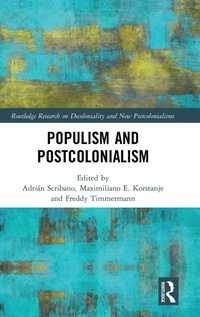
Populism and Postcolonialism
1st Edition
Published on 17. October 2019
Book
Hardback
200 pages
978-0-367-18070-6 (ISBN)
Description
This book investigates the interconnections between populism and neoliberalism through the lens of postcolonialism. Its primary focus is to build a distinct understanding of the concept of populism as a political movement in the twenty-first century, interwoven with the lasting effects of colonialism.
This volume particularly aims to fill the gap in the current literature by establishing a clear-cut connection between populism and postcolonialism. It sees populism as a contemporary and collective political response to the international crisis of the nation-state's limited capacity to deal with the burst of global capitalism into everyday life. Writings on Ecuador, Colombia, Chile, Brazil, Italy, France and Argentina offer regional perspectives which, in turn, provide the reader with a deepened global view of the main features of the multiple and complex relations between postcoloniality and populism.
This book will be of interest to sociologists, anthropologists and political scientists as well as postgraduate students who are interested in the problem of populism in the days of postcolonialism.
This volume particularly aims to fill the gap in the current literature by establishing a clear-cut connection between populism and postcolonialism. It sees populism as a contemporary and collective political response to the international crisis of the nation-state's limited capacity to deal with the burst of global capitalism into everyday life. Writings on Ecuador, Colombia, Chile, Brazil, Italy, France and Argentina offer regional perspectives which, in turn, provide the reader with a deepened global view of the main features of the multiple and complex relations between postcoloniality and populism.
This book will be of interest to sociologists, anthropologists and political scientists as well as postgraduate students who are interested in the problem of populism in the days of postcolonialism.
More details
Series
Language
English
Place of publication
London
United Kingdom
Publishing group
Taylor & Francis Ltd
Target group
College/higher education
Postgraduate and Undergraduate
Illustrations
4 s/w Abbildungen, 2 s/w Photographien bzw. Rasterbilder, 2 s/w Zeichnungen, 3 s/w Tabellen
3 Tables, black and white; 2 Line drawings, black and white; 2 Halftones, black and white; 4 Illustrations, black and white
Dimensions
Height: 240 mm
Width: 161 mm
Thickness: 16 mm
Weight
490 gr
ISBN-13
978-0-367-18070-6 (9780367180706)
Copyright in bibliographic data and cover images is held by Nielsen Book Services Limited or by the publishers or by their respective licensors: all rights reserved.
Schweitzer Classification
Other editions
Additional editions
Adrian Scribano | Maximiliano E. Korstanje | Freddy Timmermann Lopez
Populism and Postcolonialism
Book
06/2021
1st Edition
Routledge
€65.10
Shipment within 10-20 days
Adrian Scribano | Maximiliano E. Korstanje | Freddy Timmermann Lopez
Populism and Postcolonialism
E-Book
10/2019
1st Edition
Routledge
€59.49
Available for download
Adrian Scribano | Maximiliano E. Korstanje | Freddy Timmermann Lopez
Populism and Postcolonialism
E-Book
10/2019
1st Edition
Routledge
€59.49
Available for download
Persons
Adrian Scribano is Director of the Centre for Sociological Research and Studies and Principal Researcher at the National Scientific and Technological Research Council, Argentina. He is also the Director of the Latin American Journal of Studies on Bodies, Emotions and Society and the Study Group on Sociology of Emotions and Bodies, in the Gino Germani Research Institute, Faculty of Social Sciences, University of Buenos Aires.
Maximiliano E. Korstanje is a global cultural theorist specialising in terrorism, mobilities and tourism. He is a Senior Researcher at the University of Palermo, Buenos Aires (Economics Department) and Editor in Chief of the International Journal of Safety and Security in Tourism/Hospitality (University of Palermo, Argentina).
Freddy Timmermann is a Professor at the Silva Henriquez Catholic University, Santiago de Chile; Bachelor in History and Professor of History and Geography (Pontifical Catholic University of Valparaiso); and Magister and Doctor in History (University of Chile).
Maximiliano E. Korstanje is a global cultural theorist specialising in terrorism, mobilities and tourism. He is a Senior Researcher at the University of Palermo, Buenos Aires (Economics Department) and Editor in Chief of the International Journal of Safety and Security in Tourism/Hospitality (University of Palermo, Argentina).
Freddy Timmermann is a Professor at the Silva Henriquez Catholic University, Santiago de Chile; Bachelor in History and Professor of History and Geography (Pontifical Catholic University of Valparaiso); and Magister and Doctor in History (University of Chile).
Content
List of illustrations; List of contributors; Acknowledgements; Introduction: Populism and postcoloniality: Geopolitical experiences; 1. Populism, religion and the many faces of colonialism: Ongoing struggles for "the people"; 2. Parody, satire and the rise of populism under postcolonial criticism: A French and an Italian case; 3. Neoliberalism and Populism in Argentina: Kirchnerism and Macrism as the two side of the same coin; 4. Vox of whom? An assessment of Vox through discourse analysis and study of the profile of its social base; 5. From Jorge Eliecer Gaitan to Alvaro Uribe: A brief exploration of populism in Colombia; 6. The social question in the twenty-first century: A critique of the coloniality of social policies; 7. Losing the battle to take back control? Clashing conceptions of democracy in the debate about Brexit; 8. Populism and neoliberalism in Chile; 9. The game of disillusion: social movements and populism in Italy; 10. Intercultural critical reflections on postcolonialist-decolonialist and populist theories from Latin America and Ecuador; 11. Populism: The highest stage of neoliberalism of the twenty-first century?; Index