

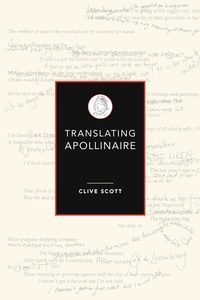
Translating Apollinaire
Published on 15. September 2014
Book
Paperback/Softback
304 pages
978-0-85989-895-9 (ISBN)
Description
Translating Apollinaire delves into Apollinaire's poetry and poetics through the challenges and invitations it offers to the process of translation.
Besides providing a new appraisal of Apollinaire, the most significant French poet of WWI, Translating Apollinaire aims to put the ordinary reader at the centre of the translational project. It proposes that translation's primary task is to capture the responses of the reader to the poetic text, and to find ways of writing those responses into the act of translation. Every reader is invited to translate, and to translate with a creativity appropriate to the complexity of their own reading experiences. Throughout, Scott himself consistently uses the creative resource of photography, and more particularly photographic fragments, as a cross-media language used to help capture the activity of the reading consciousness.
Besides providing a new appraisal of Apollinaire, the most significant French poet of WWI, Translating Apollinaire aims to put the ordinary reader at the centre of the translational project. It proposes that translation's primary task is to capture the responses of the reader to the poetic text, and to find ways of writing those responses into the act of translation. Every reader is invited to translate, and to translate with a creativity appropriate to the complexity of their own reading experiences. Throughout, Scott himself consistently uses the creative resource of photography, and more particularly photographic fragments, as a cross-media language used to help capture the activity of the reading consciousness.
Reviews / Votes
"Clive Scott's theory and practice are underpinned by his own highly developed literary, technical and communication skills. Well informed, sympathetic to Apollinaire's aspirations and achievements, he is similarly attuned to the complexities of French versification. [. . .] Scott is an influential writer and teacher, a mover and shaker who is making a game-changing contribution to his discipline, a man on a mission to raise the status of translators and to inject translation itself with a powerful new dose of creative confidence." Professor Peter Read, University of Kent'This is a bold and invigorating book - challenging, stimulating and full of insights' Professor Adam Watt, University of Exeter
More details
Language
English
Place of publication
Exter
United Kingdom
Target group
College/higher education
Dimensions
Height: 234 mm
Width: 156 mm
ISBN-13
978-0-85989-895-9 (9780859898959)
Copyright in bibliographic data and cover images is held by Nielsen Book Services Limited or by the publishers or by their respective licensors: all rights reserved.
Schweitzer Classification
Other editions
Additional editions
Clive Scott
Translating Apollinaire
E-Book
03/2015
1st Edition
University of Exeter Press
from
€55.99
Available for download
Clive Scott
Translating Apollinaire
E-Book
03/2015
1st Edition
University of Exeter Press
€167.99
Available for download
Clive Scott
Translating Apollinaire
Book
09/2014
University of Exeter
€93.00
Shipment within 15-20 days
Person
Clive Scott is Professor Emeritus of European Literature, University of East Anglia. He is a Fellow of the British Academy and 2014 President of the Modern Humanities Research Association. He has been described as "the founder of an innovative school of UK translation studies" at the University of East Anglia.
Content
Illustrations
Acknowledgements
A Note on the Text
Prefatory Remarks
Introduction
Chapter One: Styles and Margins
Chapter Two: Choices, Variants and Variation
Chapter Three: The Linear and the Tabular
Chapter Four: Frames and Blind Fields
Chapter Five: The Chromatic and the Acoustic
Chapter Six: New Sounds, New Languages
Conclusion: Repetition, Difference and Simulacrity
Appendix I: Texts
Appendix II: The Case for the Tabular
Notes
Bibliographical References
Index
Acknowledgements
A Note on the Text
Prefatory Remarks
Introduction
Chapter One: Styles and Margins
Chapter Two: Choices, Variants and Variation
Chapter Three: The Linear and the Tabular
Chapter Four: Frames and Blind Fields
Chapter Five: The Chromatic and the Acoustic
Chapter Six: New Sounds, New Languages
Conclusion: Repetition, Difference and Simulacrity
Appendix I: Texts
Appendix II: The Case for the Tabular
Notes
Bibliographical References
Index