

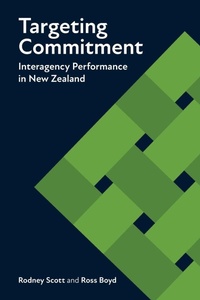
Targeting Commitment
Interagency Performance in New Zealand
Published on 8. March 2022
Book
Paperback/Softback
310 pages
978-0-8157-3918-0 (ISBN)
Description
New Zealand's deceptively simple but effective program to improve public services
New Zealand has long been considered at the forefront of public administration, experimenting with new ways of organizing and delivering public services. Even so, successive New Zealand governments had mixed results from using traditional public management tools to lift the performance of the public service and address persistent problems that required multi-agency action.
In 2012 the government decided to try something different. As part of a reform package called Better Public Services, the government challenged the public service to organize itself around achieving just ten results that had proven resistant to previous interventions. The plan was deceptively simple: set ambitious targets and publicly report on progress every six months; hold small groups of public managers collectively responsible; use lead indicators; and learn from both success and failure.
This book explores how and why the New Zealand government made progress and how the program was able to create and sustain the commitment of public servants and unleash the creativity of public entrepreneurs.
The authors combine case studies based on the experience of people involved in the change, together with public management research. They explain how ambitious targets and public accountability were used as levers to overcome the bureaucratic barriers that impeded public service delivery, and how data, evidence, and innovation were used to change practice. New Zealand experimented, failed, succeeded, and learned from the experience over five years. This New Zealand experience demonstrates that interagency performance targets are a potentially powerful tool for fostering better public services and thus improving social outcomes.
New Zealand has long been considered at the forefront of public administration, experimenting with new ways of organizing and delivering public services. Even so, successive New Zealand governments had mixed results from using traditional public management tools to lift the performance of the public service and address persistent problems that required multi-agency action.
In 2012 the government decided to try something different. As part of a reform package called Better Public Services, the government challenged the public service to organize itself around achieving just ten results that had proven resistant to previous interventions. The plan was deceptively simple: set ambitious targets and publicly report on progress every six months; hold small groups of public managers collectively responsible; use lead indicators; and learn from both success and failure.
This book explores how and why the New Zealand government made progress and how the program was able to create and sustain the commitment of public servants and unleash the creativity of public entrepreneurs.
The authors combine case studies based on the experience of people involved in the change, together with public management research. They explain how ambitious targets and public accountability were used as levers to overcome the bureaucratic barriers that impeded public service delivery, and how data, evidence, and innovation were used to change practice. New Zealand experimented, failed, succeeded, and learned from the experience over five years. This New Zealand experience demonstrates that interagency performance targets are a potentially powerful tool for fostering better public services and thus improving social outcomes.
Reviews / Votes
In 2012, the New Zealand government attempted to solve its interagency coordination problem with a new approach. Specifically, it set strict interagency targets, focusing on outcomes instead of process or intermediary goals, to resolve ten difficult social and governmental problems. This book is a deep dive into how these performance targets aided interagency cooperation and led to positive, though not perfect, outcomes. The book begins with background on the government of New Zealand and a review of interagency coordination in the field of public administration before moving to a description of the program itself, from initial development through implementation and its current state.... This book is recommended to any student of public administration looking for a case study of the relationship between setting performance targets and reaching actual governmental outcomes. Recommended. Undergraduate and graduate students. * Choice Reviews *More details
Series
Language
English
Place of publication
United States
Publishing group
Bloomsbury Publishing Plc
Target group
Professional and scholarly
Dimensions
Height: 229 mm
Width: 152 mm
Thickness: 18 mm
Weight
506 gr
ISBN-13
978-0-8157-3918-0 (9780815739180)
Copyright in bibliographic data and cover images is held by Nielsen Book Services Limited or by the publishers or by their respective licensors: all rights reserved.
Schweitzer Classification
Other editions
Additional editions
E-Book
03/2022
1st Edition
Brookings Institution
€40.49
Available for download
E-Book
03/2022
1st Edition
Bloomsbury eBooks US
€40.49
Available for download
Persons
Rodney Scott is an Adjunct Associate Professor of Public Management at the University of New South Wales. He has a PhD in Public Administration from the University of Queensland and research fellowships at Harvard's Kennedy School of Government and Oxford's Blavatnik School of Government. As Chief Policy Advisor at New Zealand's State Services Commission, Rodney was responsible for the commission's research program.
Ross Boyd is an Adjunct Research Fellow of the Australia and New Zealand School of Government. As Principal Policy Analyst in New Zealand's State Services Commission, Ross led thinking on the Better Public Services Results program, and was responsible for design, implementation, reporting, and evaluation.
Ross Boyd is an Adjunct Research Fellow of the Australia and New Zealand School of Government. As Principal Policy Analyst in New Zealand's State Services Commission, Ross led thinking on the Better Public Services Results program, and was responsible for design, implementation, reporting, and evaluation.