

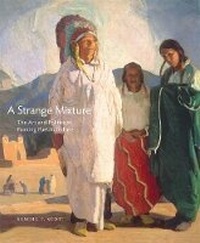
A Strange Mixture
The Art and Politics of Painting Pueblo Indians
Will be published approx. on 21. January 2015
Book
Hardback
280 pages
978-0-8061-4484-9 (ISBN)
Description
Attracted to the rich ceremonial life and unique architecture of the New Mexico pueblos, many early-twentieth-century artists depicted Pueblo peoples, places, and culture in paintings. These artists' encounters with Pueblo Indians fostered their awareness of Native political struggles and led them to join with Pueblo communities to champion Indian rights. In this book, art historian Sascha T. Scott examines the ways in which non-Pueblo and Pueblo artists advocated for American Indian cultures by confronting some of the cultural, legal, and political issues of the day.
Scott closely examines the work of five diverse artists, exploring how their art was shaped by and helped to shape Indian politics. She places the art within the context of the interwar period, 1915-30, a time when federal Indian policy shifted away from forced assimilation and toward preservation of Native cultures. Through careful analysis of paintings by Ernest L. Blumenschein, John Sloan, Marsden Hartley, and Awa Tsireh (Alfonso Roybal), Scott shows how their depictions of thriving Pueblo life and rituals promoted cultural preservation and challenged the pervasive romanticizing theme of the ""vanishing Indian."" Georgia O'Keeffe's images of Pueblo dances, which connect abstraction with lived experience, testify to the legacy of these political and aesthetic transformations.
Scott makes use of anthropology, history, and indigenous studies in her art historical narrative. She is one of the first scholars to address varied responses to issues of cultural preservation by aesthetically and culturally diverse artists, including Pueblo painters. Beautifully designed, this book features nearly sixty artworks reproduced in full color.
Scott closely examines the work of five diverse artists, exploring how their art was shaped by and helped to shape Indian politics. She places the art within the context of the interwar period, 1915-30, a time when federal Indian policy shifted away from forced assimilation and toward preservation of Native cultures. Through careful analysis of paintings by Ernest L. Blumenschein, John Sloan, Marsden Hartley, and Awa Tsireh (Alfonso Roybal), Scott shows how their depictions of thriving Pueblo life and rituals promoted cultural preservation and challenged the pervasive romanticizing theme of the ""vanishing Indian."" Georgia O'Keeffe's images of Pueblo dances, which connect abstraction with lived experience, testify to the legacy of these political and aesthetic transformations.
Scott makes use of anthropology, history, and indigenous studies in her art historical narrative. She is one of the first scholars to address varied responses to issues of cultural preservation by aesthetically and culturally diverse artists, including Pueblo painters. Beautifully designed, this book features nearly sixty artworks reproduced in full color.
Reviews / Votes
the broader approach Scott has developed - inspired visual analysis based on an acute understanding of Pueblo politics - could be a model for the field, raising the bar of scholarship to a level that has not been reached in most previous publications.""- Caa.reviews, William Truettner, Smithsonian American Art MuseumMore details
Series
Language
English
Place of publication
Oklahoma
United States
Target group
Professional and scholarly
Illustrations
58 colour and 30 black & white illustrations
Dimensions
Height: 284 mm
Width: 236 mm
Thickness: 33 mm
Weight
333 gr
ISBN-13
978-0-8061-4484-9 (9780806144849)
Copyright in bibliographic data and cover images is held by Nielsen Book Services Limited or by the publishers or by their respective licensors: all rights reserved.
Schweitzer Classification
Person
Sascha T. Scott is Assistant Professor of American Art and a member of the Native American Studies faculty at Syracuse University.