

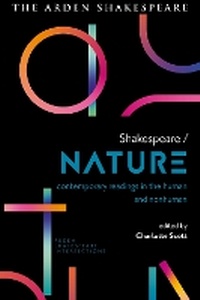
Shakespeare / Nature
Contemporary Readings in the Human and Non-human
Published on 8. February 2024
Book
Hardback
312 pages
978-1-350-25983-6 (ISBN)
Description
Shakespeare / Nature sets new agendas for the study of nature in Shakespeare's work. Offering a rich exploration of the intersections between the human and non-human worlds, the chapters focus on the contested and persuasive language of nature, both as organic matter and cultural conditioning.
Rooted in close textual analysis and historical acuity, this collection addresses Shakespeare's works through the many ways in which 'nature' performs, as a cultural category, a moral marker and a set of essential conditions through which the human may pass, as well as affect. Addressing the complex conditions of the play worlds, the chapters explore the assorted forms through which Shakespeare's nature makes sense of its narratives and supports, upholds or contests its story-telling.
Over the course of the collection, the contributors examine plays including Macbeth, Julius Caesar, The Tempest, The Taming of the Shrew, Othello, Love's Labour's Lost, Hamlet, Timon of Athens and many more. They discuss them through the various lenses of philosophy, historicism, psychoanalysis, gender studies, cosmography, geography, sexuality, linguistics, environmentalism, feminism and robotics, to provide new and nuanced readings of the intersectional terms of both meaning and matter.
Approaching 'nature' in all its multiplicity, this collection sets out to examine the divergent and complex ways in which the human and non-human worlds intersect and the development of a language of symbiosis that attempts to both control and create the terms of human authority. It offers an entirely new approach to the subject of nature, bringing together disparate methods that have previously been pursued independently to offer a shared investment in the intersections between the human and non-human worlds and how these discourses shape and condition the emotional, organic, cultural and psychological landscapes of Shakespeare's play worlds.
Rooted in close textual analysis and historical acuity, this collection addresses Shakespeare's works through the many ways in which 'nature' performs, as a cultural category, a moral marker and a set of essential conditions through which the human may pass, as well as affect. Addressing the complex conditions of the play worlds, the chapters explore the assorted forms through which Shakespeare's nature makes sense of its narratives and supports, upholds or contests its story-telling.
Over the course of the collection, the contributors examine plays including Macbeth, Julius Caesar, The Tempest, The Taming of the Shrew, Othello, Love's Labour's Lost, Hamlet, Timon of Athens and many more. They discuss them through the various lenses of philosophy, historicism, psychoanalysis, gender studies, cosmography, geography, sexuality, linguistics, environmentalism, feminism and robotics, to provide new and nuanced readings of the intersectional terms of both meaning and matter.
Approaching 'nature' in all its multiplicity, this collection sets out to examine the divergent and complex ways in which the human and non-human worlds intersect and the development of a language of symbiosis that attempts to both control and create the terms of human authority. It offers an entirely new approach to the subject of nature, bringing together disparate methods that have previously been pursued independently to offer a shared investment in the intersections between the human and non-human worlds and how these discourses shape and condition the emotional, organic, cultural and psychological landscapes of Shakespeare's play worlds.
Reviews / Votes
This wonderful collection offers insightful rereadings of canonical texts, new directions for investigation, and a refreshing and vital commitment to connecting the world and words. * Modern Language Review *More details
Series
Language
English
Place of publication
London
United Kingdom
Publishing group
Bloomsbury Publishing PLC
Target group
College/higher education
Illustrations
4 bw illus
Dimensions
Height: 236 mm
Width: 154 mm
Thickness: 22 mm
Weight
600 gr
ISBN-13
978-1-350-25983-6 (9781350259836)
Copyright in bibliographic data and cover images is held by Nielsen Book Services Limited or by the publishers or by their respective licensors: all rights reserved.
Schweitzer Classification
Persons
Charlotte Scott is Director of Knowledge and Engagement at the Shakespeare Birthplace Trust, UK, and was formerly Professor of Shakespeare Studies at Goldsmiths, University of London, UK. Her publications include The Child in Shakespeare (2018), Shakespeare's Nature: From Cultivation to Culture (2014) and Shakespeare and the Idea of the Book (2007), as well as book chapters, journal articles and reviews. She was textual editor for the RSC Complete Works and pedagogical advisor for the New Oxford Shakespeare.
Content
List of Illustrations
Notes on Contributors
Series Preface
Acknowledgements
1. Nature/Natural
Charlotte Scott (The Shakespeare Birthplace Trust and Goldsmiths College, University of London, UK)
2. Human/Trees
Kristen Poole (University of Delaware, USA)
3. Weather/Phenomena
Sophie Chiari (Clermont Auvergne University, France)
4. Creations/Recreations
Randall Martin (University of New Brunswick, Canada)
5. Nature/Interrupted
Shankar Raman (Massachusetts Institute of Technology, USA)
6. Herbs/Flowers
Rebecca Bushnell (University of Pennsylvania, USA)
7. Cultivation/Body
Rebecca Laroche (University of Colorado, Colorado Springs, USA)
8. Contamination/Transcorporeality
Jennifer Munroe (University of North Carolina, Charlotte, USA)
9. Monstrous/Bestial
Michela Compagnoni (University of Genoa, Italy)
10. Animal/Fable
Abigail Shinn (Goldsmiths College, University of London, UK)
11. Skin/Aberrance
Anna Kowalcze-Pawlik (University of Lodz, Poland)
12. Hunting/Prey
Catherine Bates (University of Warwick, UK)
13. Enclosures/Echoes
Delilah Braatas (Norwegian University of Science and Technology)
14. Mining/History
Chris Thurman (University of Witwatersrand, South Africa)
Index
Notes on Contributors
Series Preface
Acknowledgements
1. Nature/Natural
Charlotte Scott (The Shakespeare Birthplace Trust and Goldsmiths College, University of London, UK)
2. Human/Trees
Kristen Poole (University of Delaware, USA)
3. Weather/Phenomena
Sophie Chiari (Clermont Auvergne University, France)
4. Creations/Recreations
Randall Martin (University of New Brunswick, Canada)
5. Nature/Interrupted
Shankar Raman (Massachusetts Institute of Technology, USA)
6. Herbs/Flowers
Rebecca Bushnell (University of Pennsylvania, USA)
7. Cultivation/Body
Rebecca Laroche (University of Colorado, Colorado Springs, USA)
8. Contamination/Transcorporeality
Jennifer Munroe (University of North Carolina, Charlotte, USA)
9. Monstrous/Bestial
Michela Compagnoni (University of Genoa, Italy)
10. Animal/Fable
Abigail Shinn (Goldsmiths College, University of London, UK)
11. Skin/Aberrance
Anna Kowalcze-Pawlik (University of Lodz, Poland)
12. Hunting/Prey
Catherine Bates (University of Warwick, UK)
13. Enclosures/Echoes
Delilah Braatas (Norwegian University of Science and Technology)
14. Mining/History
Chris Thurman (University of Witwatersrand, South Africa)
Index