

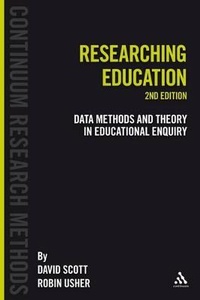
Researching Education
Data, methods and theory in educational enquiry
2nd Edition
Published on 15. February 2011
Book
Paperback/Softback
224 pages
978-1-4411-0166-2 (ISBN)
Description
This book examines the philosophical, historical, political and social contexts of research and the implications of these for the collection and analysis of data. "Researching Education" looks at the theory and practice of researching education and examines the philosophical, historical, political and social contexts of research and the implications of these for the collection and analysis of data. Scott and Usher argue that while power is ever present in the construction of research texts, this is inevitable as research imposes a closure of the world through representations and thus is always and inevitably involved with and implicated in the operation of power. The authors provide a theoretical framework against previously compiled research can be judged to stimulates further study and consider key questions: What is legitimate knowledge? What is the relationship between the collection and analysis of data? How does the researcher's presence in the field impact on their data? This new edition has been completely revised to reflect new insights into education research and educational research methodology and the impact of recent political initiatives.
"Researching Education" is invaluable reading for educational and social researchers as well as postgraduate and doctoral students.
"Researching Education" is invaluable reading for educational and social researchers as well as postgraduate and doctoral students.
Reviews / Votes
'A rigorous and thought-provoking text which challenges the intellectual sloppiness that informs much educational research. The book challenges us constantly to reconsider our own assumptions and those of others in evaluating the claims that are made about what research does and does not, can or cannot, tell us.' Richard Edwards, Professor of Education and Head of The Stirling Institute of Education, University of Stirling, UK 'An elegant tour through the key philosophical positions on research and a detailed and practical description of approaches and methods common in educational research. It will serve as an excellent text for new researchers and those wishing to understand the implications of the approaches and methods they are using.' Alison Lee, Professor of Education and Director of the Centre for Research in Learning and Change, University of Technology, Sydney, Australia This book outlines the importance of (and dearth of, in many research reports) the examination and explication of the theoretical underpinnings, philosophical viewpoints and power relationships within educational research, and is useful for both postgraduate and doctoral students. -- Evaluation and ResearchMore details
Series
Edition
2nd edition
Language
English
Place of publication
New York
United States
Target group
College/higher education
Professional and scholarly
Dimensions
Height: 234 mm
Width: 156 mm
ISBN-13
978-1-4411-0166-2 (9781441101662)
Copyright in bibliographic data and cover images is held by Nielsen Book Services Limited or by the publishers or by their respective licensors: all rights reserved.
Schweitzer Classification
Other editions
Additional editions
E-Book
12/2010
2nd Edition
Continuum Publishing Corporation
€48.49
Available for download
Persons
David Scott is Professor of Curriculum, Pedagogy and Assessment and Faculty Director of Teaching and Learning at the Institute of Education, University of London, UK. Robin Usher is Senior Policy Advisor and Coordinator at RMIT University, Melbourne, Australia.
Content
1. Introduction; Part I: Philosophy; 2. The Place of Philosophical Issues in Educational Research; 3. Critical Approaches to Research; 4. Practice-Based Research; 5. Modes of Thinking: Positivism, Empiricism, Post-Positivism, Critical Theory, Post-Structuralism, Post-Modernism; Part II. Strategies and Methods; 6. Experimentation; 7. Survey and Correlational Designs; 8. Qualitative Research Design, Case Study and Theory-Building; 9. Observational Approaches; 10. Interview Methods and Methodologies; 11. Biographical and Autobiographical Method; Part III. Issues; 12. Ethics and Educational Research; 13. Evaluation and Research; 14. Criteria for Evaluating Research; 15. Transgressive Research; References; Subject Index; Name Index.