

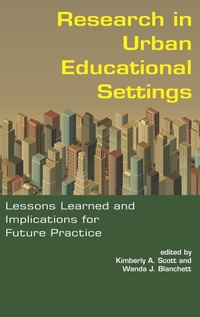
Research in Urban Educational Settings
Lessons Learned and Implications for Future Practice
Will be published approx. on 1. April 2011
Book
Hardback
244 pages
978-1-61735-207-2 (ISBN)
Description
Results from quantitative and qualitative research studies have painted countless images of the unique features shaping urban schools including students' experiences and how the surrounding communities affect the entire system. Race, ethnicity, social class, language, power, politics, and public image operate as intersecting elements shaping the contours of urban school life therefore its documentation. Little has been written about how researchers of urban schools and their constituencies effectively navigate these complex elements, design a culturally sensitive and responsive project, and acquire meaningful data. What are some of the critically important issues a researcher should consider when working with urban schools? What should be a researcher's commitment to the urban communities in which they conduct research? How can a researcher develop a trusting relationship in an environment justifiably distrustful of outsiders? These and other inquiries shape the contours of this edited volume.
As educators and policy makers take a closer examination at urban schools and their successes, research of these unique settings assumes a more prominent role. For academics, both novice and experienced, establishing and maintaining rapport within these environments often require greater attention than qualitative or quantitative research books accord. Authors in this compilation share lessons learned about power, privilege, and their meanings as they pertain to conducting research in and with urban settings. To this end, four primary objectives guide this manuscript: 1) To expand the conversation of urban school research to include multiple voices of culturally responsible, caring scholars with a professed commitment to using research as an empowering tool for urban educational contexts; 2) To provide practical accounts of what has and has not worked for individuals conducting both short-term and longitudinal research in urban educational institutions and communities; 3) To demonstrate the (dis)connect between classroom discussions of urban education and real-life field experiences of researchers working in urban settings; and 4) To broaden discussions of reflexivity by analyzing the complex journey qualitative and quantitative sociologists, anthropologists, teacher educators, urban educators, and special educators experience while negotiating and creating collaborative relationships with urban educators, administrators, students, parents, and community members.
As educators and policy makers take a closer examination at urban schools and their successes, research of these unique settings assumes a more prominent role. For academics, both novice and experienced, establishing and maintaining rapport within these environments often require greater attention than qualitative or quantitative research books accord. Authors in this compilation share lessons learned about power, privilege, and their meanings as they pertain to conducting research in and with urban settings. To this end, four primary objectives guide this manuscript: 1) To expand the conversation of urban school research to include multiple voices of culturally responsible, caring scholars with a professed commitment to using research as an empowering tool for urban educational contexts; 2) To provide practical accounts of what has and has not worked for individuals conducting both short-term and longitudinal research in urban educational institutions and communities; 3) To demonstrate the (dis)connect between classroom discussions of urban education and real-life field experiences of researchers working in urban settings; and 4) To broaden discussions of reflexivity by analyzing the complex journey qualitative and quantitative sociologists, anthropologists, teacher educators, urban educators, and special educators experience while negotiating and creating collaborative relationships with urban educators, administrators, students, parents, and community members.
More details
Language
English
Place of publication
Charlotte
United States
Publishing group
Emerald Publishing Inc
Target group
College/higher education
Dimensions
Height: 240 mm
Width: 161 mm
Thickness: 18 mm
Weight
534 gr
ISBN-13
978-1-61735-207-2 (9781617352072)
Copyright in bibliographic data and cover images is held by Nielsen Book Services Limited or by the publishers or by their respective licensors: all rights reserved.
Schweitzer Classification
Content
Foreword; Carol Lee.
Part I. Transitions.
Chapter 1. Stories for Educational Leadership Programs: Research at Its Best; Kimberly A. Scott and Jessica Solyom.
Chapter 2. Asking the Right Questions in Urban Education Research: Researcher Values; Wanda J. Blanchett and Shelley Zion.
Chapter 3. Research as an Epistemological Architect of Marginalizing Power; Beverly E. Cross.
Chapter 4. Transformative Scholarship: Problematizing the Role of Insider Within Educational Research in Urban Settings; Jody N. Polleck.
Part II. Lessons Learned.
Chapter 5. A View From the Other Side: Practitioner Research on Critical Mathematics Pedagogy in an Urban High School; Andrew Brantlinger.
Chapter 6. Creating Effective Learning Opportunities for Diverse Students and Families: Implications for Conducting Urban Education Research; Kimberley Woo.
Chapter 7. Makin' a Way Out of No Way: Forging a Path in Urban Special Education Research; Monika Shealey.
Part III. Negotiations and Collaborations.
Chapter 8. Service and Scholarship: How Opportunities to Give Back Foster Culturally Responsive and Respectful Research Projects; Raquel Farmer-Hinton.
Chapter 9. Insider and Outsider: Reflexivity and Intersubjectivity in Ethnography; Jamie Lew.
Chapter 10. One Educator's Perspective of the Disconnect Between the Academy and African American School Districts; Eustace Thompson.
Chapter 11. Getting Beyond the Script: Negotiating the Complexities of Urban Settings as Research Sites; Amina Jones and Na'ilah Suad Nasir.
About the Authors.
Part I. Transitions.
Chapter 1. Stories for Educational Leadership Programs: Research at Its Best; Kimberly A. Scott and Jessica Solyom.
Chapter 2. Asking the Right Questions in Urban Education Research: Researcher Values; Wanda J. Blanchett and Shelley Zion.
Chapter 3. Research as an Epistemological Architect of Marginalizing Power; Beverly E. Cross.
Chapter 4. Transformative Scholarship: Problematizing the Role of Insider Within Educational Research in Urban Settings; Jody N. Polleck.
Part II. Lessons Learned.
Chapter 5. A View From the Other Side: Practitioner Research on Critical Mathematics Pedagogy in an Urban High School; Andrew Brantlinger.
Chapter 6. Creating Effective Learning Opportunities for Diverse Students and Families: Implications for Conducting Urban Education Research; Kimberley Woo.
Chapter 7. Makin' a Way Out of No Way: Forging a Path in Urban Special Education Research; Monika Shealey.
Part III. Negotiations and Collaborations.
Chapter 8. Service and Scholarship: How Opportunities to Give Back Foster Culturally Responsive and Respectful Research Projects; Raquel Farmer-Hinton.
Chapter 9. Insider and Outsider: Reflexivity and Intersubjectivity in Ethnography; Jamie Lew.
Chapter 10. One Educator's Perspective of the Disconnect Between the Academy and African American School Districts; Eustace Thompson.
Chapter 11. Getting Beyond the Script: Negotiating the Complexities of Urban Settings as Research Sites; Amina Jones and Na'ilah Suad Nasir.
About the Authors.