

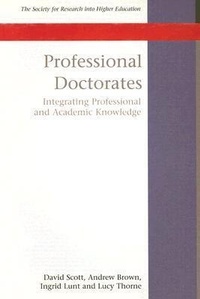
Professional Doctorates: Integrating Academic and Professional Knowledge
Integrating Academic and Professional Knowledge
Published on 16. April 2004
Book
Paperback/Softback
184 pages
978-0-335-21332-0 (ISBN)
Description
- What are professional doctorates?
- How do they change professional knowledge and improve practice?
- How can universities organise doctoral programmes to facilitate professional learning and development?
- What is the most appropriate relationship between professional and academic knowledge?
This book examines the relationship between advanced study on higher education courses and professional practice. It explores contributions made by research on practice to professional development.
The editors document and explain strategies that universities use:
- in recruitment
- aims and purposes of the degree
- selection of content and focus
- assessment procedures
- curricular structures
- pedagogy
- teaching strategies
- conditions for learning
- support for professionals
- relations with interested bodies and stakeholders.
The book uses in-depth case studies of three professional doctorates: the doctorate in business administration (DBA), the engineering doctorate (DEng) and the education doctorate (EdD).
Examining Professional Doctorates makes an important contribution to this neglected area of research. Essential reading for policy makers in higher education and anyone interested in professional doctoral study.
- How do they change professional knowledge and improve practice?
- How can universities organise doctoral programmes to facilitate professional learning and development?
- What is the most appropriate relationship between professional and academic knowledge?
This book examines the relationship between advanced study on higher education courses and professional practice. It explores contributions made by research on practice to professional development.
The editors document and explain strategies that universities use:
- in recruitment
- aims and purposes of the degree
- selection of content and focus
- assessment procedures
- curricular structures
- pedagogy
- teaching strategies
- conditions for learning
- support for professionals
- relations with interested bodies and stakeholders.
The book uses in-depth case studies of three professional doctorates: the doctorate in business administration (DBA), the engineering doctorate (DEng) and the education doctorate (EdD).
Examining Professional Doctorates makes an important contribution to this neglected area of research. Essential reading for policy makers in higher education and anyone interested in professional doctoral study.
More details
Persons
David Scott is Professor of Educational Leadership and Learning at the University of Lincoln. He has researched widely in the field of education including projects on: citizenship education, professional doctorates, accelerated learning programmes and language teaching in higher education. His extensive publications in the fields of curriculum, assessment, higher education and research methodology include Reading Educational Research and Policy and A Realist Approach to Educational Research. Andrew Brown is Coordinator of the EdD programme in the University of London Institute of Education Doctoral School. He is European Director of an EU/US funded project on doctoral education and Director of the Institute's TQEF funded learning and teaching research projects. He has published widely in the fields of Mathematics Education, Professional Doctorates and Pedagogy, including co-authoring Doing Research/ Reading Research: A Mode of Interrogation for Education. Ingrid Lunt is Professor of Educational Psychology, Dean of the Doctoral School and has responsibility for Doctoral Education and research degrees at the University of London Institute of Education. She is Director of an EU funded project on higher professional education in psychology and a past President of the British Psychological Association. Her research interests include professional doctorates, continuing professional development, education policy, school organization and collaboration. She has published widely in these fields. Lucy Thorne works at the Learning and Skills Development Agency. She has previously worked at the University of Middlesex, and has published widely on higher professional degrees, professional doctorates and reflective practice.
Content
Acknowledgements 1 Introduction
Part 1: Histories and Contexts
2 The Changing Role of the University
3 The Evolution of Professional Doctorates
Part 2: Knowledge Matters
4 Academic and Professional Knowledge
5 The Reflective Student-Practitioner
Part 3: Teaching and Learning
6 Marketing, Selection and Assessment
7 Curriculum and Pedagogy
Part 4: Trajectories
8 Motivation
9 Identity
10 The Professions: Status and Qualifications
11 Conclusions: Hybrid Forms of Knowledge
References
Index
The Society for Research into Higher Education
Part 1: Histories and Contexts
2 The Changing Role of the University
3 The Evolution of Professional Doctorates
Part 2: Knowledge Matters
4 Academic and Professional Knowledge
5 The Reflective Student-Practitioner
Part 3: Teaching and Learning
6 Marketing, Selection and Assessment
7 Curriculum and Pedagogy
Part 4: Trajectories
8 Motivation
9 Identity
10 The Professions: Status and Qualifications
11 Conclusions: Hybrid Forms of Knowledge
References
Index
The Society for Research into Higher Education